Pumps & Fluid Systems Fastening Solutions for Reliable Equipment Assemblies
Pumps and fluid systems fastening solutions are essential for maintaining reliable mechanical connections across pumps, valves, piping modules, filtration equipment, compressors, fluid-control units, skids, and other industrial flow systems. These assemblies operate under combinations of pressure, vibration, temperature variation, moisture, chemicals, and repeated maintenance, creating demanding conditions for bolts, screws, studs, nuts, washers, and other threaded components.
For pump manufacturers, fluid-system integrators, equipment OEMs, maintenance contractors, distributors, and industrial procurement teams, choosing the correct fastener requires more than matching diameter and length. Material, mechanical properties, thread specification, corrosion resistance, head geometry, coating, preload, installation access, and service conditions should all be considered when defining a fastening system.
A practical sourcing strategy should combine standard industrial hardware with application-specific and custom fasteners where conventional catalog products cannot meet the dimensions, material requirements, or assembly geometry of pumps and fluid-handling equipment.
Complete Fastening Support for Pumps and Fluid Handling Equipment
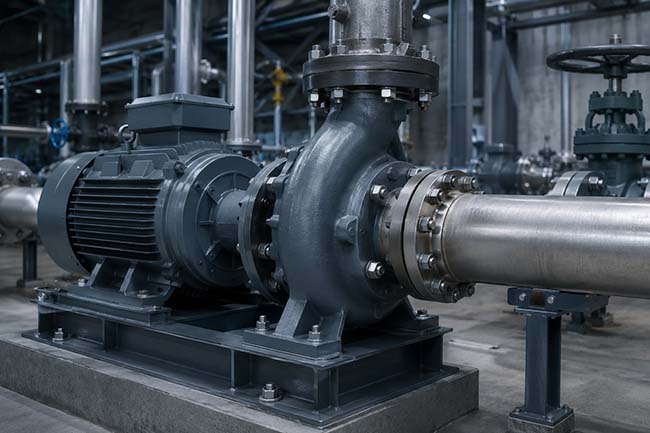
Pump and fluid systems contain fastening points with very different functions. Casing bolts may contribute to maintaining a secure housing joint, foundation bolts secure equipment to structural bases, studs can support repeated disassembly of covers and flanges, while smaller screws and nuts are used for guards, sensors, motors, brackets, instrumentation, and control components.
Flybear supports one-stop sourcing of standard and custom fastening components for pumps and fluid-system projects, helping buyers consolidate bolts, studs, screws, nuts, washers, threaded rods, pins, inserts, and drawing-based fasteners according to the technical requirements of each equipment assembly.
Pumps and Fluid Systems Fastening Solutions for Pump Casings
Pump casings contain important mechanical joints that must remain stable during operation. Depending on pump type and design, casing sections, covers, bearing housings, and related components may be assembled with hex bolts, studs, socket screws, nuts, and washers.
Fastener selection for these joints should reflect operating pressure, joint geometry, temperature, vibration, casing material, sealing arrangement, and maintenance requirements. A bolt with suitable tensile strength may still be inappropriate if its material, thread, finish, or installation characteristics do not match the complete assembly.
Stud-and-nut systems can be useful where pump casings or covers need periodic removal. Because the stud remains installed in the primary component, repeated maintenance can reduce wear on the internal threaded hole compared with repeatedly removing a conventional bolt from the housing.
Where dimensional accuracy is important, buyers should specify thread length, unthreaded sections, overall stud length, nut configuration, and any surface-treatment requirements during the RFQ stage.
Fasteners for Centrifugal Pump Assemblies
Centrifugal pumps are widely used in industrial processing, water treatment, chemical handling, power generation, HVAC systems, mining, and general manufacturing. Their assemblies may include pump casings, impellers, shafts, bearing housings, baseplates, couplings, motors, guards, and connecting pipework.
Different areas of the pump may require different fastening solutions. Structural mounting points may use hex bolts or studs, while bearing housings and removable covers may use socket screws or flange bolts. Smaller machine screws may be used for guards, indicators, sensors, and accessories.
Fasteners around rotating equipment should be selected with vibration in mind. Proper preload, adequate thread engagement, suitable bearing surfaces, and appropriate locking methods can help maintain joint stability during repeated operation.
Maintenance accessibility should also influence fastener selection. Equipment that requires regular inspection benefits from fasteners that can be removed and reinstalled efficiently using standard service tools.
Fastening Solutions for Positive Displacement Pumps
Gear pumps, diaphragm pumps, piston pumps, screw pumps, and other positive displacement systems can generate different pressure and vibration characteristics than centrifugal equipment. Fasteners may be used to secure pump bodies, covers, manifolds, cylinders, drive assemblies, mounting plates, and accessory systems.
The selected bolt or stud should match the mechanical requirements of the joint and the material of the connected components. Thread engagement is particularly important when fasteners are installed directly into cast iron, aluminum, stainless steel, or other pump housing materials.
Where a standard screw does not provide the required shoulder, thread length, or head geometry, custom pump fasteners can be produced according to customer drawings. This can be useful for specialized pump designs where installation space or internal geometry limits standard hardware options.
High-Strength Fasteners for Pump Baseplates and Supports
Pumps and drive motors are often mounted to baseplates, skids, frames, or foundations. These structural connections help maintain alignment and resist loads generated during operation, transportation, and maintenance.
Depending on the design, mounting assemblies may use hex bolts, anchor-style components, threaded rods, studs, heavy-duty nuts, and washers. Carbon steel or alloy steel fasteners may be selected where higher mechanical strength is required.
Fastener strength should be matched to the complete structure. Using a stronger bolt does not automatically improve the assembly if the baseplate, threaded hole, washer surface, or supporting structure becomes the limiting part of the joint.
For equipment skids, consistent fastener specifications can also simplify fabrication and final installation. Standardizing common thread diameters and head styles where engineering requirements allow can reduce unnecessary part variation.
Corrosion-Resistant Fasteners for Fluid Handling Systems
Corrosion is an important consideration because pump and fluid-system fasteners may be exposed to water, condensation, cleaning agents, industrial chemicals, process environments, or outdoor conditions. In some installations, the external environment may be as important as the fluid being transported.
Stainless steel fasteners can be considered for selected corrosive or wet environments, while carbon and alloy steel fasteners may use protective surface treatments where permitted by the equipment specification. Zinc plating, zinc flake coatings, phosphate finishes, and other systems can be selected according to environmental and assembly requirements.
Material selection should account for the pump housing, piping, flange, and other mating materials. Dissimilar-metal combinations can require additional consideration, particularly in humid or chemically aggressive environments.
Coating selection can also influence thread dimensions and installation friction. Buyers should therefore define surface-treatment requirements before production rather than treating coating as a purely cosmetic finishing operation.
Stainless Steel Fasteners for Pumps and Process Equipment
Stainless steel bolts, screws, studs, nuts, and washers are frequently considered for equipment used in water treatment, chemical processing, food-related machinery, pharmaceutical processing equipment, marine environments, and other corrosion-sensitive applications.
However, stainless steel is not one single material. Different grades provide different combinations of corrosion resistance, mechanical properties, temperature capability, and cost. The appropriate grade should therefore follow the equipment specification and actual operating conditions.
Thread behavior and mating materials should also be considered when stainless steel fasteners are used. Correct thread fit, installation practice, and lubrication requirements can contribute to more predictable assembly.
Procurement teams should specify the exact material grade rather than requesting only a general “stainless steel bolt,” especially for equipment operating in controlled process environments.
Fasteners for Valves, Manifolds and Fluid-Control Components
Pump systems rarely operate as isolated pieces of equipment. They are commonly integrated with valves, manifolds, regulators, filters, strainers, flow meters, instrumentation, and control devices. These components add multiple types of fastening requirements within the same fluid system.
Stud bolts and nuts may be used for flanged connections, while socket screws, hex bolts, machine screws, and threaded components can secure valve covers, actuator brackets, manifolds, sensors, and accessories.
Fastener selection should distinguish between pressure-related joints and general mounting connections. A fastener suitable for attaching a sensor bracket may not be appropriate for a joint associated with a pressure-containing component.
Where fastening components form part of a pressure boundary, the equipment manufacturer’s approved material and mechanical requirements should always take priority.
Fasteners for Filtration and Separation Equipment
Industrial fluid systems may include filter housings, strainers, separators, cartridges, treatment vessels, and other removable components. These assemblies frequently need to be opened during cleaning or filter replacement, making serviceability an important fastening consideration.
Studs, bolts, nuts, washers, clamps, and custom threaded components can be used depending on equipment design. Repeated assembly and disassembly may influence the preferred thread design, material, coating, and nut configuration.
Fasteners should provide reliable clamping while remaining practical for maintenance personnel to access. Where covers or housings are removed frequently, equipment designers may also consider captive fasteners or other configurations intended to reduce loose hardware during servicing.
Vibration-Resistant Fastening for Pumps and Rotating Equipment
Pumps, motors, compressors, and other rotating equipment naturally generate vibration. Misalignment, operating loads, changes in flow, and connected piping can further influence the mechanical environment around fastening points.
Stable fastening depends on correct preload and suitable joint design rather than simply adding a locking component. Thread engagement, contact surfaces, bolt stiffness, connected materials, installation torque, and vibration level should all be considered.
Where the equipment design requires additional resistance to loosening, prevailing-torque nuts, flange locking features, mechanical locking systems, or other engineered methods may be specified.
The selected method should also reflect maintenance frequency. Equipment that requires regular servicing may need a fastening system that combines vibration resistance with controlled and practical disassembly.
Fasteners for Water Treatment and Utility Pump Systems
Water supply, wastewater treatment, irrigation, drainage, and utility pumping systems can expose fasteners to continuous humidity, water, outdoor environments, and treatment chemicals. Material and surface protection are therefore significant factors in fastener selection.
Pump stations may require fasteners for pump bodies, motors, pipe connections, supports, access systems, filtration equipment, control cabinets, and structural frames. Stainless steel or appropriately coated fasteners can be considered according to exposure conditions and engineering specifications.
For outdoor equipment, buyers should review both the fastener and surrounding components when choosing a corrosion-protection strategy. The most appropriate material may differ between submerged, splash-zone, enclosed, and dry installation areas.
Fastening Solutions for Chemical Processing Equipment
Chemical-processing fluid systems can introduce additional challenges because different liquids, vapors, cleaning agents, and operating temperatures can interact differently with fastener materials and coatings.
Fasteners for chemical pumps and related equipment should therefore be specified according to both mechanical and environmental requirements. Stainless steels, alloy steels, or other materials may be appropriate depending on the actual application and customer specification.
Procurement teams should avoid assuming that one corrosion-resistant material will be suitable for every chemical environment. Information about equipment location, exposure conditions, temperature, and mating materials should be included where these factors affect the fastener specification.
Fasteners for Skid-Mounted Fluid Systems
Many industrial fluid systems are supplied as complete skids containing pumps, motors, valves, pipework, instruments, electrical components, filtration units, and structural frames. Such systems can require a particularly broad fastener range within one project.
Structural frames may use high-strength bolts and nuts, pump mounting points may use standard metric or inch hardware, piping supports may require U-bolts or threaded rods, and smaller equipment may use machine screws, socket screws, washers, and inserts.
A consolidated fastener sourcing program can help skid manufacturers reduce the number of separate supplier channels required for standard hardware and custom components. Parts can be organized by assembly area, material, thread system, coating, and size to support more efficient production and inventory management.
Standard and Custom Fasteners for Pump Manufacturers
Many pump assemblies use fasteners manufactured according to recognized ISO, DIN, ANSI, or other dimensional standards. Standard fasteners can simplify sourcing and replacement where commonly available configurations meet engineering requirements.
Specialized pumps and fluid-control equipment, however, often require non-standard geometry. Custom pump fasteners may include special studs, double-ended studs, shoulder bolts, threaded shafts, reduced-head screws, stepped pins, long bolts, special nuts, precision spacers, and other drawing-based components.
Custom manufacturing can help solve limited installation space, unusual thread engagement, alignment requirements, or equipment-specific geometry. It can also allow several functional features to be integrated into a single component.
Technical drawings should identify material, thread specification, dimensions, tolerances, mechanical properties, heat treatment where applicable, finish, and inspection requirements. Clearly defined critical characteristics help reduce ambiguity during both manufacturing and quality control.
Quality Considerations for Pump and Fluid-System Fasteners
Reliable fastener sourcing begins with clearly defined technical requirements. Buyers should confirm the applicable product standard or drawing, material, mechanical properties, thread dimensions, finish, quantity, packaging, and required inspection before placing a production order.
Depending on the product specification, verification may involve dimensional measurement, thread inspection, hardness testing, tensile or proof-load testing, coating checks, material verification, or other customer-defined requirements.
Custom precision components may require additional dimensional controls for shoulders, locating surfaces, machined diameters, or special thread transitions. These characteristics should be identified during quotation so that suitable inspection methods can be planned.
If material documentation, batch identification, product marking, or traceability is required, the requirements should be communicated before production. Documentation expectations can vary significantly between general industrial pumps and more controlled process equipment.
Replacement Fasteners for Pump Maintenance and Overhaul
Pumps and fluid systems require routine maintenance throughout their operating life. Overhauls may involve removing casings, covers, bearing housings, seals, motors, valves, filters, and other components, creating an ongoing requirement for replacement bolts, studs, nuts, washers, and specialty parts.
Replacement fasteners should be matched to the original technical specification. Thread diameter and length alone are not enough to confirm interchangeability. Material, property class, thread pitch, coating, head geometry, stud configuration, and service conditions should also be reviewed.
For older or imported equipment, replacement components may include non-standard parts that are difficult to purchase from normal stock. Detailed dimensions or engineering drawings can be used to evaluate custom production for these maintenance requirements.
How to Prepare an RFQ for Pump and Fluid-System Fasteners
A complete RFQ allows a supplier to evaluate the technical requirement efficiently and reduces unnecessary quotation revisions. Standard hardware should be identified by its full specification wherever possible, while custom components should be accompanied by a technical drawing.
Recommended RFQ Information
- Fastener type and applicable standard
- Diameter, thread system, pitch, and length
- Technical drawing and revision for custom parts
- Material and required grade or property class
- Mechanical-property requirements
- Surface treatment or coating specification
- Application within the pump or fluid system
- Operating environment and corrosion exposure
- Temperature requirements where relevant
- Critical dimensions and tolerances
- Required quantity and purchasing frequency
- Inspection and documentation requirements
- Packaging, marking, and labeling requirements
If the final fastener specification has not yet been determined, information about the complete joint can also support technical evaluation. Mating materials, pressure-related requirements, vibration, installation space, maintenance frequency, corrosion exposure, and assembly methods can all influence fastener selection.
One-Stop Fastener Sourcing for Pump and Fluid-System Projects
Pump manufacturers and fluid-system integrators often require a combination of standard industrial hardware and specialized drawing-based components. Managing separate sources for bolts, studs, nuts, washers, screws, threaded rods, pins, inserts, and custom fasteners can increase purchasing complexity, particularly when multiple pump models or skid projects are being produced simultaneously.
A one-stop sourcing strategy can help consolidate these product categories while preserving the individual technical requirements of each fastening point. Common components can be standardized where engineering requirements allow, while application-specific parts can be produced according to drawings when a standard product does not provide the required geometry or material.
Whether the project involves centrifugal pumps, positive displacement pumps, water-treatment systems, chemical-process equipment, filtration systems, fluid-control skids, or general industrial pumping equipment, reliable fastening starts with accurate specifications. Matching fastener material, strength, dimensions, thread configuration, corrosion protection, and installation requirements to the actual equipment helps create dependable assemblies and a more efficient procurement process throughout production and maintenance.