Automotive Fastening Solutions for Vehicle and EV Assemblies
Automotive fastening solutions play a critical role in the safety, durability, production efficiency, and serviceability of modern vehicles. From conventional passenger cars and commercial vehicles to electric vehicles, battery systems, and lightweight body structures, every assembly contains joints that must withstand vibration, thermal cycling, impact loads, moisture, road contaminants, and repeated operating stresses.
For automotive manufacturers, component suppliers, engineering teams, and sourcing departments, selecting the correct fastener involves much more than choosing a bolt or screw of the right diameter. Material strength, property class, thread design, surface treatment, locking method, installation process, mating materials, corrosion exposure, and production requirements must all be considered together. A reliable fastening supply strategy therefore combines suitable standard products with application-specific and custom automotive fasteners.
Complete Fastening Support for Automotive and EV Production
Vehicle manufacturing requires a broad range of fastening products because different areas of the vehicle operate under very different mechanical and environmental conditions. Chassis connections may require high-strength fasteners capable of maintaining clamp load under dynamic loading, while interior assemblies may prioritize installation speed, compact dimensions, and clean appearance. EV battery assemblies introduce additional requirements involving lightweight materials, sealing interfaces, restricted installation areas, and repeated temperature changes.
Flybear supports one-stop sourcing of standard and custom fastening components for automotive and EV projects, helping buyers consolidate different fastener types, materials, standards, finishes, and drawing-based parts within a coordinated supply program.
Automotive Fastening Solutions for Chassis and Structural Assemblies
Chassis and structural joints are among the most mechanically demanding fastening locations in a vehicle. Suspension-related structures, cross members, brackets, subframes, supports, and other load-bearing components may experience vibration, shock, cyclic loading, and exposure to water, dirt, and road chemicals.
Common fastening choices for these areas include metric hex bolts, flange bolts, socket screws, high-strength nuts, lock nuts, washers, studs, and engineered special fasteners. Depending on the joint design, property classes such as 8.8, 10.9, or 12.9 may be considered where higher tensile strength and clamp-load capability are required.
Flange bolts and flange nuts can be useful where load distribution and efficient automated assembly are important. Locking systems may also be incorporated where resistance to vibration-induced loosening is required. The final selection should be based on the joint load, tightening method, mating materials, available installation space, and vehicle manufacturer’s technical requirements.
EV Fasteners for Battery Packs and Electric Power Systems
Electric vehicle architecture creates new fastening challenges alongside conventional automotive requirements. Battery trays, battery enclosures, module structures, electrical housings, thermal-management components, motor assemblies, and electronic control systems may combine steel, aluminum, engineering plastics, and other materials within compact assemblies.
EV fasteners must therefore be selected with attention to material compatibility, installation access, thermal expansion, vibration, corrosion resistance, and the need for consistent joint performance throughout repeated charging and operating cycles.
Typical options can include flange bolts, machine screws, socket screws, thread-forming screws, rivet nuts, self-clinching fasteners, sealing washers, precision pins, and custom drawing parts. Where thin sheet metal or enclosed profiles make conventional nuts difficult to install, rivet nuts or self-clinching solutions can provide practical threaded attachment points.
Battery pack fasteners may also need to work around sealing systems and restricted assembly spaces. In these applications, head geometry, drive type, washer configuration, coating selection, and installation tooling should be reviewed as part of the complete joint rather than specified independently.
Fasteners for Automotive Body and Sheet Metal Assembly
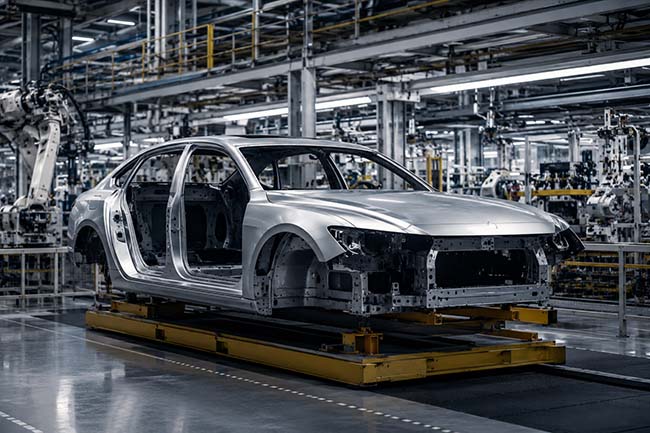
Body structures and sheet metal assemblies require fastening systems that support high-volume production while maintaining reliable positioning and joint integrity. Weld nuts, weld bolts, self-clinching fasteners, rivet nuts, blind rivets, structural rivets, thread-forming screws, and self-tapping screws can all be used depending on material thickness and assembly access.
For production engineers, installation method is an important selection factor. A fastener that performs correctly after installation may still create unnecessary production complexity if it requires additional tools, difficult alignment, or access to both sides of the joint.
When developing vehicle assembly fasteners for sheet metal structures, engineers should consider hole preparation, panel thickness, joint stack-up, installation direction, torque requirements, pull-out resistance, mating thread design, and whether the connection must be removable during servicing.
Fastening Solutions for Powertrain and Under-Hood Components
Internal combustion vehicles, hybrid vehicles, and electric power systems all contain fastening locations exposed to vibration and changing temperatures. Engines, transmissions, electric motors, pumps, brackets, housings, covers, and related systems can require fasteners with controlled mechanical properties and stable tightening performance.
Alloy-steel bolts and screws are frequently considered for higher-load applications, while stainless steel or other materials may be appropriate where corrosion resistance has greater priority. Studs can be useful for repeatable positioning and service operations, and flange-style fasteners can simplify component assembly by combining bearing-area functionality into the fastener design.
For these applications, fastener selection should account for temperature range, required clamp load, tightening strategy, joint stiffness, service frequency, vibration, and the materials being joined.
Seat, Interior, and Accessory Fasteners
Automotive fastening requirements extend beyond major structural assemblies. Seats, dashboards, consoles, trim systems, brackets, electronic modules, lighting components, and accessories all require reliable attachment solutions.
These applications may use machine screws, SEMS screws, self-tapping screws, thread-forming screws, nuts, washers, clips, rivets, pins, and custom components. Pre-assembled SEMS screws can help reduce separate-component handling by combining a screw with one or more captive washers, making them suitable for production environments where assembly efficiency is important.
For interior applications, fastener head style and appearance may also influence the choice. Low-profile heads, specific drive configurations, or corrosion-resistant materials can be selected according to the installation location and product design.
Material Selection for Automotive Fasteners
Automotive fasteners are produced from different materials according to mechanical, environmental, cost, and weight requirements. Carbon steel remains widely applicable because it can provide an effective combination of strength, manufacturability, and cost. Alloy steel is often considered when higher strength levels or demanding mechanical performance are required.
Stainless steel can be selected for corrosion-sensitive locations, particularly where environmental exposure is significant. Aluminum, titanium, and engineering plastic fasteners may be considered in specialized assemblies where weight reduction, electrical properties, chemical resistance, or material compatibility is a design priority.
Material choice should always be matched to the actual joint. Replacing one material with another without reviewing mechanical properties, galvanic interaction, thread strength, torque behavior, and operating environment can create performance problems even when the replacement material offers better performance in one individual category.
Coatings and Corrosion Protection for Automotive Fasteners
Surface treatment is an essential part of many automotive fastener specifications. Vehicle components may be exposed to humidity, water, road contaminants, chemicals, and temperature changes throughout their service life.
Depending on the application and customer specification, common finishing options may include zinc plating, zinc-nickel coatings, phosphate treatments, black oxide, and other engineered coating systems. The appropriate finish depends on corrosion requirements, friction behavior, appearance, electrical considerations, mating materials, and assembly conditions.
Fastener buyers should define coating requirements clearly during the RFQ stage. Important details may include coating type, required appearance, friction requirements, dimensional restrictions after coating, and any customer-specific testing requirements. For high-strength steel fasteners, appropriate manufacturing and coating processes should also be considered in relation to hydrogen embrittlement risk.
Standard and Custom Automotive Fasteners
Many vehicle assemblies can use fasteners manufactured according to established DIN, ISO, ANSI, or other recognized dimensional standards. Standard components can simplify sourcing and make specifications easier to manage across multiple projects.
However, automotive assemblies frequently require special dimensions or features that cannot be satisfied by standard catalog products. Custom automotive fasteners may include non-standard head geometries, special shoulders, reduced or increased thread lengths, combination parts, special points, captive washer assemblies, locating features, unique drive systems, or parts manufactured entirely according to customer drawings.
When a custom part is required, buyers should provide a detailed technical drawing whenever possible. The drawing should identify critical dimensions, tolerances, material, mechanical properties, thread specifications, surface finish, and any inspection requirements. Clear specifications reduce unnecessary revisions and help suppliers evaluate production feasibility more efficiently.
Fastener Selection for Automated Vehicle Assembly
Automotive production depends heavily on repeatability. Fasteners must not only perform correctly in the finished vehicle but also be compatible with the assembly process used to install them.
For automated or semi-automated production lines, engineers may need to consider fastener feeding, drive engagement, head geometry, thread starting behavior, installation torque, component orientation, and dimensional consistency. A small change in fastener geometry can influence feeding reliability or installation cycle stability.
Packaging should also be considered when fasteners are supplied to high-volume manufacturing operations. The appropriate packaging approach depends on component geometry, surface protection, handling method, production sequence, and customer logistics requirements.
Quality Considerations for Automotive Fastener Procurement
Automotive fastener procurement requires consistent communication between engineering, quality, production, and purchasing teams. Before placing an order, the buyer should confirm the product standard or drawing, material, property class, thread specification, dimensions, finish, quantity, packaging, and required inspection documentation.
Depending on the specification, verification may involve dimensional inspection, thread inspection, hardness testing, tensile or proof-load testing, coating-thickness evaluation, material documentation, or other customer-defined checks. Requirements should be established before production rather than added after the parts have been manufactured.
Lot identification and traceability requirements should also be communicated during quotation, especially when the fasteners are intended for controlled automotive production programs.
How to Prepare an RFQ for Automotive and EV Fasteners
A detailed RFQ helps suppliers identify the correct fastening solution and reduces unnecessary quotation cycles. Automotive and EV buyers should provide as much technical information as possible when requesting standard or custom parts.
Recommended RFQ Information
- Fastener type or applicable standard
- Technical drawing for custom components
- Diameter, thread pitch, and length
- Material and required property class
- Surface treatment or coating requirement
- Expected order quantity and purchasing frequency
- Application and operating environment
- Critical dimensions and tolerances
- Inspection and documentation requirements
- Packaging and labeling requirements
For applications where the fastener specification has not yet been finalized, information about the joint can also be useful. Mating materials, available installation space, expected loading, assembly method, corrosion exposure, and service requirements can help determine whether a standard product or custom design is more appropriate.
One-Stop Fastener Sourcing for Global Automotive Projects
Vehicle and EV assemblies can contain many different fastener families, making supplier coordination an important part of purchasing efficiency. Consolidating bolts, screws, nuts, washers, rivets, pins, threaded components, and custom parts through a broader sourcing program can simplify communication and reduce the number of individual purchasing channels that must be managed.
A practical automotive fastener supply strategy should focus on technical fit first. Each part must match its joint, installation method, environmental exposure, and mechanical requirements. After the technical requirements are confirmed, buyers can evaluate opportunities to standardize components, consolidate product families, and streamline repeat procurement.
Whether the project involves conventional vehicle production, electric vehicle platforms, battery systems, automotive components, or supporting manufacturing equipment, selecting the right fasteners early in the development and sourcing process can help create more reliable joints and more efficient assembly operations.