Lock Washer Types Compared: Spring, Tooth and Wedge-Locking Washers
The main lock washer types differ in their operating principle, contact requirements and suitability for vibration. A split spring washer compresses during tightening, a tooth lock washer engages the mating surfaces, and a wedge-locking pair uses interacting cams to oppose loosening rotation. These mechanisms should not be treated as interchangeable.
For industrial buyers, the useful question is which washer fits the joint and provides the required performance. This guide compares the three groups, explains the checks that affect selection, and outlines what an industrial washer supplier needs to quote a clearly defined part.
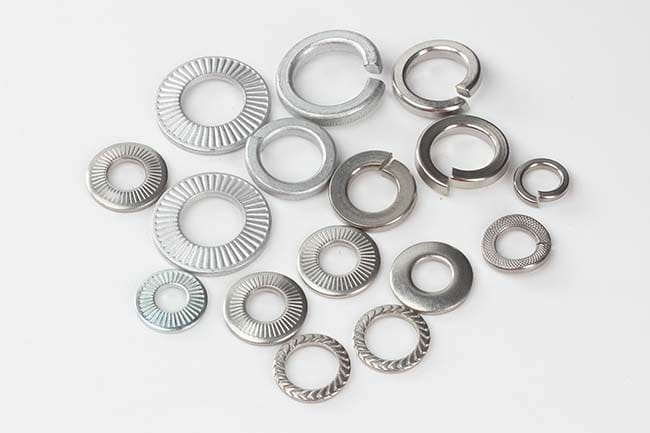
Lock Washer Types at a Glance
| Washer type | Main mechanism | Selection consideration |
|---|---|---|
| Split spring washer | Helical ring compresses as the fastener is tightened. | Common in legacy specifications; compression alone does not establish reliable vibration locking. |
| Internal tooth washer | Teeth around the hole engage the contact surfaces. | Consider for smaller screw-head footprints, with adequate tooth contact and acceptable surface marking. |
| External tooth washer | Teeth around the outer edge engage the contact surfaces. | Check that the head or nut bearing face covers and loads the teeth. |
| Wedge-locking washer pair | Internal cams work with external serrations to oppose loosening rotation. | Evaluate for vibration-sensitive joints using the selected system’s installation rules and performance evidence. |
This comparison identifies mechanisms rather than universal performance ratings. Review industrial lock washer options against the drawing, mating materials and assembly requirements before approving a purchase.
Split Spring Washers: Understand the Limitation
A conventional spring lock washer is a split ring formed into a helix. Its free height decreases under compression, creating spring action during part of the tightening process.
NASA’s Fastener Design Manual explains that a typical helical spring washer is normally flattened when the bolt is fully tightened, at which point it provides no effective locking action. A visible gap before assembly therefore does not demonstrate that useful spring travel remains after installation.
DIN 127:1987-10, a familiar reference for this product, is withdrawn. When an existing drawing specifies it, confirm the required form, material and acceptance requirements. For a new vibration-sensitive joint, do not select a conventional split washer solely because it is sold as an anti loosening washer.
Other spring components, including wave washers and engineered disc springs, have different functions and load-deflection characteristics. Their performance should not be inferred from this discussion of conventional split rings.
Tooth Lock Washers: Contact Geometry Matters
A tooth lock washer, often called a star washer, has formed teeth that engage the underside of the fastener head or nut and the opposing surface. The engagement depends on the tooth geometry, contact pressure and condition of the mating surfaces.
Internal Teeth
Internal teeth sit around the washer opening. These designs are often considered where the screw head is relatively small or the teeth should remain concealed beneath it. Confirm that the actual bearing face reaches the tooth contact region.
External Teeth
External teeth sit around the outside edge. They are commonly paired with larger head footprints. Matching the nominal screw diameter alone is insufficient: a narrow bearing face may fail to load the teeth as intended.
Surface Marking and Application Limits
Tooth engagement can mark the mating surfaces. Assess whether this is acceptable on painted panels, plated parts, visible covers or components with controlled surface requirements. Do not assume that visible tooth marks prove adequate retained preload.
Internal-external and countersunk versions also exist. Their geometry needs to match the intended assembly. A flat star washer, a countersunk tooth washer and a serrated conical washer should not be substituted merely because their holes fit the same screw.
Wedge-Locking Washers: A Matched Pair with Installation Conditions
A typical wedge lock washer system uses two washers with cam faces together and serrations facing outward. The serrations engage the bolt head or nut and the supporting surface, while the cam geometry opposes loosening rotation.
For this mechanism to work, movement must occur at the intended cam interface. If another contact surface can rotate freely, the assembly may bypass the intended locking action.
Check these conditions before selection:
- Contact surfaces: Confirm that the selected washer can engage both mating surfaces.
- Material behaviour: Review very hard, soft, brittle or settlement-prone surfaces with the system supplier.
- Orientation: Install the matched pair with the cam faces together.
- Additional washers: Avoid adding an ordinary flat washer unless the complete arrangement has been approved.
- Assembly procedure: Follow the product-specific instructions for tightening, lubrication and reuse.
A wedge-locking pair addresses rotational loosening. It does not automatically compensate for substantial creep, gasket compression or other causes of clamp-force loss. If settlement is the main problem, review the joint’s bearing support and compliance as well as its locking method.
Start with the Failure Mode and Service Conditions
Before changing washer types, determine what the connection must resist. Loss of preload and rotation are related concerns, but they are not identical. A joint may lose clamp force through settlement without the nut visibly turning.
The following examples provide a starting point for engineering review:
| Application condition | Selection approach | Information to confirm |
|---|---|---|
| Legacy equipment with an approved split-washer specification | Source the specified component or obtain approval for a change. | Drawing revision, washer form, material, finish and maintenance procedure. |
| Small screw securing a metal cover | Assess an internal or external tooth design where surface marking is acceptable. | Head footprint, tooth contact, sheet thickness and service loading. |
| Machinery bracket exposed to repeated transverse movement | Evaluate a qualified locking system, including a suitable wedge-locking pair. | Initial preload, contact surfaces, installation method and representative test evidence. |
| Soft substrate or compressible interface | Review bearing support and settlement before selecting a washer. | Local deformation, retained clamp force and whether the joint needs redesign. |
For pumps, valves and hydraulic equipment, distinguish mounting connections from pressure-sealing joints. A locking washer does not establish sealing performance. For automotive or construction equipment, use the approved assembly specification and service requirements rather than a general washer category.
Dimensions, Materials and Finishes to Check
Measure the Complete Assembly Envelope
Specify the inside diameter, outside diameter, thickness or pair height, and relevant tolerances. Also check clearance to fillets, recesses and nearby features. A change in washer thickness can affect available thread engagement and installation space.
For toothed designs, identify the tooth arrangement and compatible bearing footprint. For wedge-locking systems, identify the manufacturer’s part number or controlled drawing and whether the order quantity means individual washers or complete pairs.
Define Material and Mechanical Requirements Separately
“Steel” and “stainless steel” are incomplete descriptions where material grade, hardness or spring characteristics affect acceptance. Request the specified grade and condition, together with the mechanical requirements applicable to that product.
Do not transfer bolt property classes directly to washer descriptions. A class 10.9 bolt does not define a “class 10.9 washer.” Select the washer using the joint specification and the product’s documented compatibility.
Review the Finish with the Tightening Process
Specify the coating system rather than colour alone. Include any required coating thickness, corrosion-test criteria and friction requirements. A finish change may require review of an established tightening procedure.
If electroplating is proposed for hardened steel, agree on the relevant hydrogen embrittlement controls. Coating acceptance and locking performance remain separate requirements; passing a corrosion test does not establish resistance to loosening.
Read Standard References Carefully
A product specification, a design guide and a vibration-test reference serve different purposes. Ask which document defines the washer dimensions, which defines its material requirements and which supports the claimed performance.
For example, DIN 25201-4:2021-11 addresses securing bolted joints in railway vehicles and their components. A catalogue description containing “DIN 25201” is not, by itself, a complete dimensional purchasing specification for a wedge-locking washer. The product identity and applicable verification requirements still need to be stated.
Where a legacy standard is named, confirm its status and the edition required by the drawing. For a proposed equivalent, compare dimensional fit and functional requirements before accepting a substitution.
If the assembly requires a special outside diameter, thickness or other feature, discuss drawing-based custom fastener requirements. A modified locking component also needs its performance reviewed; dimensional customization alone does not validate the locking mechanism.
Installation and Purchasing Mistakes to Avoid
- Choosing only by bolt diameter: This overlooks bearing footprint, thickness, contact surfaces and installation clearance.
- Combining unrelated washers: An added component can introduce another interface that slips, settles or rotates.
- Splitting a wedge-locking pair: One washer cannot provide the intended interaction between two cam faces.
- Assuming every serrated product works identically: Tooth, rib, cam and conical geometries have different operating requirements.
- Reusing parts based only on appearance: Follow the specified reuse criteria and inspect the relevant working surfaces.
- Comparing prices with incomplete specifications: Material, coating, pair quantity and inspection scope can differ between offers.
Update the bill of materials and work instruction together when an approved change affects orientation, tightening or maintenance. This helps the selected solution reach the assembly line in its intended configuration.
Separate Part Inspection from Joint Validation
Dimensional inspection, material verification, hardness checks and coating inspection can establish whether a supplied washer meets the order. They do not independently prove performance in a particular vibrating assembly.
Where vibration resistance is required, request test evidence with a defined setup and acceptance criteria. Transverse vibration testing, commonly called Junker testing, monitors clamp force while applying transverse movement to a joint.
Compare the fastener size, initial preload, clamping length, contact materials, displacement conditions, cycle count and retained preload. A result for one configuration should not be presented as a guarantee for every size and surface combination.
Flybear’s fastener quality control information supports discussions about inspection and documentation. Agree separately on any application-level testing required for the purchase.
What to Include in a Lock Washer RFQ
Provide enough information for suppliers to quote the same product and identify deviations:
- Type: Split spring, internal tooth, external tooth or a specified wedge-locking pair.
- Reference: Standard and edition, manufacturer part number, or drawing and revision.
- Dimensions: Nominal fastener size, critical diameters, thickness or pair height, and tolerances.
- Material and finish: Grade, mechanical requirements, coating and lubrication requirements.
- Application: Mating materials, bolt grade, tightening method, loading and environmental conditions.
- Acceptance: Inspection scope, performance evidence, traceability and required documents.
- Commercial details: Quantity, unit or pair basis, packaging, delivery destination and requested schedule.
Frequently Asked Questions
Which lock washer type is best for vibration?
A suitable wedge-locking system is a candidate for resisting rotational loosening, but selection depends on the joint and verified performance. There is no universal winner for every material and assembly.
Are internal and external tooth washers interchangeable?
Not automatically. Their teeth contact different regions beneath the head or nut. Check bearing-face coverage, surrounding clearance and the specified washer geometry.
Can I put a flat washer beneath a wedge-locking pair?
A loose flat washer can create another rotation interface. Follow the selected system’s instructions and obtain approval for any additional bearing component.
Does a tooth washer automatically provide electrical grounding?
No. Any bonding function must be established for the complete connection, including surface condition and applicable equipment requirements. The washer’s name alone provides no such assurance.
Can stainless steel replace coated steel without further checks?
No. Compare material properties, hardness, dimensions, environmental compatibility and installation requirements. Similar appearance or nominal size does not establish equivalence.
Conclusion: Select the Mechanism, Then Complete the Specification
Comparing lock washer types starts with the joint’s required function. Check how the washer engages the assembly, confirm material and dimensional compatibility, and review installation instructions and relevant evidence.
Flybear supports standard and custom fastener sourcing. Send your washer specification or assembly requirements for review and quotation, including the drawing, size, material, finish, quantity and inspection needs.