Automation & Robotics Fastening Solutions for Precision Motion and Equipment Assemblies
Automation and robotics fastening solutions are essential for building precise, repeatable, and serviceable equipment across industrial robots, collaborative robots, automated assembly lines, material-handling systems, machine vision equipment, end-of-arm tooling, linear motion systems, and smart manufacturing platforms. These systems depend on reliable mechanical connections that maintain alignment and clamp load while operating under vibration, acceleration, repeated motion, and frequent production cycles.
For automation equipment manufacturers, robotics integrators, machine builders, OEMs, distributors, and industrial sourcing teams, fastener selection involves much more than choosing the correct thread diameter. Head geometry, material, property class, dimensional tolerance, locking method, surface treatment, installation access, weight, and maintenance requirements can all influence equipment performance and assembly efficiency.
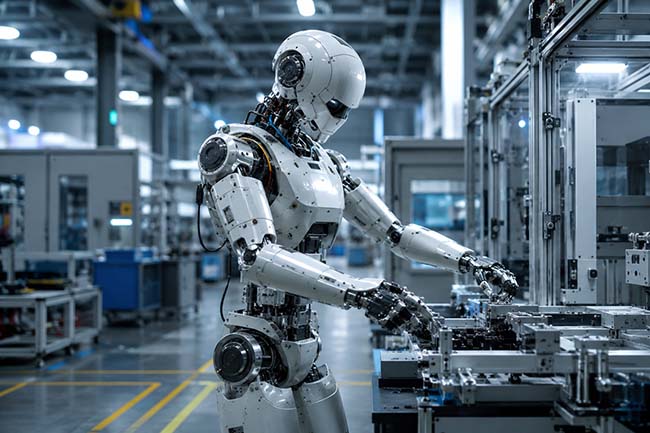
A practical fastening strategy combines standardized industrial hardware with precision and custom components where conventional catalog products cannot meet the geometry or functional requirements of the machine. This helps manufacturers support modular equipment design while maintaining the accuracy required by modern automated systems.
Complete Fastening Support for Automation and Robotic Equipment
Automation systems contain a wide variety of fastening points. Structural frames may use high-strength bolts, robotic joints can require precision screws and locating pins, linear motion assemblies need closely controlled mounting hardware, sensor brackets may use compact machine screws, and end-of-arm tooling often requires frequent adjustment or component replacement.
Flybear supports one-stop sourcing of standard and custom fasteners for automation and robotics projects, helping buyers consolidate socket screws, bolts, nuts, washers, precision pins, shoulder screws, threaded inserts, rivet nuts, standoffs, and drawing-based parts within a coordinated procurement program.
Automation and Robotics Fastening Solutions for Structural Frames
Machine frames provide the mechanical foundation for robotic cells, automated production lines, conveyors, inspection systems, and assembly equipment. Their fastening systems must maintain structural rigidity while allowing equipment to be assembled, adjusted, relocated, or expanded when necessary.
Hex bolts, socket head cap screws, flange bolts, T-slot bolts, nuts, washers, threaded rods, and structural fastening components may be used depending on frame design. Aluminum extrusion systems frequently use specialized T-slot nuts and bolts, while welded steel frames may rely on conventional threaded fasteners for modules, brackets, guarding, and mounted equipment.
Fastener selection should consider the connected material, expected loading, available thread engagement, installation access, and required stiffness. Where precise alignment is important, bolts may be used together with dowel pins or other locating elements so that clamping and positioning functions are controlled separately.
Precision Fasteners for Industrial Robots
Industrial robots combine base structures, rotating joints, gear systems, servo motors, housings, arms, covers, sensors, and cable-management components within compact mechanical assemblies. Fasteners in these systems may be subjected to repeated acceleration, deceleration, vibration, and changes in load direction.
Socket head cap screws are commonly suitable for compact mechanical assemblies because their internal drive allows installation in areas where external wrench clearance may be limited. Low-head and countersunk screws may also be selected where surrounding components require reduced head height.
Shoulder screws, precision pins, studs, and custom machined fasteners can support joints requiring controlled positioning or specific bearing surfaces. In these applications, shoulder diameter, concentricity, surface finish, and dimensional tolerance can be as important as the threaded section.
For precision robotic equipment, manufacturers should define critical dimensions clearly so that fastening components can be evaluated according to their actual mechanical function rather than only their nominal size.
Fasteners for Collaborative Robot Assemblies
Collaborative robots are designed for flexible integration into production environments and often combine compact mechanical structures with sensors, lightweight covers, tool interfaces, control modules, and adjustable mounting systems.
Fasteners used in collaborative robot assemblies may include socket screws, machine screws, low-profile screws, captive fasteners, nuts, washers, precision pins, standoffs, and threaded inserts. Compact head geometry can be particularly useful where exterior surfaces or internal packaging restrict available space.
Weight can also influence fastener selection in moving robot assemblies. Engineers may evaluate fastener dimensions and materials together with the complete structural design to avoid unnecessary mass while maintaining the required mechanical performance.
Any change to fastener material or geometry should be reviewed as part of the complete joint. A lighter component should not be substituted solely for weight reduction if it changes strength, thread behavior, preload capability, or compatibility with the mating structure.
Fastening Solutions for End-of-Arm Tooling
End-of-arm tooling can include grippers, vacuum systems, welding tools, dispensing equipment, inspection devices, cutting tools, and customized fixtures. These assemblies frequently require compact fastening systems that allow precise positioning and fast maintenance.
Socket screws, shoulder bolts, locating pins, machine screws, studs, washers, threaded inserts, and custom components can all be used depending on tooling design. Tooling plates may also contain repeated threaded mounting patterns to support interchangeable equipment.
Because end-of-arm tooling moves together with the robot, weight and balance are important design considerations. Fasteners should provide sufficient strength without adding unnecessary mass or interfering with surrounding components.
Where tooling is changed regularly, manufacturers may prefer fastening arrangements that simplify removal and reinstallation. Repeatable locating features can also help maintain positioning when a tool is removed for maintenance and returned to service.
Fasteners for Linear Motion and Positioning Systems
Linear guides, ball screws, actuators, slides, gantries, and positioning stages rely on accurate mounting. Small deviations in alignment can influence movement quality, making fastening precision especially important in these assemblies.
Socket screws, countersunk screws, shoulder fasteners, precision pins, and specialized mounting hardware can be used to secure rails, bearing blocks, motor brackets, supports, and drive components.
Correct preload should be applied according to the equipment design while avoiding distortion of precision rails or mounting surfaces. Fastener dimensions, head style, and bearing area should therefore match the component geometry.
Where locating accuracy must be maintained during repeated disassembly, dowel pins or precision shoulders can be incorporated into the design. In these cases, the fastener provides clamp load while a separate locating surface controls position.
Vibration-Resistant Fasteners for Automated Machinery
Automated production equipment contains motors, gearboxes, actuators, conveyors, rotating tools, pumps, and other components that can generate vibration. Repeated robot motion and machine cycling can also produce changing forces within mechanical joints.
Resistance to loosening depends on proper joint design, installation preload, thread engagement, connected materials, and suitable locking methods. Lock nuts, prevailing-torque nuts, serrated flange components, mechanical locking washers, or other locking systems may be considered where required by the equipment design.
The locking method should match the maintenance requirements of the machine. Equipment that requires frequent adjustment or servicing may benefit from reusable locking solutions, while other connections may have different assembly priorities.
Locking hardware should not compensate for insufficient tightening or poorly designed joints. Stable fastening begins with a properly engineered connection.
Fasteners for Servo Motors, Gearboxes and Drive Systems
Servo motors, gear reducers, couplings, bearings, and drive modules are central components in automation and robotics. Their fastening systems help maintain equipment alignment while resisting torque, vibration, and repeated dynamic loading.
Flange bolts, socket screws, studs, washers, and precision pins may be used to connect motors and gearboxes to machine structures. In assemblies where alignment is critical, locating features can be combined with threaded fasteners to improve repeatability.
Installation space is often limited around drive systems. Low-head or socket-drive fasteners can provide practical tool access where conventional hex heads would interfere with adjacent equipment.
Custom fasteners may be useful when a drive assembly requires special shoulders, reduced heads, controlled thread lengths, or unique positioning features that cannot be achieved using standard hardware.
Fastening Solutions for Machine Vision and Sensor Equipment
Machine vision cameras, sensors, lighting systems, scanners, and monitoring equipment must be positioned accurately within automated production lines. Their brackets and support systems often require small, precise, and adjustable fasteners.
Machine screws, socket screws, thumb screws, washers, standoffs, threaded inserts, precision pins, and custom mounting components can be used according to the equipment design.
Fasteners should maintain the required position without making adjustment unnecessarily difficult. Slotted brackets, shoulder hardware, and controlled clamping systems can allow alignment during installation while providing stable final positioning.
Because sensor equipment is often mounted near moving machinery, head clearance and cable routing should also be considered when selecting fastener geometry.
Fasteners for Electrical Cabinets and Control Systems
Automation systems include control cabinets, junction boxes, operator panels, power supplies, servo drives, communication modules, and electrical enclosures. These assemblies require fastening components for panels, mounting plates, covers, DIN-rail supports, fans, cable-management systems, and accessories.
Machine screws, captive screws, rivet nuts, threaded inserts, nuts, washers, and standoffs can provide practical solutions for sheet metal and enclosure applications.
Rivet nuts can create reusable threaded attachment points where access is available from only one side of a panel. Captive screws can help keep fasteners attached to removable covers, reducing the possibility of loose hardware during maintenance.
Electrical equipment installed in humid, outdoor, or washdown environments may also require corrosion-resistant materials or surface treatments according to the enclosure and operating conditions.
Fasteners for Aluminum Extrusion Automation Frames
Modular aluminum profiles are widely used for robotic cells, guarding, test equipment, conveyors, workstations, and machine frames because they allow flexible configuration and later modification.
T-slot nuts, T-bolts, socket screws, flange screws, corner-bracket hardware, and threaded components are commonly used to connect extrusion systems. The fasteners must match the profile geometry, slot dimensions, and loading requirements.
Standardizing common fastener sizes across an extrusion-based machine can simplify assembly and spare-parts management. However, connection strength should still be evaluated according to the actual load and profile configuration.
Custom T-slot hardware may also be required where a proprietary profile system or unusual installation geometry cannot accept conventional components.
Fasteners for Robotic Grippers, Fixtures and Tooling Plates
Robotic grippers and production fixtures frequently contain small mechanical components that must be positioned accurately and replaced efficiently. Finger assemblies, jaws, sensors, actuators, brackets, stops, and tooling plates may require different fastening designs within a compact area.
Shoulder screws and precision pins can support controlled movement and alignment, while socket screws and low-profile fasteners can help reduce interference. Threaded inserts can provide durable reusable threads in aluminum or other softer materials.
For custom fixtures, special fasteners may integrate locating shoulders, threaded sections, wrench flats, or other features into a single component. This can help reduce part count and simplify assembly where a standard screw and separate spacer would otherwise be required.
Material Selection for Automation and Robotics Fasteners
Material selection depends on mechanical load, weight, corrosion exposure, mating materials, and equipment environment. Carbon steel is widely suitable for general industrial automation, while alloy steel can be selected where higher strength is required.
Stainless steel fasteners may be appropriate for equipment exposed to humidity, cleaning processes, food-related manufacturing environments, or other corrosion-sensitive conditions. Aluminum and other lightweight materials may be considered for specialized applications where reduced moving mass is important.
The selected fastener material must remain compatible with the connected components. A material substitution should be evaluated for strength, thread performance, wear, corrosion interaction, and installation behavior before approval.
Surface Treatments for Automation Equipment Fasteners
Surface finish can influence corrosion resistance, appearance, friction, wear, and assembly behavior. Zinc plating, black oxide, zinc flake coatings, nickel-based finishes, phosphate treatments, and other industrial surface systems may be specified according to the fastener material and equipment environment.
Black or dark finishes may be selected for optical equipment or machine vision assemblies where reflections need to be considered, while corrosion-resistant coatings may be more important for equipment operating in humid production areas.
Coating thickness should be considered where threads and precision dimensions have tight tolerances. Surface treatment can also affect the relationship between tightening torque and fastener preload.
Buyers should therefore define coating requirements during the RFQ stage, particularly for precision or high-strength fastening components.
Custom Fasteners for Automation and Robotics Equipment
Automation equipment often contains proprietary mechanisms that cannot be assembled efficiently with standard catalog fasteners. Custom automation fasteners can be developed for specific geometry, alignment, weight, or installation requirements.
Typical custom components may include shoulder screws, stepped pins, precision studs, reduced-head bolts, special socket screws, threaded shafts, captive screws, spacers, standoffs, combination fasteners, and parts manufactured entirely according to customer drawings.
Custom components can integrate several functions into a single part, helping reduce component count and simplify machine assembly. A shoulder screw, for example, may combine a precision locating surface with a threaded clamping section.
Technical drawings should clearly identify material, dimensions, tolerances, thread specifications, mechanical requirements, surface finish, and critical functional features. Accurate information supports both manufacturing feasibility review and inspection planning.
Fastener Standardization for Automated Production Equipment
Automation OEMs frequently use hundreds of fastener sizes and configurations across multiple machine models. Excessive variation can increase purchasing complexity, assembly errors, inventory requirements, and maintenance workload.
Engineering and procurement teams can review common fasteners to identify opportunities for standardization. Where technical requirements permit, reducing the number of thread sizes, drive types, head styles, and lengths can simplify machine production and spare-parts management.
Standardization is particularly valuable for modular production equipment that is repeatedly configured for different customers. A controlled library of preferred fasteners can support faster design and purchasing while special components remain available for joints requiring unique geometry or performance.
Quality Considerations for Precision Automation Fasteners
Automation and robotics assemblies depend on dimensional consistency, especially when fasteners interact with precision-machined components. Buyers should define product standards, material requirements, thread dimensions, tolerances, finish, and inspection criteria before production.
Depending on the component specification, inspection may include dimensional measurement, thread verification, hardness testing, mechanical-property verification, coating inspection, or other customer-defined checks.
Custom shoulder screws, pins, and precision machined fasteners may require closer attention to diameter, length, concentricity, and surface finish. Critical characteristics should be identified on the technical drawing so that appropriate inspection methods can be planned.
If batch identification, labeling, material documentation, or specific inspection records are required, these requirements should also be communicated during quotation.
Fasteners for Maintenance, Upgrades and Machine Reconfiguration
Automation systems are frequently modified throughout their operating life. Production changes may require new fixtures, sensor positions, robot tools, conveyors, guarding, or additional equipment modules. Maintenance teams also need replacement fasteners during repairs and scheduled servicing.
Replacement components should match the original thread, material, dimensions, property class, head configuration, and finish where these features affect equipment performance.
For custom robotic or automation equipment, maintaining technical drawings for special fasteners can make long-term spare-parts sourcing easier. Drawing-based components can be reproduced when the original hardware is no longer available as a standard part.
How to Prepare an RFQ for Automation and Robotics Fasteners
A complete RFQ helps suppliers identify the correct fastening components and reduces unnecessary clarification during quotation. Standard fasteners should be specified using the applicable dimensional standard and complete size designation, while precision custom parts should include detailed technical drawings.
Recommended RFQ Information
- Fastener type and applicable standard
- Technical drawing and revision for custom components
- Diameter, thread pitch, and overall length
- Material and required property class or grade
- Head geometry and drive type
- Critical dimensions and tolerances
- Surface treatment or coating requirement
- Application within the automation system
- Vibration, motion, or environmental requirements where relevant
- Required order quantity and purchasing frequency
- Inspection and documentation requirements
- Packaging and labeling requirements
If the final fastening specification has not yet been determined, buyers can also provide information about the complete joint. Connected materials, expected loads, motion frequency, installation space, alignment requirements, maintenance frequency, and environmental exposure can help determine whether a standard or custom fastener is more suitable.
One-Stop Fastener Sourcing for Automation and Robotics Projects
Automation and robotics manufacturers often require many different fastening categories across machine frames, robotic arms, drive systems, linear motion equipment, grippers, sensors, electrical cabinets, guarding, and custom tooling. Managing separate suppliers for socket screws, bolts, nuts, washers, T-slot hardware, shoulder screws, precision pins, inserts, and drawing-based components can increase procurement complexity.
A one-stop sourcing approach allows manufacturers and system integrators to consolidate standard and custom fasteners while maintaining the individual specifications required by each assembly. Common hardware can be standardized for repeat machine platforms, while precision custom parts can be produced according to drawings for proprietary mechanisms and tooling.
Whether the project involves industrial robots, collaborative robots, automated assembly lines, machine vision systems, linear motion equipment, robotic grippers, or customized factory automation, reliable fastening begins with accurate technical requirements. Matching material, dimensions, strength, precision, locking method, finish, and installation characteristics to the actual assembly can support reliable motion, easier maintenance, and more efficient automation equipment production.