ASTM A193 B7 Stud Bolts: A Practical Sourcing Guide
ASTM A193 B7 stud bolts are widely specified for pressure vessels, valves, flanges, fittings, piping systems, and other industrial applications requiring alloy-steel bolting for elevated-temperature, high-pressure, or other special-purpose service. For buyers, however, “A193 B7” is only part of a complete purchasing specification. Thread series, stud geometry, finished length, matching nuts, coating, inspection, marking, certificates, and application requirements must also be defined.
ASTM A193/A193M-26 is the current ASTM edition. It covers alloy-steel and stainless-steel bolting materials and components for pressure vessels, valves, flanges, and fittings used for high-temperature or high-pressure service or other special-purpose applications. Grade B7 is an alloy-steel bolting grade within this specification. Buyers should distinguish this material and mechanical-property standard from dimensional standards that define stud geometry or thread standards that define the thread form.
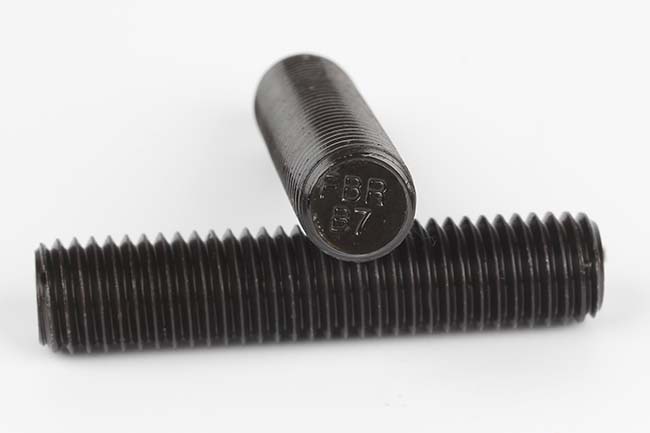
Flybear supplies standard, special, and custom industrial fastening solutions for OEM, EPC, maintenance, and distributor requirements. Buyers evaluating B7 bolting can review an ASTM A193 B7 stud bolt example and provide the applicable specification, size, thread, length, coating, quantity, and documentation requirements for technical review.
What ASTM A193 B7 Actually Specifies
ASTM A193/A193M is primarily a bolting material and mechanical-property specification. It addresses requirements such as material chemistry, heat treatment, mechanical properties, hardness, testing, and related manufacturing controls within its scope.
This distinction is important because an ASTM A193 B7 callout does not by itself completely define the physical stud bolt that should arrive at the buyer’s warehouse. A complete order may need separate requirements for:
- Stud configuration and dimensional standard.
- Nominal diameter and finished length.
- Thread series, pitch, and class.
- End chamfers or other end preparation.
- Matching nut specification and grade.
- Surface coating and lubrication.
- Required marking and traceability.
- Material test reports and inspection documents.
This is one of the most common sources of quotation differences. Two suppliers can both quote “B7 stud bolts” while making different assumptions about thread, nuts, coating, dimensions, and inspection scope.
ASTM A193 B7 Stud Bolts vs B7 Threaded Rod
A B7 threaded rod and an ASTM A193 B7 stud bolt can sometimes look similar, especially when both are continuously threaded. However, appearance alone does not establish equivalence.
A pressure bolting stud can have controlled finished dimensions, end preparation, thread requirements, material traceability, mechanical testing, marking, and documentation that may not be included in a generic threaded-rod quotation.
| Purchasing Factor | B7 Threaded Rod | Finished B7 Stud Bolt |
|---|---|---|
| General Form | Often supplied as longer continuously threaded bar or cut lengths | Supplied to a defined finished stud length and configuration |
| Application | Can be used for general industrial or project-specific threaded applications | Commonly specified for flanges, valves, pressure equipment, and engineered joints |
| End Condition | Depends on cut and finishing requirements | Chamfers or other end preparation may be controlled by the applicable dimensional specification |
| Documentation | Depends on purchase specification | Pressure-service projects commonly require controlled material and inspection documentation |
| Substitution | Not automatically equivalent to a specified stud bolt | Must satisfy the complete project specification |
If a buyer intends to cut B7 threaded rod into finished studs, the resulting components still need to satisfy all applicable dimensional, mechanical, marking, traceability, and documentation requirements. Cutting a conforming material bar to length does not by itself establish compliance with every finished-fastener requirement.
Separate the Material Standard from the Dimensional Standard
A practical RFQ should identify which standard controls each characteristic. ASTM A193/A193M controls the applicable bolting material and mechanical requirements, while a dimensional standard or drawing may define the stud configuration.
For inch-series studs, ASME B18.31.2-2014 (R2019) remains in effect and covers dimensional and general data for continuous-thread studs, flange bolting studs, and double-end studs. It specifically identifies flange bolting studs as products used primarily in flange applications and made from ASTM bolting materials.
Thread requirements are another separate layer. ASME B1.1-2024 is the current standard covering Unified inch thread forms, series, classes, allowances, tolerances, and designations within its scope.
As a result, a controlled purchase may involve several documents rather than one:
- ASTM A193/A193M for bolting material and mechanical requirements.
- An ASME dimensional standard or customer drawing for stud geometry.
- An applicable thread standard for thread form and tolerance.
- A separate nut specification.
- A coating or project specification for surface treatment.
Grade B7 Material and Heat Treatment
Grade B7 is a chromium-molybdenum alloy-steel bolting grade commonly used for demanding industrial service. Its specified mechanical properties are developed through controlled heat treatment. Buyers should therefore treat heat treatment as part of grade conformity rather than assume that any chromium-molybdenum alloy bar automatically qualifies as B7.
The current ASTM specification includes chemical, heat-treatment, tensile, hardness, and other applicable requirements. Mechanical acceptance can also depend on fastener diameter, so buyers should avoid placing a single universal strength value on every B7 size unless that value has been checked against the applicable current standard table.
For procurement, the safer specification is “ASTM A193/A193M Grade B7” together with the required product dimensions and documentation, rather than attempting to recreate the grade from a material name and one tensile value.
Do Not Confuse B7 with B7M or Low-Temperature Bolting
Grade designations should be copied accurately from the engineering specification. B7 and B7M are separate ASTM grades with different requirements and should not be treated as interchangeable because their names are similar.
Likewise, a buyer should not automatically specify B7 when the application involves low-temperature service. ASTM A193 itself directs users to ASTM A320/A320M for grades of alloy-steel bolting intended for low-temperature applications.
Before requesting quotation, confirm:
- Design temperature range.
- Pressure and equipment specification.
- Required bolting grade.
- Any impact-testing requirement.
- Environmental or process restrictions.
- Customer or EPC material specification.
This verification is especially important for replacement orders where maintenance personnel may identify only diameter, thread, and an incomplete marking from the removed stud.
Specify Stud Diameter, Length, and Configuration
An A193 B7 supplier needs the finished stud dimensions, not only the material grade. Specify nominal diameter and finished length together with the stud configuration.
Typical configurations include:
- Continuous-thread flange studs.
- Fully threaded studs for machinery and equipment.
- Double-end studs with an unthreaded center section.
- Drawing-based special studs.
Length measurement should follow the applicable dimensional standard or approved drawing. For pressure-equipment maintenance, copying a nominal length from an informal stock list can lead to insufficient thread engagement or excessive projection after the nuts are installed.
Where the assembly uses two nuts, verify that the finished stud provides adequate engagement and required thread projection at both ends under the actual joint stack-up.
Thread Series and Class Must Be Explicit
In North American pressure bolting, Unified inch threads are common, but buyers should not assume the thread series simply from the words “A193 B7 stud.” State the complete thread requirement.
The RFQ may need to define:
- Nominal diameter.
- UNC, UNF, or another specified thread series.
- Threads per inch.
- Thread class.
- Right-hand or special direction where applicable.
- Thread condition after coating.
A fine-thread alloy steel stud bolt is not interchangeable with a coarse-thread stud of the same nominal diameter. Maintenance buyers should verify the mating nut and existing equipment specification before placing an urgent replacement order.
Matching Nuts for ASTM A193 B7 Stud Bolts
The nut should be specified as carefully as the stud. ASTM A194/A194M-26 is the current ASTM specification for carbon-steel, alloy-steel, and stainless-steel nuts intended for high-pressure or high-temperature service, or both.
ASTM A194 Grade 2H is a common nut grade used with B7 bolting in many industrial specifications. However, buyers should not assume that 2H is mandatory for every B7 application. The equipment code, project specification, engineering drawing, temperature, coating system, and customer requirements should determine the required nut.
When ordering a complete stud assembly, state:
- Nut standard and grade.
- Quantity of nuts per stud.
- Thread requirement.
- Coating or lubrication condition.
- Washer requirement where applicable.
- Marking and documentation requirements.
This prevents the stud and nuts from being sourced independently with incompatible threads or surface conditions.
Coating Selection for B7 Pressure Bolting
ASTM A193 B7 stud bolts can be supplied with different surface conditions depending on the project. Examples encountered in industrial sourcing include plain or black finishes, zinc-based coatings, and fluoropolymer or PTFE-type coating systems.
Coating should not be selected from corrosion resistance alone. Surface condition can change friction during tightening, and this can alter the relationship between applied torque and stud tension.
For a coated pressure bolting assembly, buyers should consider:
- Operating temperature.
- Corrosion environment.
- Coating compatibility with the process environment.
- Thread dimensional allowance.
- Mating-nut coating.
- Lubrication condition.
- Specified tightening procedure.
- Hydrogen-embrittlement controls where applicable to the coating process.
A black oxide finish can provide a uniform dark surface and basic protection but should not be treated as a high-corrosion-resistance coating for aggressive outdoor or chemical exposure. Fluoropolymer coatings can provide different corrosion and friction characteristics, but the approved tightening method should reflect the actual coated assembly.
Inspection and Certificates: Define Them Before Quotation
For pressure bolting, documentation can be as important to the receiving process as the physical product. Inspection and certificate requirements should therefore be included in the RFQ rather than added after the supplier has quoted or produced the order.
Depending on the project, buyers may require:
- Material test reports or mill test certificates.
- Chemical composition verification.
- Heat-treatment records where required.
- Tensile or other mechanical test results.
- Hardness testing.
- Dimensional inspection reports.
- Thread gauge inspection.
- Coating-thickness reports.
- Product or lot traceability.
- Marking verification.
- Third-party inspection where specified.
Flybear’s quality control process supports material and certificate review, dimensional and thread inspection, hardness and tensile testing, material verification, coating inspection, and other project-specific checks according to agreed requirements.
How to Evaluate an A193 B7 Supplier
Supplier evaluation should focus on whether the supplier can control the complete specification rather than simply offer an attractive unit price. An experienced stud bolt supplier should be able to identify missing RFQ information before production begins.
Useful evaluation questions include:
- Can the supplier quote to the current ASTM edition or the project-specified edition?
- Can the required stud dimensional standard or drawing be followed?
- Can the exact thread series and class be inspected?
- Can matching A194 nuts be supplied when required?
- Can heat treatment and mechanical properties be verified?
- Can the required coating system and thickness be controlled?
- Can material and test documentation be supplied with lot traceability?
- Can special lengths, double-end studs, or non-standard configurations be supported?
- Can packaging and identification be adapted to project or maintenance requirements?
For non-standard geometry, unusual threads, special end configurations, or drawing-controlled stud requirements, buyers can also use Flybear’s custom fastener support.
Sample and Pre-Order Approval for Critical Projects
For a new supplier, unusual coating, special thread, or drawing-based stud, sample approval can reduce production risk. The buyer can confirm dimensions, thread fit, nut assembly, marking, finish, and documentation format before approving a larger order.
For coating changes, it is useful to evaluate the stud and mating nut as an assembly. A coating that passes visual inspection can still change thread fit or tightening behavior.
Where pressure-equipment codes, EPC specifications, or end-user approval procedures apply, the buyer should communicate those requirements before samples or production are prepared.
Common ASTM A193 B7 Stud Bolt Sourcing Mistakes
- Using ASTM A193 as the complete dimensional specification. A193 primarily controls bolting material and mechanical requirements; finished geometry may require an ASME standard or drawing.
- Ordering “B7 stud bolts” without thread information. Diameter alone does not define thread series, pitch, or class.
- Assuming B7 threaded rod is automatically equivalent to finished flange bolting. Dimensions, end condition, marking, inspection, and traceability may differ.
- Confusing B7 and B7M. They are separate grade designations with different requirements.
- Using B7 automatically for low-temperature service. Confirm the applicable material specification for the design temperature.
- Leaving matching nuts unspecified. Nut grade, thread, coating, and quantity should be defined with the stud assembly.
- Selecting coating only for appearance. Coating also affects corrosion behavior, thread condition, friction, and tightening.
- Requesting certificates after production. Documentation and traceability requirements should be established at RFQ stage.
ASTM A193 B7 Stud Bolts RFQ Checklist
A complete RFQ helps an A193 B7 supplier quote the intended assembly without assumptions. Include:
- ASTM A193/A193M edition required by the project.
- Grade B7 designation.
- Applicable dimensional standard or controlled drawing.
- Stud type: continuous thread, flange stud, double-end, or custom.
- Nominal diameter.
- Thread series, TPI, and class.
- Finished stud length and tolerance.
- Required end preparation.
- Surface finish, coating, and lubrication.
- Matching nut standard, grade, quantity, and finish.
- Order quantity.
- Pressure-equipment, piping, valve, machinery, or other application.
- Operating temperature and relevant environmental exposure.
- Required material certificates and mechanical test reports.
- Dimensional, thread, coating, and marking inspection scope.
- Lot traceability and packaging requirements.
FAQ
What are ASTM A193 B7 stud bolts used for?
They are commonly specified for pressure vessels, valves, flanges, fittings, piping equipment, and other industrial applications requiring alloy-steel bolting for high-temperature, high-pressure, or special-purpose service. The equipment and project specification should confirm whether B7 is the correct grade.
What is the current ASTM A193 standard?
ASTM A193/A193M-26 is the current active edition. It covers alloy-steel and stainless-steel bolting materials and components for pressure vessels, valves, flanges, fittings, and other specified applications within its scope.
Is ASTM A193 B7 a dimensional standard?
No. It primarily establishes material and mechanical requirements for bolting. Stud dimensions may be controlled by a separate ASME standard, drawing, or project specification.
What nut is commonly used with B7 stud bolts?
ASTM A194 Grade 2H is commonly paired with B7 in many industrial applications, but the actual required nut grade should follow the equipment, project, or engineering specification.
Can B7 stud bolts be PTFE coated?
Suitable B7 stud bolts can be supplied with specified fluoropolymer or PTFE-type coating systems when permitted by the project. Buyers should verify temperature, corrosion, thread fit, friction, tightening procedures, and matching-nut requirements.
What information should I send for a B7 stud bolt quotation?
Send the required ASTM edition and grade, dimensional standard or drawing, diameter, thread, finished length, coating, matching nuts, quantity, application, operating conditions, and required inspection, traceability, and certificate documents.
Conclusion
Successful sourcing of ASTM A193 B7 stud bolts requires separating material requirements from dimensions, threads, coatings, and assembly requirements. ASTM A193/A193M defines the applicable B7 bolting material and mechanical framework, while dimensional and thread standards or project drawings define the finished product configuration.
For pressure bolting, buyers should also control matching nuts, surface condition, tightening assumptions, inspection, marking, and documentation. These details make quotations comparable and reduce the risk of receiving a stud that is nominally “B7” but does not match the actual piping or equipment specification.
For standard or project-specific B7 studs, Flybear can support technical requirement review and quotation. Send your standard or drawing, diameter and thread, finished length, Grade B7 requirement, finish or coating, matching nuts, quantity, application, and inspection or certificate requirements through the Flybear contact page.