Rivet Nuts for Thin Sheet Metal: Grip Range, Body Style and Installation
Rivet nuts for thin sheet metal provide a reusable internal thread where the base material is too thin for practical direct tapping or where access is available from only one side of the assembly. Also called blind rivet nuts, threaded rivet nuts, or rivnuts in common market terminology, these fasteners are widely used in electrical enclosures, machinery panels, automotive structures, tubes, fabricated frames, equipment housings, and other thin-section assemblies.
Correct selection depends on much more than thread size. Buyers should define the panel thickness, grip range, installation-hole diameter, body style, head type, open or closed end, material, surface finish, mating screw, installation method, and required pull-out or torque-out performance. A rivet nut that fits an M6 bolt can still perform poorly if its grip range or body geometry does not match the sheet.
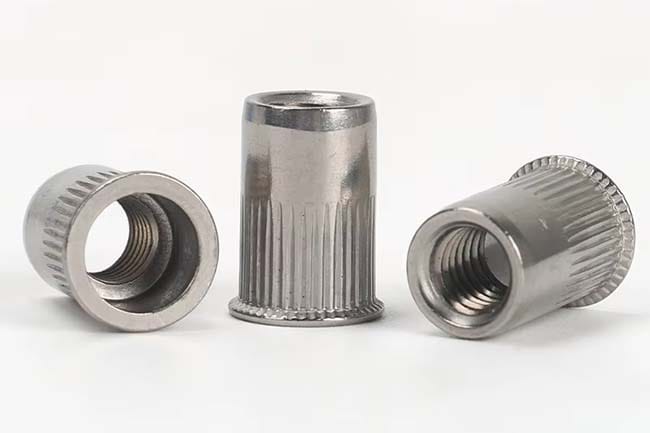
Flybear supplies standard, special, and custom industrial fastening solutions for OEM and sheet-metal applications. Buyers can review the rivet nut range and provide the thread, panel material and thickness, body style, finish, quantity, and installation requirements for technical review.
How Do Rivet Nuts for Thin Sheet Metal Work?
A blind rivet nut is inserted into a prepared hole from the accessible side of a panel. During installation, a dedicated tool engages the internal thread and applies an axial setting force. The deformable portion of the rivet nut collapses behind the sheet, creating a mechanically retained threaded insert.
After installation, the tool is removed and a conventional machine screw or bolt can be threaded into the installed nut. This creates a permanent female thread without requiring access to hold a loose nut behind the panel during final assembly.
This one-sided installation capability is particularly useful for:
- Closed tubes and box sections.
- Electrical cabinets and control panels.
- Automotive body and enclosure assemblies.
- Machine guards and removable covers.
- HVAC and ventilation equipment.
- Rail and transportation interiors.
- Battery enclosures and energy equipment.
- Fabricated sheet-metal structures.
A rivet nut should be treated as part of a complete installation system. The insert, panel, hole, setting tool, installation force, and mating screw all influence final performance.
Grip Range Is One of the Most Important Specifications
The grip range describes the panel-thickness interval for which a particular rivet nut configuration is intended. Different versions of the same thread size can have different grip ranges because the deformable body length must match the material being clamped.
If the panel is thinner than the intended grip range, the rivet nut may not collapse and clamp in the designed manner. If the panel is too thick, there may be insufficient deformable length to create the required blind-side bulge or retention feature.
For an RFQ, buyers should provide the actual sheet thickness and tolerance rather than requesting only “M6 rivet nut.” If the same fastener is expected to be used across several panel thicknesses, identify the complete thickness range so the supplier can review whether one grip range is suitable.
Multiple Sheet Layers Need Additional Review
A rivet nut can sometimes be installed through multiple sheet layers, but the effective grip thickness is the total material stack through the installation location. Gaps, coatings, adhesive layers, or poorly clamped sheets can influence the setting process.
For laminated or multi-layer assemblies, buyers should provide the complete stack-up and identify whether the layers are already fixed together before rivet nut installation.
Round vs Hex Rivet Nut Body Styles
Body shape affects installation-hole geometry and resistance to rotation in the panel. Two common families are round-body and hexagonal-body rivet nuts.
| Body Style | Hole Requirement | Typical Advantage | Important Consideration |
|---|---|---|---|
| Smooth Round | Round hole | Simple hole preparation and broad application range | Anti-rotation performance depends strongly on clamping and panel conditions |
| Knurled Round | Round hole | External knurling can increase engagement with suitable panel material | Knurl effectiveness depends on material hardness and installation quality |
| Half-Hex | Hexagonal or compatible formed hole | Mechanical body-to-hole engagement can improve resistance to rotation | Requires controlled non-round hole preparation |
| Full-Hex | Hexagonal hole | Strong geometric anti-rotation interface | Hole production and orientation require tighter process control |
Round Body Rivet Nuts
Round bodies are convenient because a circular installation hole can be produced by drilling, punching, laser cutting, or another suitable sheet-metal process. Smooth-body versions rely primarily on the installed clamping condition and body deformation to resist movement.
A knurled rivet nut adds longitudinal or other external texture to the body. In suitable materials, this can increase resistance to rotation by creating additional mechanical engagement with the hole wall.
However, a knurled body is not universally superior. Very hard sheet may not allow meaningful embedding, while very soft material can deform differently under installation loads. Production trials should be used for joints with demanding torque-out requirements.
Hex Body Rivet Nuts
A hex rivet nut engages a matching non-round hole. Because the body cannot rotate freely inside a correctly sized hexagonal opening, this geometry can provide a positive mechanical contribution to anti-rotation performance.
Hex bodies can be useful where relatively high torque is applied to the mating bolt or where repetitive removal could otherwise rotate a round insert in the panel.
The tradeoff is hole preparation. Punching, laser cutting, or another controlled manufacturing process must produce the required shape and dimensions. A hex rivet nut should not be forced into an undersized or irregular opening.
Flat Head, Reduced Head and Countersunk Rivet Nuts
Head style determines how the installed rivet nut bears against the accessible side of the panel and how far it projects above the surface.
Flat or Large Head
A conventional flange or flat head provides a relatively broad bearing surface. It is often a practical choice for general sheet-metal assembly because the head helps distribute setting and service loads around the installation hole.
Available radial clearance should still be checked, particularly near bends, enclosure edges, or closely spaced components.
Reduced Head
A reduced-head rivet nut has a smaller and thinner flange, creating a lower installed profile without requiring a full countersink. It can be useful for electrical enclosures, panels, and assemblies where projection needs to be minimized.
Because the flange is smaller, its bearing conditions differ from those of a large-head design. The panel material and application load should therefore be considered before substitution.
Countersunk Head
A countersunk design can provide a flush or nearly flush installation when used with a correctly prepared countersink. This can be useful where another component must sit directly against the panel.
Thin sheet needs special attention because countersinking removes or forms material around the hole. Panel thickness, countersink geometry, head design, and setting behavior should be validated together.
Open-End vs Closed-End Blind Rivet Nuts
Rivet nuts can also be classified by whether the threaded body is open or closed at the blind end.
Open-end rivet nuts allow the mating screw to pass through the internal thread and potentially project beyond the insert. They are widely used where internal clearance exists and there is no requirement to close the end of the threaded insert.
Closed-end rivet nuts include a sealed physical end to the insert body. They can help prevent the mating screw from projecting beyond the insert and can provide a barrier at the end of the body.
A closed end alone should not be treated as a guaranteed liquid- or gas-tight seal. Sealing performance depends on the rivet nut head, panel hole, installation, gasket or sealing feature where used, and the applicable application test.
Hole Size and Hole Quality Directly Affect Installation
The prepared hole is a critical part of the rivet nut joint. An oversized hole can reduce body engagement and allow movement or rotation. An undersized hole can damage the insert during installation or prevent proper seating.
Buyers and production engineers should control:
- Nominal hole diameter or shape.
- Hole-size tolerance.
- Burr condition.
- Hole roundness or hex geometry.
- Distance from sheet edges.
- Panel flatness around the hole.
- Paint, plating, or coating buildup.
Punched holes can have different edge and taper characteristics from drilled or laser-cut holes. For demanding applications, production testing should use holes made by the actual manufacturing process.
Steel, Stainless Steel or Aluminum Rivet Nuts?
Material selection should consider both the installation process and the service environment. Common rivet nut materials include steel, stainless steel, and aluminum.
| Material | Typical Selection Reason | Buyer Considerations |
|---|---|---|
| Steel | General industrial use and balanced mechanical performance | Usually requires suitable corrosion protection for exposed environments |
| Stainless Steel | Corrosion-resistant assemblies and stainless sheet applications | Higher setting force may apply depending on design; grade and environment require review |
| Aluminum | Lightweight assemblies and compatible aluminum structures | Lower material strength than many steel designs; application loads require verification |
Material should not be selected from corrosion requirements alone. Setting force, panel material, pull-out requirement, torque-out resistance, galvanic compatibility, temperature, weight, and cost can all affect the choice.
Material Compatibility with the Sheet
The relationship between the rivet nut and panel material is important because installation deforms the insert against the back of the sheet. A hard stainless insert installed into thin aluminum behaves differently from a steel insert installed into a steel panel.
Where dissimilar metals are combined, galvanic corrosion may also become relevant in the presence of an electrolyte. Material combination, coating, sealing, drainage, and environmental exposure should be evaluated together.
For aluminum enclosures, stainless panels, painted steel cabinets, and other special material combinations, buyers should provide both rivet nut and panel requirements during technical review.
Coatings and Finishes for Steel Rivet Nuts
Steel rivet nuts can use zinc-based plating, zinc-flake systems, or other specified finishes depending on corrosion and assembly requirements. The surface treatment can influence corrosion protection, appearance, friction, dimensional fit, and installation behavior.
Because the body deforms significantly during setting, buyers should consider the coating in the installed condition. Surface treatments that look acceptable before installation can experience localized deformation at the collapsed section.
Where corrosion testing is required, the RFQ should identify the coating system, test method, duration, and acceptance criteria. Service-life claims should not be inferred from coating color alone.
Installation Tooling and Setting Control
Rivet nuts can be installed with manual, pneumatic, hydraulic, electric, or automated tooling depending on the insert size, material, and production volume. The installation process must apply sufficient axial deformation to secure the insert without damaging the internal thread or panel.
Common process approaches can control stroke damaging the internal thread or panel.
Common process approaches can control stroke, force, or a combination of installation parameters depending on the tool design. The correct setting should be established for the specific rivet nut and panel combination.
Typical installation problems include:
- Under-setting, leaving the insert loose.
- Over-setting, damaging the body, thread, or thin panel.
- Incorrect mandrel or nosepiece selection.
- Poor tool alignment.
- Using the wrong grip range.
- Installing into an oversized or damaged hole.
- Allowing the flange to seat on burrs or debris.
High-volume OEM projects should validate tooling and settings before production and maintain suitable process-control checks during assembly.
Pull-Out and Torque-Out Performance
Two common functional considerations for rivet nuts are pull-out resistance and torque-out resistance.
Pull-out resistance concerns the insert’s ability to resist axial extraction from the panel. It depends on the installed body deformation, flange, panel thickness and material, hole dimensions, and applied load.
Torque-out resistance concerns the insert’s resistance to rotating in the panel when torque is applied through the mating screw. Body shape, knurling, hole geometry, panel material, and installation quality can influence this behavior.
Neither value should be assumed from thread size alone. An M8 insert installed into thin aluminum can behave very differently from an M8 insert installed in thicker steel.
Where these characteristics are critical, buyers should define the test configuration, panel material and thickness, hole size, minimum required performance, sampling plan, and whether tests apply to samples or production lots.
Rivet Nuts vs Weld Nuts for Thin Sheet Metal
Rivet nuts and weld nuts both create captive internal threads, but their installation processes are different.
| Factor | Rivet Nut | Weld Nut |
|---|---|---|
| Installation | Mechanical deformation | Welding process |
| Access | Typically installed from one side | Requires suitable welding access and equipment |
| Heat Input | No welding heat required | Local welding heat is part of installation |
| Finished or Coated Panel | Can be installed after some finishing operations when compatible | Welding can affect surrounding coatings |
| Production Equipment | Rivet nut setting tool | Welding equipment and fixtures |
| Selection Basis | Grip range, hole, body, setting, and panel conditions | Weld projections, sheet material, weld parameters, and joint geometry |
The better option depends on the fabrication sequence, panel material, production volume, available equipment, strength requirements, corrosion process, and service conditions.
Quality Control for Rivet Nuts for Thin Sheet Metal
Incoming rivet nut inspection can include thread verification, overall dimensions, body and flange geometry, material confirmation, coating thickness, surface condition, and packaging checks. Grip-range and installation-related dimensions are particularly important because they affect the setting process.
After installation, functional verification may include visual inspection of the set insert, dimensional checks, torque-out testing, pull-out testing, or application-specific assembly tests when required by the project.
Flybear’s quality control support includes dimensional and thread inspection, material verification, coating inspection, optical inspection, hardness or other mechanical testing where applicable, and additional project-specific checks according to agreed requirements.
Common Rivet Nut Purchasing Mistakes
- Ordering only by thread size. Grip range, hole size, body style, and head type are equally important.
- Ignoring panel thickness tolerance. The entire production thickness range should fit the selected grip range.
- Using a round insert where high torque-out resistance is required without testing. Hex or suitably knurled designs may need to be evaluated.
- Specifying material without panel information. Insert and sheet materials interact during setting.
- Ignoring the installation tool. Mandrel, nosepiece, stroke, force, and alignment can determine installation quality.
- Assuming a closed-end insert is automatically waterproof. Sealing must be evaluated for the complete installed joint.
- Using generic pull-out values from an unrelated panel. Functional strength depends strongly on test material and installation conditions.
- Changing coating without process review. Finish can affect dimensions, corrosion behavior, and setting performance.
When a Custom Rivet Nut Is Needed
Standard rivet nuts do not cover every OEM requirement. A project may require a special grip range, unusual flange diameter, proprietary body geometry, special anti-rotation feature, non-standard length, closed-end design, sealing element, special material, or drawing-controlled coating.
For these requirements, buyers can provide a controlled drawing or sample through Flybear’s custom fastener support. The specification should identify the thread, body and head geometry, grip range, material, surface treatment, panel interface, installation requirement, and functional acceptance criteria.
RFQ Checklist for Rivet Nuts
A complete RFQ helps an industrial rivet nut supplier evaluate both the product and the installation application. Buyers should provide:
- Applicable standard, supplier specification, or controlled drawing.
- Internal thread diameter and pitch.
- Required body style: round, knurled, half-hex, full-hex, or custom.
- Head type: flat, large, reduced, countersunk, or drawing-specific.
- Open-end or closed-end requirement.
- Panel material and grade.
- Minimum, nominal, and maximum panel thickness.
- Required grip range.
- Installation-hole diameter, shape, and tolerance.
- Rivet nut material.
- Surface coating or finish.
- Mating screw or bolt specification.
- Order quantity and expected repeat volume.
- Manual, pneumatic, hydraulic, electric, or automated installation process where known.
- Required pull-out, torque-out, or other functional tests.
- Inspection reports, material documents, coating reports, traceability, labeling, and packaging requirements.
FAQ
Why are rivet nuts useful in thin sheet metal?
Thin sheet may not provide enough material thickness for a durable directly tapped thread. A rivet nut creates a reusable internal thread by mechanically clamping into the panel and can normally be installed from one accessible side.
How do I choose the correct rivet nut grip range?
Determine the actual panel thickness, including its manufacturing tolerance and any relevant material stack. Select an insert whose specified grip range covers that complete thickness. Do not select grip range from thread size alone.
Which is better: round or hex rivet nuts?
Neither is universally better. Round bodies simplify hole preparation, while hex bodies can provide positive mechanical resistance to rotation when installed in a matching hole. Required torque-out performance, panel material, production process, and cost should guide the choice.
What is the difference between knurled and smooth rivet nuts?
A knurled body has external texture intended to increase engagement with suitable panel material. A smooth round body has no such texture. Actual anti-rotation performance depends on sheet hardness, hole quality, grip range, installation, and the specific insert design.
Can a rivet nut be installed after a panel is painted?
It can be possible in suitable applications, but coating thickness, hole dimensions, coating damage during setting, electrical requirements, and final corrosion protection should be reviewed. The production sequence should be validated using the actual finish.
What should buyers provide for a rivet nut quotation?
Provide the thread, body and head styles, grip range, panel material and thickness, hole size, rivet nut material and finish, quantity, installation method, functional test requirements, and required inspection or certificate documents.
Conclusion
Successful selection of rivet nuts for thin sheet metal starts with the panel rather than the thread alone. Grip range, hole dimensions, round or hex body geometry, head style, open or closed end, insert material, coating, and installation tooling all influence the finished threaded attachment point.
For OEM projects, buyers should also define the functional requirements of the installed insert. Pull-out and torque-out performance must be evaluated using representative panel material and installation conditions rather than assumed from nominal thread size or a generic catalog value.
For standard or project-specific rivet nuts, Flybear can support requirement review and quotation. Send your thread specification, panel material and thickness, grip range, body and head style, material, finish, quantity, application, installation requirements, and required inspection documents through the Flybear contact page.