Weld Nut Types Explained: Styles for Sheet Metal and Fabrication
Weld nut types differ in body shape, welding projections, installation method, sheet-metal interface, and the way they create a permanent threaded attachment point. Projection weld nuts, square weld nuts, round weld nuts, and hex weld nuts can all be useful in fabricated metal assemblies, but the correct choice depends on sheet thickness, base material, welding process, thread requirement, joint loading, available space, corrosion protection, and production method.
Unlike a conventional loose nut, a weld nut is permanently attached to a metal component before final bolt assembly. This can create a captive internal thread where rear-side access would otherwise be difficult during equipment assembly. Weld nuts are widely used in automotive components, machinery frames, electrical cabinets, fabricated brackets, rail equipment, construction machinery, and other welded structures.
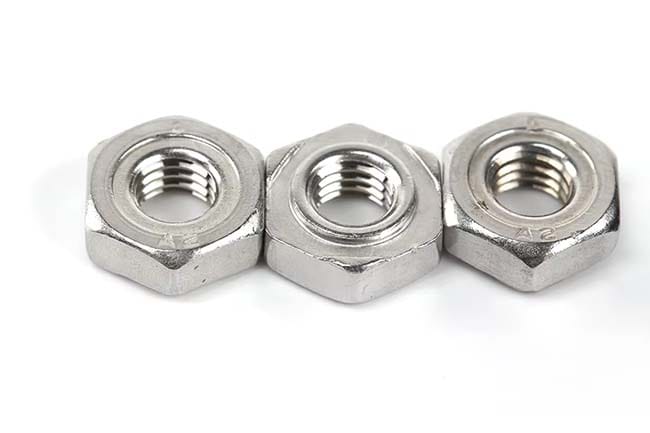
Flybear supplies standard, special, and custom industrial fastening solutions for OEM and fabrication requirements. Buyers comparing different designs can review the weld nut range and provide the required standard or drawing, thread, material, welding configuration, finish, quantity, and application for technical review.
Weld Nut Types: Quick Comparison
| Weld Nut Style | Main Feature | Typical Selection Reason | Key Engineering Consideration |
|---|---|---|---|
| Projection Weld Nut | One or more raised welding projections concentrate the welding process | High-volume resistance welding to sheet or fabricated components | Projection geometry, sheet condition, welding parameters, and joint testing must be controlled |
| Square Weld Nut | Square external body, usually combined with welding features | Broad footprint and easy orientation in suitable fixtures | Requires sufficient surrounding space and correct projection contact |
| Round Weld Nut | Circular external body with application-specific welding features | Compact circular envelope or drawing-specific sheet-metal assemblies | Geometry and anti-rotation behavior depend heavily on the actual design |
| Hex Weld Nut | Hexagonal body, with or without flange depending on the standard or drawing | Standardized industrial and sheet-metal applications | Check standard, dimensions, projection design, thread, and mechanical requirements |
These descriptions are not mutually exclusive. A projection weld nut describes how welding energy is concentrated at defined projections, while square, round, and hex describe the external body geometry. A square or hex nut can therefore also be a projection weld nut.
How Weld Nuts Work in Sheet Metal Assemblies
A weld nut is positioned over a prepared hole in the sheet or fabricated component and permanently joined to the base metal. In resistance projection welding, electrical current and electrode force are concentrated through defined projection areas. The projections heat and collapse during the welding cycle, creating localized welded joints between the nut and the sheet.
The resulting assembly provides a captive female thread. During final product assembly, a bolt or screw can then be installed from the accessible side without requiring an operator to hold a loose nut behind the panel.
This feature can be valuable for:
- Closed box sections and fabricated frames.
- Automotive body and chassis components.
- Electrical cabinets and equipment housings.
- Machine covers and mounting brackets.
- Rail and transportation structures.
- High-volume welded subassemblies.
Welding performance should be treated separately from the thread function. A nut can have a correct internal thread but an unacceptable weld, or it can be securely welded while heat, spatter, distortion, or contamination creates problems with the thread. Both characteristics require control.
Projection Weld Nuts
A projection weld nut contains raised features on the welding face that concentrate current and pressure during resistance welding. The number, shape, size, and location of the projections depend on the nut design or applicable standard.
Projection welding is commonly used in production environments because several weld locations can be created during one controlled welding operation. It can also provide repeatable positioning when the nut, sheet hole, electrodes, and fixture are correctly designed.
For buyers, the term projection weld nut is not a complete specification. The RFQ should also define the body style, thread, dimensions, material, projection geometry where drawing-controlled, and any required weld-performance tests.
Projection Geometry Matters
Projection height and shape influence current concentration and collapse during welding. If projections vary significantly, one area can contact the sheet before another, producing uneven current distribution and an inconsistent weld.
Other variables include electrode condition, force, current, welding time, sheet thickness, sheet coating, surface contamination, and fit-up. For this reason, welding parameters should be validated using representative production nuts and the actual or equivalent sheet material.
Square Weld Nuts
A square weld nut has a four-sided external body that provides a comparatively broad footprint around the threaded hole. Square geometry can make orientation straightforward in suitable fixtures and provides room for welding features around the nut body.
DIN 928:2013-12 is a current DIN standard for square weld nuts. Its scope includes metric coarse threads from M4 to M16 and fine pitch metric threads with nominal diameters from 8 mm to 16 mm, with product grade A.
When a drawing calls for DIN 928, buyers should specify the complete thread and required material or mechanical properties rather than simply requesting a generic square weld nut. Non-standard square products can differ in body dimensions, projection geometry, thread, and welding interface.
Square weld nuts are commonly considered for sheet-metal brackets, automotive components, welded frames, machinery panels, and fabricated equipment where sufficient space is available around the nut.
Hex Weld Nuts
A hex weld nut uses a six-sided external body. DIN 929:2013-12 is a current DIN standard for hexagon weld nuts and covers metric coarse threads from M3 to M16 and fine pitch threads with nominal diameters from 8 mm to 16 mm, with product grade A.
ISO 21670:2014 is another product reference for hexagon weld nuts with flange. Its scope includes coarse-thread sizes M5 to M16 and specified fine-pitch sizes from 8 mm to 16 mm, with product grade A. The ISO specification also defines compatibility with applicable bolts up to property class 10.9 within its stated scope.
These standards should not be treated as automatically interchangeable. DIN 929 and ISO 21670 describe different product configurations, and the buyer should verify dimensions, flange or welding geometry, thread, material requirements, and the mating assembly before substitution.
Round Weld Nuts
A round weld nut uses a circular external body rather than a square or hexagon shape. Round designs can be useful where the available envelope favors a cylindrical component or where an OEM drawing has been optimized around a circular nut profile.
Unlike common DIN square and hex weld nut families, the phrase “round weld nut” does not by itself define one universal dimensional specification. Round products may use different flanges, projections, locating features, pilot sections, or anti-rotation geometry depending on the supplier or customer drawing.
For a round weld nut, buyers should therefore provide the approved drawing whenever outside diameter, height, projection arrangement, locating features, or weld strength are critical.
Standard Weld Nut or Custom Weld Nut?
A recognized standard can simplify procurement when the joint can accept the standardized geometry. DIN 928 square weld nuts and DIN 929 hexagon weld nuts are examples of current standardized product families, while ISO 21670 covers a specific flanged hexagon weld nut configuration.
A custom design may be more appropriate when the assembly requires:
- Special projection geometry.
- Non-standard outside dimensions.
- Reduced or increased nut height.
- Special locating pilots.
- Unusual flange dimensions.
- Fine or special threads outside a preferred catalog configuration.
- Drawing-controlled weld locations.
- Customer-specific materials or surface conditions.
For these applications, buyers can send an approved drawing or sample through Flybear’s custom fastener support. A custom weld nut should be evaluated as an engineered component rather than assumed to retain the dimensional or load characteristics of a standard nut.
Sheet Thickness and Hole Design
Weld nut performance depends strongly on the component to which the nut is attached. Sheet thickness, hole diameter, hole location, surrounding flange geometry, edge distance, and part stiffness can influence welding and final assembly.
The sheet hole must allow the mating bolt to pass correctly while maintaining the positioning required for the nut. If the nut uses a pilot or locating feature, the hole dimensions and tolerances should match that geometry.
Thin sheet can deform under welding force or heat if the process is not controlled. Thick or stiff components may require different welding parameters. There is no single welding setting that should be applied to every sheet thickness and material.
Material Selection for Weld Nuts
Weld nut material must satisfy two sets of requirements: it must support the required threaded-joint performance and it must be suitable for the specified welding process.
Carbon Steel
Carbon steel is widely used for industrial weld nuts because suitable grades can provide practical forming, threading, and welding characteristics. However, buyers should not specify only “carbon steel” where mechanical properties or weldability are controlled.
The material specification, required nut property or proof-load performance, and welding process should be reviewed together. A material selected only for high mechanical strength may require additional welding-process validation.
Stainless Steel
Stainless steel weld nuts can be used where corrosion resistance or stainless assembly compatibility is important. The exact stainless grade should be stated when controlled by the project.
Resistance welding behavior differs with alloy, sheet material, surface condition, electrode selection, and welding parameters. A stainless weld nut should therefore be validated with the actual mating sheet rather than assumed to use the same process settings as a carbon steel version.
Coating and Surface Condition Before Welding
Surface finish is especially important for a welding nut because the joining process occurs directly at the nut-to-sheet interface. Plating, oil, scale, paint, oxide, and other surface conditions can influence electrical resistance, weld consistency, fumes, spatter, and electrode life.
Depending on the production route, a weld nut may be supplied in a condition intended for welding and receive additional corrosion protection as part of the welded assembly, or a compatible pre-finished fastener may be used with a validated welding procedure. The correct route depends on the nut, sheet coating, welding equipment, and final corrosion requirement.
Buyers should therefore avoid specifying a coating independently from the welding process. If zinc plating, zinc-based sheet coatings, stainless surfaces, or another finish is required, provide that information during quotation and welding validation.
Corrosion Protection After Welding
Welding can alter or damage protective coatings locally around the joint. For equipment exposed to moisture, salt, outdoor service, or industrial contaminants, corrosion protection should be evaluated after the complete fabrication process.
Post-weld painting, electrocoating, powder coating, plating, sealing, or another finishing process may be used depending on the fabricated product. The appropriate method is application-specific and should account for threads as well as exposed weld areas.
Threads may need protection during painting or coating so that excessive buildup does not prevent bolt assembly. The finished component should meet the agreed thread-fit requirement.
Weld Nut Quality Control
Weld nut quality involves both fastener inspection and process validation. Before welding, relevant characteristics can include nut dimensions, internal thread, projection geometry, material, surface condition, and coating where applicable.
Depending on the order, Flybear’s quality control process can support dimensional inspection, Go/No-Go thread gauging, material verification, hardness or mechanical testing where applicable, coating inspection, optical inspection, and packaging review according to agreed requirements.
For the welded assembly itself, OEMs may also define application-specific tests such as push-out, pull-out, torque-out, destructive sectioning, or production weld monitoring. Test method, sample preparation, sheet specification, acceptance value, and sampling frequency should be agreed by the responsible engineering and welding teams rather than assumed from the nut designation alone.
Common Weld Nut Purchasing Mistakes
- Ordering only by thread size. Body style, projections, height, locating features, material, and welding interface also matter.
- Treating projection, square, and round as mutually exclusive categories. Projection describes the welding feature, while square or round describes body geometry.
- Ignoring the sheet specification. Sheet material, thickness, coating, and hole geometry directly influence the welding process.
- Assuming all weld nuts use the same standard. DIN 928, DIN 929, ISO 21670, customer drawings, and other specifications cover different product configurations.
- Choosing material only by nut strength. Weldability and the production process must also be considered.
- Specifying coating without welding review. Surface condition can influence resistance welding and post-weld corrosion protection.
- Inspecting only the internal thread. Welding projections and the final welded joint can be equally critical.
- Using catalog dimensions for a drawing-controlled automotive or OEM part. Round, pilot, flange, and special projection designs may be customer-specific.
How to Choose Among Weld Nut Types
| Application Need | Style to Evaluate | Reason |
|---|---|---|
| Standard square body for sheet fabrication | Square Weld Nut | DIN 928 provides a current standardized product family within its scope |
| Standard hexagonal body | Hex Weld Nut | DIN 929 provides a current standardized product family within its scope |
| Flanged hex weld nut | ISO 21670 Type or Drawing-Based Product | Provides a defined flanged hex configuration where applicable |
| High-volume resistance welding | Projection Weld Nut | Defined welding projections can support controlled production welding |
| Circular external envelope | Round Weld Nut | Useful for suitable drawing-specific or compact assembly geometry |
| Special pilot, projection, flange, or dimensions | Custom Weld Nut | Allows geometry to match the sheet and welding process |
Weld Nuts vs Other Sheet Metal Nuts
Weld nuts are only one way to create a captive thread in sheet metal. Rivet nuts, self-clinching nuts, cage nuts, threaded inserts, and formed or tapped features can serve different assembly requirements.
A weld nut is particularly useful when welding is already part of the fabrication process and a permanent threaded point is required. Alternative sheet metal nuts may be more appropriate when welding is unavailable, the component is already fully coated, heat input is undesirable, or field installation is required.
The selection should consider sheet thickness, access, required load, installation equipment, corrosion protection, serviceability, and production volume instead of choosing solely from fastener unit cost.
RFQ Checklist for Weld Nuts
To obtain a technically comparable quotation from an industrial nut supplier, provide:
- Applicable DIN, ISO, customer standard, or latest controlled drawing.
- Weld nut type: projection, square, round, hex, flanged, or custom.
- Nominal thread diameter and pitch.
- Internal thread tolerance where controlled.
- Critical body, flange, pilot, and projection dimensions.
- Nut material and required mechanical properties.
- Sheet material, grade, thickness, and surface condition.
- Hole diameter and relevant positioning tolerances.
- Required pre-weld or post-weld surface treatment.
- Order quantity and expected production volume.
- Application and assembly environment.
- Weld-performance requirements or agreed assembly tests.
- Required dimensional reports, material certificates, inspection records, coating reports, traceability, labeling, and packaging.
FAQ
What are the main weld nut types?
Common weld nut types include projection weld nuts, square weld nuts, hex weld nuts, round weld nuts, and flanged designs. Projection refers to a welding feature and can be combined with different body shapes.
What is a projection weld nut?
A projection weld nut has defined raised welding features that concentrate electrical current and force during resistance welding. Projection geometry and welding parameters must match the nut, sheet, coating, and production equipment.
What standard covers square weld nuts?
DIN 928:2013-12 is a current DIN standard for square weld nuts. It covers specified coarse and fine metric thread ranges and product grade A within its scope.
What standard covers hex weld nuts?
DIN 929:2013-12 covers hexagon weld nuts within its stated metric thread range. ISO 21670:2014 separately covers hexagon weld nuts with flange. These product standards should not be assumed to be interchangeable.
Can weld nuts be used on coated sheet metal?
They can be used in suitable coated-sheet applications when the nut, coating, welding parameters, electrodes, and final corrosion requirements are validated together. Coating can influence welding behavior and may be locally affected by the welding process.
What information should buyers provide for a weld nut quotation?
Provide the standard or drawing, thread, body and projection style, material, sheet material and thickness, surface condition, finish, quantity, welding requirements, critical dimensions, and required inspection or certificate documents.
Conclusion
Choosing among weld nut types requires matching the nut to both the final bolted joint and the fabrication process. Projection weld nuts concentrate the welding operation at defined contact features, square and hex weld nuts offer standardized body configurations for many applications, and round or custom weld nuts can address specialized packaging and sheet-metal requirements.
For reliable sourcing, buyers should specify more than thread size. The weld nut body and projection geometry, sheet material and thickness, hole preparation, material and mechanical requirements, surface condition, corrosion protection, welding process, and inspection plan should all be considered before volume production.
For standard or project-specific weld nuts, Flybear can support technical requirement review and quotation. Send your standard or drawing, thread size and pitch, weld nut style, material, finish or coating, sheet specification, quantity, application, and inspection or certificate requirements through the Flybear contact page.