DIN 1587 Cap Nuts: Dimensions, Materials and Industrial Uses
A DIN 1587 cap nut is a high-type hexagon nut with a closed domed end designed to cover the exposed end of a mating bolt, screw, or stud. Also commonly described as an acorn nut, dome nut, or hex cap nut, this fastener can protect exposed threads, reduce contact with sharp thread ends, and provide a finished appearance in machinery, equipment, automotive, construction, and general industrial assemblies.
DIN 1587:2021-11 is the current edition of the German standard and replaces DIN 1587:2014-07. It specifies high-type hexagon cap nuts with metric coarse and fine pitch threads, nominal diameters from M4 to M24, and product grades A and B. Buyers working from older drawings should therefore identify the referenced edition and confirm whether the project should remain on a legacy drawing requirement or use the current DIN specification.
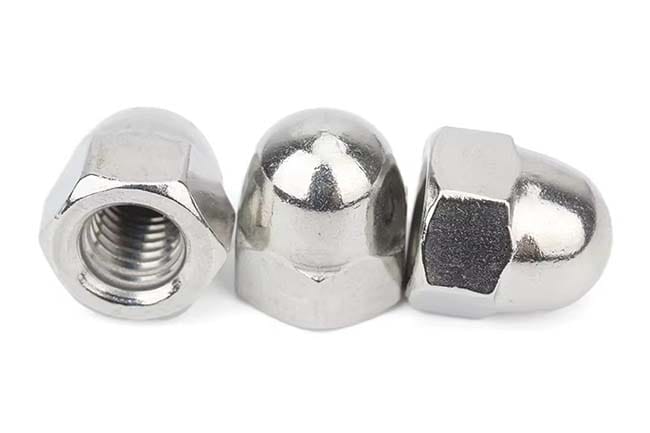
Flybear supplies standard, special, and custom industrial fastening solutions for OEM and project requirements. Buyers sourcing cap nuts can review the DIN 1587 hex domed cap nut range and provide the required thread, material, property requirement, finish, quantity, and application for technical review.
What Is a DIN 1587 Cap Nut?
A DIN 1587 cap nut combines a conventional external hexagon wrenching section with a closed dome above the internally threaded portion. Unlike an ordinary hex nut, the mating bolt or stud does not pass completely through the nut. The dome encloses the thread end once the assembly is correctly installed.
This closed-end geometry can serve several practical purposes:
- Covering exposed bolt or stud threads.
- Reducing snagging or contact with sharp thread ends.
- Protecting the covered thread end from direct contact and handling damage.
- Creating a cleaner finished appearance on visible assemblies.
- Helping keep dirt away from the enclosed portion of the thread.
A cap nut should not automatically be considered a sealing nut. The dome closes the end of the nut, but liquid or gas sealing depends on the complete thread, bearing surface, gasket or seal design, tightening condition, and application requirements.
DIN 1587 Cap Nut Standard and Current Scope
DIN 1587:2021-11 is titled “Hexagon cap nuts, high type.” The standard covers metric coarse and fine pitch thread versions from M4 through M24 and specifies product grades A and B within its scope.
| Specification Item | DIN 1587 Requirement or Buyer Consideration |
|---|---|
| Current Edition | DIN 1587:2021-11 |
| Previous Edition | DIN 1587:2014-07, now replaced |
| Nut Type | Hexagon cap nut, high type |
| Nominal Diameter Range | M4 to M24 within the standard scope |
| Thread Options | Metric coarse and specified fine pitch threads |
| Product Grades | A and B according to the applicable dimensional requirements |
DIN 1587 is a product standard covering the cap-nut form and associated technical requirements. It should not be confused with a mechanical-property standard. Material grade, nut property class, stainless steel designation, coating, and project-specific testing may require additional specifications.
Important DIN 1587 Cap Nut Dimensions
When purchasing a standard or replacement cap nut, nominal thread size alone is not enough. The dome and hexagon create additional dimensional interfaces that can affect wrench clearance, overall assembly height, available internal thread depth, and surrounding component clearance.
Important dimensions to review include:
- Nominal thread diameter and pitch: determines compatibility with the bolt or stud.
- Overall nut height: determines the total space required above the joint.
- Hexagon height: affects wrench engagement.
- Width across flats: determines wrench or socket size and radial clearance.
- Width across corners: matters where the nut sits close to surrounding features.
- Dome diameter and profile: affect external clearance and appearance.
- Usable internal thread depth: determines how far the external thread can enter before approaching the closed end.
- Thread runout or undercut geometry: can affect usable engagement near the top of the internally threaded section.
For replacement work, buyers should use the dimensions from the applicable DIN edition or approved drawing rather than relying on an old catalog table. Legacy dimensions, non-standard commercial cap nuts, and customer-specific parts can differ even when the same nominal thread is used.
Thread Depth and Bolt Projection Are Critical
The closed end is one of the most important differences between an acorn nut and an ordinary open hex nut. The bolt or stud must not bottom against the inside of the dome before the nut bearing surface properly seats against the joint.
If the external thread is too long, the end of the bolt can contact the closed portion of the nut first. An installer may then feel increasing torque even though the joint has not developed the intended clamping condition. This can create misleading assembly results and may damage the nut or external thread.
For this reason, engineers should verify:
- Length of bolt or stud projecting beyond the joint.
- Available usable internal thread depth.
- Required thread engagement.
- Any chamfer, runout, or unthreaded internal clearance.
- Joint stack-up tolerances.
This check is especially important when a standard hex nut is being replaced with a closed dome nut without changing the bolt length.
Acorn Nut, Dome Nut and Hex Cap Nut: Are They the Same?
Acorn nut, dome nut, and cap nut are commonly used market terms for nuts with a closed rounded end. However, these names do not by themselves establish DIN 1587 conformity.
A commercial acorn nut can use different dome height, hex dimensions, thread depth, material, or dimensional tolerance from a DIN 1587 product. Some cap nuts may also use lower profiles, decorative geometries, sheet-metal constructions, or two-piece designs.
If DIN 1587 is required by the drawing, purchase order, or customer specification, buyers should state the standard and edition rather than relying only on the words “dome nut” or “acorn nut.”
Carbon Steel DIN 1587 Cap Nuts
Carbon or alloy steel cap nuts are widely used in general machinery and industrial assemblies where the selected material and mechanical properties meet the joint requirement. Steel versions can also be supplied with different surface treatments for appearance and corrosion protection.
Mechanical-property requirements should be treated separately from the dimensional standard. ISO 898-2:2022 provides mechanical and physical property requirements for applicable carbon and alloy steel nuts with specified property classes within its scope.
Buyers should therefore avoid specifying only “DIN 1587 steel.” Where loadability matters, state the required material or nut property class and confirm compatibility with the mating bolt or stud.
Stainless Cap Nut Selection
A stainless cap nut is often selected where corrosion resistance, appearance, hygiene, or compatibility with stainless assemblies is important. Suitable options can include different austenitic or other stainless grades depending on the specification.
ISO 3506-2:2020 provides mechanical and physical property requirements for corrosion-resistant stainless steel nuts with specified grades and property classes within its scope. Material designation and mechanical-property class should therefore be specified separately from DIN 1587 geometry when required.
Stainless steel should not be described as universally corrosion-proof. Chlorides, chemicals, temperature, crevices, moisture, and contact with dissimilar metals can all affect actual corrosion behavior. The exact service environment should be provided for demanding applications.
Brass, Copper and Other Cap Nut Materials
Cap nuts are also available in brass, copper, and other non-ferrous materials for applications involving appearance, electrical properties, corrosion considerations, or specific customer requirements. These materials should not automatically be assigned the property-class system used for carbon steel nuts.
When specifying a brass or copper cap nut, buyers should state the actual material grade or approved material specification, thread, required dimensions, surface condition, and mechanical or functional requirements.
If a non-ferrous product is expected to conform fully to DIN 1587 technical requirements, confirm the applicable material provisions and documentation with the supplier rather than assuming that every commercially available dome nut is equivalent.
Surface Finishes for DIN 1587 Cap Nuts
Surface finish should be selected according to base material, corrosion exposure, appearance, thread fit, and customer specification. Depending on the application, steel cap nuts may use zinc-based finishes or other engineered coating systems, while stainless steel products may use a specified surface treatment or passivated condition. Brass or copper versions may be supplied in a natural or project-specific finish.
Buyers should avoid specifying a coating by color alone. A controlled RFQ should identify the finish or coating system, required thickness or class where applicable, corrosion-test requirement, and appearance criteria when these characteristics are important.
The final internal thread condition also matters. Coating buildup can influence thread fit, so thread acceptance should be based on the finished product when required by the specification.
Where DIN 1587 Cap Nuts Are Used
DIN 1587 cap nuts are suitable for many assemblies where an exposed thread end is undesirable or where a finished dome profile provides practical or visual advantages.
Common application areas include:
- Industrial machinery and guards.
- Automotive and transportation equipment.
- Rail equipment and interior assemblies.
- Construction machinery and fabricated structures.
- Handrails, fixtures, frames, and brackets.
- Electrical or mechanical equipment with accessible threaded ends.
- Furniture, fitness equipment, and equipment housings.
- Visible OEM assemblies requiring a finished external appearance.
For safety-related use, the cap nut should be viewed as one component in the complete assembly. Covering an exposed thread can reduce direct contact with the thread end, but it does not replace guarding, clearance, or other safety measures required by the equipment design.
DIN 1587 Cap Nut vs Standard Hex Nut
| Feature | DIN 1587 Cap Nut | Standard Hex Nut |
|---|---|---|
| Thread End | Closed by dome | Open |
| Bolt Projection | Limited by available internal depth | Can normally pass through the nut |
| External Profile | Domed finished top | Flat open top |
| Thread-End Coverage | Yes | No |
| Assembly Height | Higher because of dome | Generally lower |
| Replacement Check | Internal clearance must be verified | Less sensitive to projecting external thread length |
Quality Control for Hex Cap Nuts
Cap nut inspection should verify both the threaded nut portion and the closed dome geometry. Depending on the order specification, checks can include overall height, width across flats, dome dimensions, thread depth, Go/No-Go internal thread inspection, material verification, hardness or mechanical testing where applicable, coating thickness, surface appearance, and packaging.
The closed dome also makes internal thread depth an important inspection characteristic when bolt projection is tightly controlled. For visible products, scratches, dents, plating defects, polishing quality, and dome appearance may be included in the agreed acceptance criteria.
Flybear’s quality control process supports dimensional and thread inspection, material verification, hardness and mechanical testing where applicable, coating-thickness inspection, salt-spray testing when required, optical inspection, and final packaging checks according to agreed order requirements.
Common DIN 1587 Cap Nut Purchasing Mistakes
- Ordering only by the term “acorn nut.” Commercial acorn nuts are not automatically DIN 1587 products.
- Ignoring the standard edition. DIN 1587:2021-11 is the current edition and replaced the 2014 edition.
- Checking thread size but not internal depth. A projecting bolt can bottom inside the closed dome before the joint is properly clamped.
- Assuming DIN 1587 defines every mechanical property. Material and property-class requirements may need separate specification.
- Using “stainless” without a grade. Different stainless alloys and property classes can provide different mechanical and corrosion characteristics.
- Specifying coating by appearance only. Color does not define coating process, thickness, friction, or corrosion requirement.
- Assuming the dome creates a fluid seal. Sealing requires a specifically designed and validated joint.
- Replacing an open hex nut without checking bolt projection. Closed-end geometry changes the available internal clearance.
When a Custom Cap Nut Is Required
A standard DIN 1587 cap nut may not fit every OEM application. Projects can require a taller dome, reduced overall height, special thread depth, unusual hex size, fine pitch outside the standard requirement, custom material, decorative finish, sealing feature, or drawing-controlled geometry.
For these applications, buyers can provide a drawing or sample through Flybear’s custom fastener support. Custom cap nuts should be evaluated as drawing-controlled components rather than assumed to retain every dimensional or mechanical characteristic of a standard DIN 1587 nut.
RFQ Checklist for DIN 1587 Cap Nuts
To obtain a technically comparable quotation from an industrial nut supplier, provide:
- Applicable DIN 1587 edition or latest controlled drawing.
- Nominal thread diameter and pitch.
- Required coarse or fine thread.
- Critical overall height, dome, or thread-depth dimensions where applicable.
- Material grade or nut property class.
- Stainless steel grade or non-ferrous material specification where required.
- Surface finish, coating, polishing, or passivation requirement.
- Order quantity and expected repeat demand.
- Mating bolt or stud size and available projection.
- Application and operating environment.
- Critical appearance requirements for visible assemblies.
- Required dimensional reports, material certificates, mechanical tests, coating reports, traceability, labeling, and packaging requirements.
FAQ
What is the current DIN 1587 standard?
DIN 1587:2021-11 is the current edition for hexagon cap nuts, high type. It replaced DIN 1587:2014-07 and covers coarse and fine pitch versions from M4 to M24 within its scope.
Is a DIN 1587 cap nut the same as an acorn nut?
DIN 1587 cap nuts are commonly called acorn nuts or dome nuts, but not every commercial acorn nut conforms to DIN 1587. The standard and required dimensions should be stated when conformity is required.
Why must bolt length be checked with a cap nut?
Because the nut has a closed end. If the bolt or stud projects too far, it can bottom inside the dome before the bearing surface is fully seated, preventing the intended clamping condition.
Can DIN 1587 cap nuts be made from stainless steel?
Yes, stainless cap nuts are commonly used for suitable applications. The required stainless grade and mechanical-property class should be specified separately, and corrosion suitability should be evaluated for the actual environment.
Does a dome nut make a joint waterproof?
Not automatically. A closed dome covers the external thread end, but sealing performance depends on the complete joint, including threads, bearing surfaces, sealing elements, preload, and application conditions.
What should buyers provide for a DIN 1587 cap nut quotation?
Provide the standard or drawing, size and thread pitch, material or property requirement, finish or coating, quantity, mating bolt projection, application, critical dimensions, and required inspection or certificate documents.
Conclusion
A DIN 1587 cap nut provides a closed, domed finish for metric threaded assemblies while covering the exposed end of a bolt or stud. The current DIN 1587:2021-11 standard covers high-type cap nuts from M4 to M24 with coarse and fine pitch threads within its scope.
Successful selection requires more than choosing an M-size. Buyers should verify internal thread depth, bolt projection, overall height, wrench clearance, material, mechanical properties, surface finish, corrosion environment, and inspection requirements. The closed-end geometry makes bolt-length and thread-depth checks particularly important when replacing an ordinary open hex nut.
For standard or project-specific cap nuts, Flybear can support technical requirement review and quotation. Send your standard or drawing, size and thread, material or property class, finish or coating, quantity, application, bolt projection, and inspection requirements through the Flybear contact page.