Jam Nut vs Hex Nut: When Is a Thin Nut Useful?
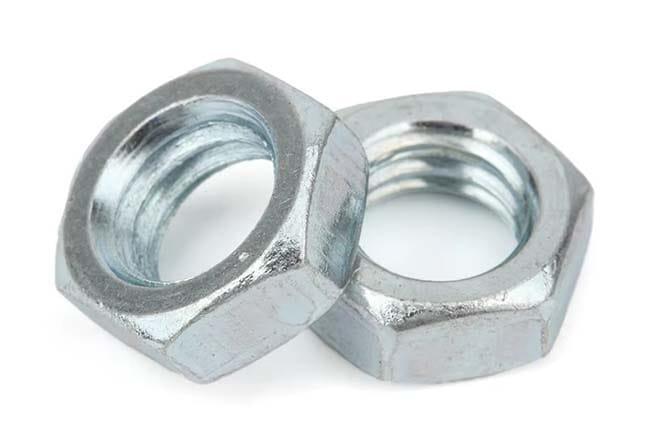
Jam nut vs hex nut selection is mainly a question of nut height, loadability, available space, and whether the thin nut is being used as part of a locking arrangement or simply because the assembly needs a low-profile nut. A standard hex nut provides greater nut height and thread engagement, while a jam nut is substantially thinner and must be evaluated differently when mechanical load is important.
For metric fasteners, ISO 4035:2023 defines hexagon thin nuts, style 0, while ISO 4032:2023 defines hexagon regular nuts, style 1. ISO 4035 specifically warns that thin nuts have reduced loadability compared with regular or high nuts and states that thin nuts used as jam nuts are to be assembled together with a regular or high nut. This means a thin nut should not automatically replace a standard hex nut merely because the thread diameter and wrench size appear compatible.
Flybear supplies standard, special, and custom industrial fastening solutions for machinery, automotive, rail, energy, construction equipment, and general assembly. Buyers comparing these nut styles can review the jam nut range and provide the required standard or drawing, thread, material or property requirement, finish, quantity, and application for technical review.
Jam Nut vs Hex Nut: Quick Comparison
| Selection Factor | Jam Nut / Thin Hex Nut | Standard Hex Nut |
|---|---|---|
| Nut Height | Reduced height | Regular height |
| Metric ISO Style | Style 0 | Style 1 |
| Typical Current Metric Standard | ISO 4035:2023 for coarse-pitch thin nuts within its scope | ISO 4032:2023 for coarse-pitch regular nuts within its scope |
| Loadability | Reduced compared with regular or high nuts | Designed for regular nut loadability within the applicable standard and property class |
| Typical Use | Jam-nut pair, adjustment, low-profile assembly, positioning | General bolted joints and primary clamping applications |
| Locking Function | Can be used with another nut in a jam-nut arrangement | Not inherently a locking nut unless another locking method is provided |
| Space Requirement | Useful where axial space is restricted | Requires more axial space |
What Is a Jam Nut?
A jam nut is a thin hex nut commonly used either as part of a two-nut locking arrangement or where reduced nut height is required. The term is widely used in both metric and inch fastener markets, although the applicable dimensional standard depends on the thread system and product specification.
In the metric ISO system, ISO 4035:2023 specifies hexagon thin nuts, style 0, in steel and stainless steel with metric coarse pitch threads from M1.6 to M64 and product grades A and B within its scope.
The standard makes an important distinction between a thin nut and a regular nut: reduced height also means reduced loadability. A thin hex nut should therefore not be considered a space-saving version of a regular nut with otherwise identical mechanical capability.
What Is a Standard Hex Nut?
A standard hex nut generally refers to a regular-height six-sided nut used as the primary internally threaded component in a bolted joint. For metric coarse-pitch applications, ISO 4032:2023 specifies hexagon regular nuts, style 1, in steel and stainless steel from M5 to M39 within its principal scope.
Regular nuts provide more internal thread engagement than thin nuts of the same nominal thread diameter. When combined with the appropriate property class and mating bolt, they are intended to provide the normal mechanical capacity associated with their applicable nut specification.
This makes a regular hex nut the more appropriate starting point when the nut is expected to carry the full specified load of a conventional bolted joint and there is no special requirement for reduced height.
Why Is a Jam Nut Thinner?
The reduced height of a jam nut serves specific assembly purposes. It allows two nuts to fit into a limited axial space, provides a compact means of locking an adjusted position, and can be useful where a full-height nut would interfere with surrounding components.
Typical uses include:
- Adjustable threaded rods and linkages.
- Machine stops and positioning mechanisms.
- Bearing or shaft adjustment systems.
- Equipment with limited axial clearance.
- Two-nut locking arrangements.
- Maintenance assemblies where a second nut is required to secure an adjusted position.
The dimensional advantage comes with an engineering tradeoff. Less nut height means fewer engaged internal threads and less material available to resist thread stripping. This is why thin nuts need separate mechanical consideration.
How Does a Jam Nut Locking Arrangement Work?
A lock jam nut arrangement uses two nuts tightened against each other on the same external thread. The interaction between the two nuts changes the forces acting on the engaged thread flanks and creates resistance to relative rotation.
ISO 4035 specifically states that thin nuts used as jam nuts should be assembled together with a regular or high nut. This is different from treating a thin nut as a standalone prevailing-torque lock nut.
The exact tightening sequence and required torque relationship should follow the approved engineering procedure for the application. Buyers should avoid assuming that simply installing two arbitrary nuts together creates a validated locking system.
A jam-nut arrangement is also different from:
- Nylon insert prevailing-torque nuts.
- All-metal prevailing-torque nuts.
- Serrated flange nuts.
- Chemical thread-locking compounds.
- Mechanical locking washers or locking plates.
Each locking method operates differently and should be selected according to the joint design and expected failure mode.
Thin Nut Loadability Is the Most Important Limitation
The main technical mistake in jam nut vs hex nut selection is assuming that the thinner nut can replace a regular nut in a high-load joint without further review.
ISO 4035:2023 warns that style 0 thin nuts have reduced loadability compared with regular and high nuts and are not designed to provide the same resistance to thread stripping. ISO 898-2:2022 also distinguishes thin nuts from regular and high nuts in its mechanical-property system.
For applicable carbon and alloy steel thin nuts, ISO 898-2 includes property classes 04 and 05. The leading zero indicates reduced loadability and helps distinguish these products from regular nut property classes such as 5, 6, 8, 10, and 12.
This distinction matters when a buyer is considering replacing a regular nut simply to save space. A thinner nut may physically fit the bolt but still be mechanically unsuitable as the primary load-carrying nut.
When Is a Low Profile Nut Useful?
A low profile nut can be useful when the available axial envelope is more restrictive than the mechanical load requirement. Examples include compact machinery, adjustment systems, instrumentation, electrical assemblies, and threaded mechanisms where the nut primarily retains a position rather than carrying the full capacity of a high-strength bolt.
Before using a thin nut, engineers should evaluate:
- Expected axial load.
- Bolt or stud property class.
- Available thread engagement.
- Risk of internal thread stripping.
- Need for repeated adjustment.
- Available wrench access.
- Whether another nut will share the locking function.
- Temperature, corrosion, and vibration conditions.
Where joint load is significant, reduced height should not take priority over mechanical compatibility.
Metric and Inch Jam Nuts Use Different Standards
Global sourcing teams frequently purchase both metric and inch thin nuts. The standard should therefore be identified explicitly in the RFQ.
For metric coarse-pitch thin nuts, ISO 4035:2023 is a current international reference within its scope. Standard metric regular nuts can be specified to ISO 4032:2023 where applicable.
For inch-series applications, ASME B18.2.2-2022 covers dimensional data for several general-purpose nut types and includes hex jam nuts as well as heavy hex jam nuts. An inch jam nut should not be converted to a nominally similar metric thin nut because thread diameter, pitch, geometry, and tolerance systems differ.
Legacy drawings may also reference older DIN specifications or customer-specific dimensions. When replacement parts are being sourced, the original drawing should be checked before changing to a current ISO or ASME designation.
Thread Pitch Must Match the Bolt or Stud
A thin nut and regular nut in a jam-nut pair must have compatible threads with the same bolt or stud. Confirm the thread system, nominal diameter, pitch, and tolerance requirements rather than relying only on wrench size or outside dimensions.
Metric coarse and fine threads of the same nominal diameter are not interchangeable. The same principle applies to UNC and UNF inch threads.
For adjustment mechanisms, fine threads may sometimes be selected to provide smaller axial movement per revolution, but this should be an intentional design choice rather than an assumption based on the term “jam nut.”
Material and Property Class Selection
The dimensional description “thin hex nut” does not define the material or mechanical properties. Buyers should separately state the required carbon steel, alloy steel, stainless steel, or other controlled material requirement.
Carbon and Alloy Steel
ISO 898-2:2022 provides the current mechanical-property framework for applicable carbon and alloy steel nuts, including thin style 0 nuts. The selected mechanical properties should match the actual role of the nut and the mating fastener.
If a thin nut is used only as part of a jam pair, its mechanical requirement may differ from a regular primary nut, but that decision should be defined by the engineering specification rather than left to the supplier to assume.
Stainless Steel
ISO 3506-2:2020 remains current for corrosion-resistant stainless steel nuts with specified grades and property classes within its scope and includes thin, regular, and high nut styles.
Stainless steel selection should consider the actual environment. Chlorides, industrial chemicals, temperature, crevices, and contact with dissimilar metals can affect corrosion performance. Stainless threaded assemblies can also require attention to friction and galling.
Coatings and Finishes
Steel jam nuts and regular hex nuts may use zinc plating, zinc-flake systems, black oxide, hot-dip galvanizing where applicable, or other specified finishes. Coating choice should consider corrosion protection, thread fit, friction, appearance, and compatibility with the mating bolt or stud.
Because thin nuts provide less axial thread engagement, correct finished thread condition is particularly important. Excessive coating buildup should not be allowed to create poor thread fit or difficult assembly.
For torque-sensitive applications, changes in coating or lubrication can also change the torque-to-preload relationship. A previously validated tightening procedure should therefore be reviewed when surface conditions change.
Jam Nut vs Hex Nut Selection Guide
| Application Requirement | Option to Evaluate First | Reason |
|---|---|---|
| Primary load-carrying nut in a general bolted joint | Standard Hex Nut | Regular nut height provides greater thread engagement and normal loadability |
| Two-nut locking arrangement | Jam Nut + Regular or High Nut | ISO 4035 specifically addresses thin nuts used with another nut as jam nuts |
| Very limited axial space | Thin Hex Nut | Reduced height may fit where a regular nut cannot, subject to load review |
| Adjustment or positioning mechanism | Jam Nut | Useful for securing an adjusted threaded position |
| High bolt load | Regular or High Nut | A thin nut should not automatically replace a full-load nut |
| Repeated adjustment | Application-Specific Review | Consider wrench access, thread wear, coating, and locking method |
| Existing inch-series equipment | ASME / Original Drawing | Do not substitute metric thin nuts for inch jam nuts |
Common Purchasing Mistakes
- Using a jam nut as a direct replacement for a regular nut. Thin nuts have reduced loadability and require mechanical review.
- Assuming every thin nut is automatically a locking nut. A thin nut generally provides a locking function as part of a defined jam-nut arrangement.
- Ignoring thread pitch. Nominal diameter alone does not establish thread compatibility.
- Specifying only “M12 jam nut.” Standard, pitch, material, property requirements, finish, and quantity may still be needed.
- Confusing nut height with property class. Geometry and mechanical properties are separate specification items.
- Applying regular-nut load assumptions to a style 0 nut. ISO standards explicitly distinguish thin-nut loadability.
- Mixing metric and inch standards. ISO and ASME nut systems should be specified according to the mating thread.
- Changing coating without reviewing thread fit and tightening conditions. Surface treatment can affect both assembly and friction.
Quality Control for Thin and Regular Hex Nuts
Inspection should be based on the applicable standard, drawing, and project risk. Relevant checks can include nut height, width across flats, internal thread Go/No-Go gauging, material verification, hardness or proof-load-related testing where required, coating thickness, appearance, marking, and packaging.
For a low-profile application, nut height can be a critical dimension because even a small increase may cause interference with an adjacent component. For jam-nut systems, the buyer may also need to inspect the complete assembled configuration rather than only each nut individually.
Flybear’s quality control process supports dimensional and thread inspection, material verification, hardness and mechanical testing, coating inspection, salt-spray testing when required, optical inspection, and final packaging review according to agreed project requirements.
When a Custom Thin Nut Is Required
Standard jam nuts do not fit every assembly. OEM designs may require special nut height, fine pitch thread, unusual width across flats, reduced outside envelope, non-standard material, controlled coating, special chamfers, or customer-specific tolerances.
For these requirements, buyers can provide the latest approved drawing through Flybear’s custom fastener support. A custom low profile nut should be evaluated as a drawing-controlled component rather than assumed to retain the loadability of a standard ISO regular nut.
RFQ Checklist for Jam Nuts and Standard Hex Nuts
To obtain a technically comparable quotation from an industrial nut supplier, provide:
- Applicable ISO, ASME, DIN legacy reference, or controlled drawing.
- Whether a thin jam nut or regular hex nut is required.
- Metric or inch thread designation.
- Nominal diameter and pitch or TPI.
- Required nut height where clearance is critical.
- Material and property class or stainless steel grade.
- Mating bolt or stud specification.
- Surface finish, coating, lubrication, or corrosion requirement.
- Order quantity and expected repeat demand.
- Application and whether the nut is used for primary clamping, adjustment, or locking.
- Expected load, vibration, temperature, and environmental conditions where relevant.
- Critical dimensional tolerances.
- Inspection reports, material certificates, mechanical test documents, coating reports, traceability, labeling, and packaging requirements.
FAQ
What is the difference between a jam nut and a standard hex nut?
A jam nut is a thinner hex nut with reduced height and reduced loadability compared with a regular hex nut. It is commonly used in two-nut locking arrangements, adjustment systems, or assemblies with limited axial space.
Can a jam nut replace a standard hex nut?
Not automatically. ISO 4035 warns that thin style 0 nuts have reduced loadability compared with regular and high nuts. The joint load and thread-stripping risk should be reviewed before substitution.
Does a jam nut lock by itself?
A thin nut should not simply be assumed to provide a locking function by itself. When used as a jam nut, ISO 4035 specifies assembly together with a regular or high nut.
What is the current ISO standard for metric jam nuts?
ISO 4035:2023 is the current international product standard for hexagon thin nuts, style 0, with metric coarse pitch threads within its stated scope. Thin nuts used as jam nuts are intended to be assembled with a regular or high nut.
What is the current ISO standard for regular metric hex nuts?
ISO 4032:2023 is the current standard for hexagon regular nuts, style 1, in steel and stainless steel with metric coarse pitch threads within its stated scope.
What should buyers provide for a thin hex nut quotation?
Provide the standard or drawing, thread size and pitch, required height, material or property requirement, coating, quantity, mating fastener, application, critical tolerances, and required inspection or certificate documents.
Conclusion
The jam nut vs hex nut decision should begin with the mechanical role of the nut. A standard hex nut is the normal choice for primary clamping and full regular-nut loadability, while a thin jam nut is useful for two-nut locking arrangements, adjustment mechanisms, and applications where axial space is restricted.
The reduced height of a jam nut is not a free dimensional advantage. Current ISO standards clearly distinguish style 0 thin nuts from style 1 regular nuts and warn that thin nuts have reduced loadability. Buyers should therefore verify the thread, load, nut height, mating fastener, material, property requirements, coating, and locking method before approving a substitution.
For standard or project-specific jam nuts and low-profile nut requirements, Flybear can support technical review and quotation. Send your standard or drawing, thread size and pitch, required nut height, material or property class, finish or coating, quantity, application, and inspection requirements through the Flybear contact page.