DIN 980 Lock Nut Guide: All-Metal Types, Features and Applications
A DIN 980 lock nut is a legacy all-metal prevailing torque hexagon nut used where the joint requires resistance to unintended rotation without relying on a nylon or other non-metallic locking insert. These nuts are commonly encountered on machinery, automotive equipment, rail systems, energy equipment, construction machinery, and older European OEM drawings.
DIN 980:1987-05 is no longer a current DIN standard. DIN Media lists it as withdrawn and identifies DIN EN ISO 7042 and DIN EN ISO 10513 in its replacement path. Current international references include ISO 7042:2025 for high all-metal prevailing torque hexagon nuts with coarse metric threads and ISO 10513:2025 for high all-metal prevailing torque hexagon nuts with fine metric threads.
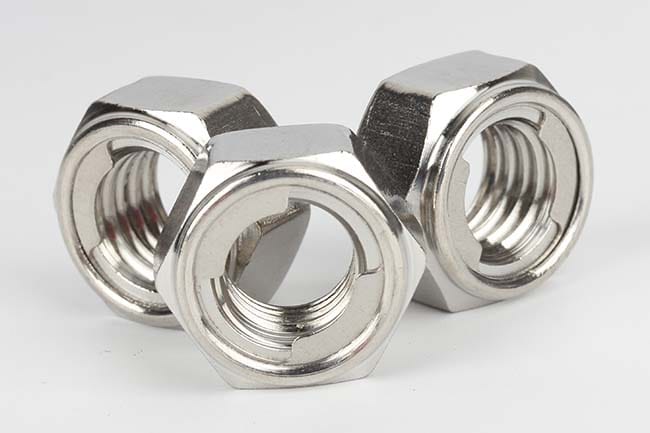
For industrial buyers, this means a request for “DIN 980” should be treated as a legacy specification that needs technical review. The thread, nut geometry, locking mechanism, material or property class, coating, prevailing torque requirement, mating bolt, temperature, and inspection scope should all be confirmed before approving a replacement.
Flybear supplies standard, special, and custom industrial fastening solutions for OEM and project requirements. Buyers sourcing legacy or current all-metal lock nuts can provide the applicable standard or drawing, size and thread, material, finish, quantity, application, and inspection requirements for technical review.
What Is a DIN 980 Lock Nut?
DIN 980 covered all-metal prevailing torque hexagon nuts. Unlike a conventional free-spinning hex nut, an all metal prevailing torque nut contains a metallic locking feature that creates resistance as it engages the mating external thread.
The locking action begins before full clamp load is developed. This resistance is called prevailing torque. It is different from the tightening torque required to generate clamp force after the nut reaches its bearing surface.
Because the locking element is metallic, the design does not depend on a polymer insert. This is one reason metal lock nuts are often evaluated for applications involving temperature, chemicals, oils, or other conditions where a non-metallic locking element may be unsuitable.
However, all-metal construction does not mean unlimited temperature capability, unlimited reuse, or universal vibration resistance. Actual performance depends on the applicable product and functional standards, material, thread, coating, mating bolt, installation conditions, and service environment.
DIN 980 Is a Withdrawn Legacy Standard
DIN 980:1987-05 is withdrawn. Its historical replacement path separates coarse- and fine-pitch applications into ISO-based standards.
| Standard | Status / Scope | Buyer Consideration |
|---|---|---|
| DIN 980:1987-05 | Withdrawn legacy standard for all-metal prevailing torque hexagon nuts | Common on older drawings; verify the exact original geometry and locking form |
| ISO 7042:2025 | Current high all-metal prevailing torque hexagon nuts with metric coarse pitch thread M5–M39 | Key current standard to evaluate for applicable coarse-pitch legacy requirements |
| ISO 10513:2025 | Current high all-metal prevailing torque hexagon nuts with metric fine pitch thread in its specified range | Relevant current reference for applicable fine-pitch requirements |
| ISO 7719:2025 | Current regular all-metal prevailing torque hexagon nuts with metric coarse pitch thread M5–M39 | Useful for new designs requiring a regular rather than high nut form; not an automatic DIN 980 replacement |
| ISO 2320:2015 | Current functional-property standard for prevailing torque steel nuts within its scope | Addresses prevailing torque and torque/clamp-force testing rather than basic nut dimensions alone |
The important point is that a modern replacement should be selected according to the required geometry and thread, not simply by choosing any product marketed as an “equivalent DIN 980 lock nut.”
Common Legacy DIN 980 Lock Nut Types
Commercial catalogs and legacy drawings commonly identify DIN 980 all-metal lock nuts using forms such as DIN 980 V and DIN 980 M. These descriptions are still widely used in the fastener market even though DIN 980 itself has been withdrawn.
DIN 980 V-Type Locking
A commonly supplied DIN 980 V-style nut uses a one-piece all-metal construction in which the locking zone is created by controlled deformation of the upper threaded portion of the nut. The deformed region interferes with the mating bolt thread and creates prevailing torque during installation and removal.
Flybear’s current DIN980V all-metal lock nut example uses a three-point end-face deformation locking structure. This type of design illustrates how the nut itself can provide the locking feature without a separate nylon insert.
DIN 980 M-Type Locking
Legacy market terminology also includes DIN 980 M-type nuts, which are commonly described as two-piece all-metal designs using a separate metallic locking element. This construction differs from one-piece deformed-thread designs even though both may be sold under the broader DIN 980 legacy family.
Because suppliers may use different legacy form descriptions and locking constructions, buyers should not specify only “DIN 980 M” or “DIN 980 V” when the locking geometry is critical. An approved drawing, product specification, or reference sample can remove ambiguity.
How Does an All-Metal Prevailing Torque Nut Work?
An ordinary hex nut can rotate relatively freely along a compatible bolt thread until its bearing surface contacts the joint. An all-metal prevailing torque nut intentionally introduces interference between part of the nut thread or locking element and the mating external thread.
During installation, the wrench must overcome this resistance in addition to the torque required to tighten the joint. During removal, the locking feature continues to create rotational resistance after clamp load has been released.
This feature can help resist unintended nut rotation, but prevailing torque should not be confused with joint preload. Proper clamp load still depends on the complete fastening system, including the bolt, nut, joint stiffness, friction, lubrication, coating, tightening procedure, and external loads.
Why Choose an All-Metal Lock Nut Instead of a Nylon Insert Nut?
The absence of a polymer locking element is the main functional difference. It can be advantageous where temperature or chemical compatibility limits the use of a non-metallic insert.
ISO 2320:2015 notes that all-metal nuts conforming to its requirements are used in applications ranging from -50 °C to +150 °C, while non-metallic insert types conforming to the same functional standard are noted for -50 °C to +120 °C. These values should not be interpreted as universal ratings for every lock nut or every coating system.
For a high temperature lock nut application, the buyer should still specify the actual continuous and peak temperatures. Material strength, oxidation, coating stability, lubrication, mating components, and thermal cycling may become important even when the locking mechanism itself contains no polymer.
Applications for DIN 980-Style All-Metal Lock Nuts
All-metal prevailing torque nuts are commonly evaluated for joints where vibration, shock, temperature, or environmental conditions make a free-spinning nut or polymer-insert design less suitable.
Typical application areas can include:
- Industrial machinery and production equipment.
- Automotive and commercial vehicle assemblies.
- Rail and transportation equipment.
- Construction and heavy machinery.
- Energy and power equipment.
- Engine-adjacent or heated mechanical assemblies.
- Pumps, compressors, and rotating equipment.
- Outdoor equipment requiring specified corrosion protection.
Application alone does not determine suitability. A rail, automotive, or machinery project can have customer-specific locking, traceability, testing, or documentation requirements that go beyond the basic DIN or ISO product designation.
Coarse vs Fine Thread Requirements
Thread pitch must be checked carefully when replacing a DIN 980 nut. Current standards distinguish coarse and fine metric thread applications.
ISO 7042:2025 covers high all-metal prevailing torque hexagon nuts with coarse metric threads from M5 to M39 within its scope. ISO 10513:2025 covers high all-metal prevailing torque hexagon nuts with metric fine pitch threads from 8 mm to 39 mm nominal diameter within its scope.
Nominal diameter alone is not enough. An M12 coarse-thread nut and an M12 fine-thread nut cannot be substituted for each other. The RFQ should state the complete thread designation, especially for maintenance parts and legacy machinery.
Regular vs High All-Metal Lock Nuts
Modern ISO standards also distinguish regular and high nut forms. ISO 7719:2025 covers regular all-metal prevailing torque nuts with coarse pitch thread, while ISO 7042:2025 covers high all-metal prevailing torque nuts.
Nut height influences thread engagement, wrenching geometry, available assembly space, and the applicable mechanical requirements. A regular-height nut should not automatically replace a high nut because the nominal thread size is identical.
For a legacy DIN 980 drawing, measure or verify the specified nut height and wrenching dimensions before selecting a current-standard replacement.
Material and Property Class Selection
Dimensional and locking standards do not replace the mechanical-property specification. Carbon and alloy steel nuts should use a property class compatible with the mating bolt or stud and the joint design.
ISO 898-2:2022 is the current ISO mechanical-property standard for applicable carbon and alloy steel nuts. Where a current all-metal product standard allows different property classes, the required class should be stated in the RFQ instead of assumed from the DIN 980 name.
Stainless steel all-metal lock nuts may also be used where corrosion resistance is important. For applicable stainless steel nuts, ISO 3506-2 provides the relevant mechanical-property framework. Buyers should specify the actual stainless grade and property class where these are controlled.
Stainless steel prevailing torque joints also require attention to friction and galling. Material combination, surface finish, lubrication where permitted, installation speed, and repeated assembly can affect thread behavior.
Coatings and Surface Finish
Steel metal lock nuts can be supplied with zinc-based plating, zinc-flake systems, hot-dip galvanizing where technically appropriate, black finishes, or other project-specific surface treatments.
The coating should be considered together with the prevailing-torque feature because surface treatment can influence:
- Thread fit.
- Prevailing torque.
- Torque-to-clamp-force relationship.
- Corrosion resistance.
- Coefficient of friction.
- Mating bolt compatibility.
If an approved assembly was developed with one coating and lubrication condition, changing the finish without validation can change tightening behavior. Buyers should therefore specify the required surface system rather than ordering by color alone.
Can DIN 980 Lock Nuts Be Reused?
All-metal lock nuts should not be described as infinitely reusable. Repeated installation and removal can change the locking feature, mating bolt thread, coating, and resulting prevailing torque.
ISO 2320 includes functional testing of prevailing torque nuts, but actual values in an application can differ from laboratory conditions. If an OEM expects repeated maintenance cycles, the required reuse condition and minimum functional performance should be defined in the engineering specification or maintenance procedure.
For critical service work, do not assume that a nut removed from one joint can automatically be reinstalled simply because the locking feature still feels tight by hand.
DIN 980 Lock Nut Selection Matrix
| Application Requirement | Option to Evaluate | Reason |
|---|---|---|
| Legacy DIN 980 coarse-pitch drawing | ISO 7042:2025 or verified legacy part | Current high all-metal coarse-pitch reference, subject to dimensional verification |
| Legacy DIN 980 fine-pitch drawing | ISO 10513:2025 or verified legacy part | Current high all-metal fine-pitch reference within its scope |
| New design requiring regular-height all-metal nut | ISO 7719:2025 | Current regular all-metal coarse-pitch product standard |
| Polymer insert unsuitable because of temperature | All-metal prevailing torque nut | Eliminates the non-metallic locking insert, subject to full temperature review |
| Chemical exposure incompatible with insert material | All-metal design | Removes the polymer locking element while material and coating compatibility still require review |
| Frequent maintenance removal | Application-specific review | Prevailing torque can change after repeated cycles |
| Legacy Form M or Form V requirement | Drawing-based verification | Locking construction can differ even within DIN 980 market terminology |
Quality Control for All-Metal Lock Nuts
Inspection should cover both ordinary nut characteristics and the functional locking feature. Depending on the project, relevant checks can include nut dimensions, internal thread Go/No-Go gauging, locking-zone geometry, material verification, hardness or other mechanical testing, coating thickness, surface condition, and prevailing-torque testing.
Functional testing matters because a nut can have acceptable external dimensions while the locking deformation or metallic insert does not produce the specified torque behavior.
Flybear’s quality control process supports dimensional and thread inspection, material verification, hardness and mechanical testing, torque testing, coating-thickness inspection, salt-spray testing when required, optical inspection, and final shipment checks according to agreed requirements.
Common Purchasing Mistakes
- Treating DIN 980 as a current standard. DIN 980:1987-05 is withdrawn.
- Ordering “DIN 980” without a form or drawing. Legacy market products can use different all-metal locking constructions.
- Ignoring coarse vs fine pitch. Current ISO replacement paths differ according to thread pitch.
- Assuming every all-metal lock nut has unlimited temperature resistance. The complete nut material, coating, lubrication, and application conditions matter.
- Using prevailing torque as a substitute for correct preload. Locking resistance and clamp load are different characteristics.
- Changing coatings without validation. Surface treatment can change friction and functional torque.
- Assuming unlimited reuse. Prevailing torque can decline or otherwise change with repeated cycles.
- Ignoring the mating bolt. Property class, thread, coating, hardness, and condition of the external thread affect the assembly.
When a Custom Metal Lock Nut Is Needed
Legacy machinery and specialized OEM applications may require a DIN 980-style nut with non-standard height, special fine pitch, unusual locking deformation, controlled prevailing torque, specific coating, stainless material, or customer-specific dimensions.
For these applications, buyers can submit a drawing or sample through Flybear’s custom fastener support. Drawing-based requirements should define thread and dimensions while the RFQ separately identifies material, property class, surface treatment, mating fastener, locking requirements, and inspection criteria.
RFQ Checklist for DIN 980 All-Metal Lock Nuts
To obtain a technically comparable quotation from an industrial nut supplier, provide:
- DIN 980 legacy designation, current ISO standard, or approved drawing.
- Required legacy form or locking construction if applicable.
- Nominal thread diameter and coarse or fine pitch.
- Nut height and other critical dimensions.
- Material and property class or stainless steel grade.
- Mating bolt or stud specification and property class.
- Surface coating, finish, and lubrication requirements.
- Order quantity and expected repeat demand.
- Continuous and peak operating temperature where relevant.
- Chemical, moisture, salt, or other environmental exposure.
- Vibration, shock, or dynamic loading conditions.
- Expected installation and removal cycles.
- Required prevailing-torque or functional tests.
- Material certificates, inspection reports, coating reports, traceability, labeling, and packaging requirements.
FAQ
Is DIN 980 still a current standard?
No. DIN 980:1987-05 is withdrawn. It remains widely referenced on legacy European drawings and in commercial fastener terminology, so replacement parts should be reviewed against current standards or the original approved drawing.
What replaced DIN 980?
DIN Media identifies DIN EN ISO 7042 and DIN EN ISO 10513 in the historical replacement path. Current international editions are ISO 7042:2025 for high all-metal coarse-pitch nuts and ISO 10513:2025 for high all-metal fine-pitch nuts within their respective scopes.
What is the difference between DIN 980 V and DIN 980 M?
In common legacy market terminology, V-type products are typically one-piece nuts using controlled deformation of the locking thread, while M-type products commonly use a separate metallic locking element. Buyers should confirm the actual drawing or supplier specification because DIN 980 is withdrawn and legacy implementations can differ.
Are DIN 980 nuts suitable for high temperatures?
All-metal construction avoids the temperature limitation of a nylon locking insert. ISO 2320 notes a -50 °C to +150 °C application range for all-metal nuts conforming to its requirements, but actual suitability must also consider material, coating, lubrication, joint design, and the real operating temperature.
Can an all-metal lock nut be reused?
Reuse should not be assumed without functional verification. Repeated installation and removal can change prevailing torque, locking geometry, coating, and mating-thread condition.
What should buyers include in a DIN 980 lock nut RFQ?
Provide the standard or drawing, thread size and pitch, locking form, material or property class, coating, mating bolt specification, quantity, temperature and environment, functional torque requirements, and required inspection or certificate documents.
Conclusion
A DIN 980 lock nut remains common in industrial sourcing because many legacy machines and OEM drawings still reference the withdrawn DIN standard. Its all-metal prevailing torque design can be useful where vibration, temperature, or environmental conditions make a conventional free-spinning nut or non-metallic insert less suitable.
For current procurement, however, DIN 980 should not be treated as an active standard. Buyers should identify whether the application requires coarse or fine pitch, regular or high nut geometry, and the specific all-metal locking construction. ISO 7042:2025, ISO 10513:2025, ISO 7719:2025, and ISO 2320:2015 provide relevant current references for different product and functional requirements.
For standard or project-specific all-metal lock nuts, Flybear can support technical requirement review and quotation. Send your standard or drawing, size and thread, locking type, material or property class, finish or coating, quantity, operating environment, and inspection requirements through the Flybear contact page.