Serrated vs Plain Flange Nut: Which Should Industrial Buyers Choose?
Serrated vs plain flange nut selection affects locking behavior, mating-surface condition, assembly friction, serviceability, and purchasing requirements. Both designs combine a hex nut with an enlarged integral flange, but the underside of the flange changes how the nut interacts with the joint. A serrated flange nut uses teeth or serrations to engage the mating surface, while a plain flange nut uses a smooth bearing face.
For OEM buyers, neither design is universally better. Serrations can help resist nut rotation when the mating surface can accept localized biting or marking. A smooth flange distributes bearing pressure without intentionally cutting into the surface and is often more appropriate where coatings, softer materials, appearance, or repeated removal matter.
The standard designation also requires care. DIN 6923:1983-06, historically used for hexagon nuts with flange, has been withdrawn. ISO 4161:2012 remains a current international standard for hexagon nuts with flange, style 2, with metric coarse threads from M5 to M20 within its scope. Buyers should still state explicitly whether the flange underside must be serrated or plain rather than relying on a standard number alone.
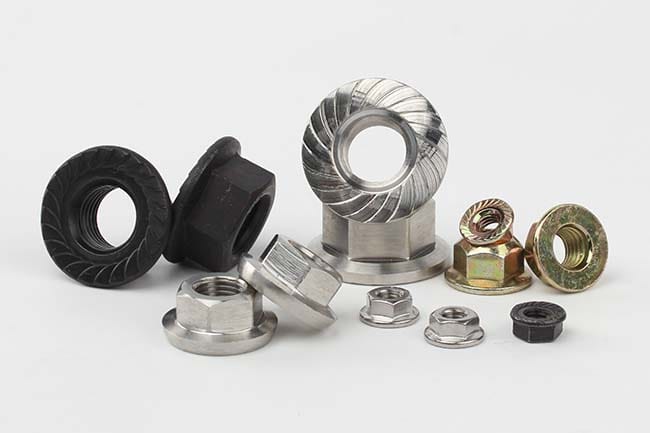
Flybear supplies standard, special, and custom industrial fastening solutions for machinery, automotive, rail, energy, construction equipment, and general OEM assembly. Buyers comparing these designs can review the flange nut range and provide the required standard or drawing, thread, serration requirement, material or property class, coating, quantity, and application for technical review.
Serrated vs Plain Flange Nut: Quick Comparison
| Selection Factor | Serrated Flange Nut | Plain Flange Nut |
|---|---|---|
| Flange Underside | Contains teeth or radial serrations | Smooth bearing surface |
| Anti-Rotation Action | Serrations can engage the mating surface after seating | Relies primarily on clamp load and joint friction unless another locking method is specified |
| Surface Marking | Can scratch, indent, or disturb coatings | Generally less aggressive to the mating surface |
| Soft Materials | Requires careful review because teeth may embed or damage the surface | Often easier to use where surface damage should be limited |
| Painted or Coated Surfaces | Can break through or disturb the finish | Better suited when preserving the coating is important |
| Repeated Removal | Original serration contact condition may change after removal | Generally more suitable where repeated service is expected, subject to the complete joint design |
| Typical Selection Priority | Additional resistance to rotation through flange-to-surface engagement | Load distribution and surface protection without serrated biting action |
What Is a Hex Flange Nut?
A hex flange nut combines a conventional hexagonal wrenching section with an enlarged circular flange beneath it. The flange increases the bearing area compared with a standard hex nut and can reduce the need for a separate flat washer in suitable assemblies.
The integrated flange can simplify high-volume production because the assembler handles one fastener rather than a separate nut and washer. It can also help bridge certain clearance holes and spread contact pressure over a larger area.
However, the flange does not mean that a washer is unnecessary in every joint. Oversized slots, very soft materials, sealing requirements, electrical isolation, special bearing conditions, or customer specifications may still require another component or a different fastening arrangement.
How a Serrated Flange Nut Works
A serrated flange nut has teeth formed on the bearing face of the flange. As the nut reaches the mating surface and is tightened, these serrations can engage the surface and create additional resistance to reverse rotation.
This is fundamentally different from a prevailing torque lock nut. A prevailing torque nut produces rotational resistance through its thread or locking element before the nut is fully seated. A typical serrated flange nut can rotate relatively freely along the mating thread until its flange contacts the joint.
Therefore, flange nut locking through serrations should be understood as a surface-engagement mechanism rather than a thread-based prevailing torque mechanism.
Serrated flange nuts are commonly evaluated for:
- Machinery brackets and frames.
- Automotive and transportation assemblies.
- Sheet-metal structures.
- Construction and agricultural equipment.
- Guards and support brackets.
- Assemblies exposed to vibration where surface engagement is acceptable.
Serrations Need a Suitable Mating Surface
The effectiveness of serrations depends on the surface they contact. Tooth geometry, mating material hardness, coating thickness, clamp load, installation torque, and surface condition all influence the interaction.
On a relatively soft metal surface, the serrations may create visible indentation. On a hard mating surface, the same teeth may engage differently. Buyers should avoid universal statements that a serrated flange nut always provides a fixed level of vibration resistance regardless of the joint.
How a Plain Flange Nut Works
A plain flange nut has a smooth underside without intentional locking teeth. Its flange provides an enlarged bearing surface while minimizing concentrated biting action against the component.
This makes plain flange nuts useful when the designer wants the assembly and load-distribution advantages of an integrated flange but does not want serrations to damage the mating material or surface treatment.
Typical applications can include:
- Painted or powder-coated components.
- Aluminum and other relatively soft mating materials.
- Finished equipment surfaces.
- Assemblies requiring periodic adjustment.
- Maintenance joints involving repeated removal.
- Applications using another approved locking method.
A smooth flange should not be described as providing the same locking mechanism as a serrated flange. If loosening resistance is a critical requirement, the engineering team should establish an appropriate locking strategy for the complete joint.
DIN 6923 Flange Nut: Current Standard Status
DIN 6923 is still widely used in supplier catalogs and legacy OEM drawings, but DIN 6923:1983-06 is a withdrawn standard. DIN Media records DIN EN 1661:1998-02 as its replacement document.
Because DIN 6923 remains common in commercial sourcing language, buyers may still receive quotations described as “DIN 6923 flange nuts.” This is particularly common for maintenance parts or products based on long-established European dimensions.
The important sourcing rule is not to assume that the old DIN designation completely defines the product being offered. State whether the required bearing surface is serrated or smooth and verify the dimensions, thread, material, property class, and finish against the approved specification.
How ISO 4161 Fits into Flange Nut Sourcing
ISO 4161:2012 is currently published and specifies hexagon nuts with flange, style 2, with metric coarse threads from M5 through M20. It specifies product grade A for threads up to and including M16 and product grade B above M16 within its stated scope.
ISO 4161 is a product standard rather than a complete statement of every mechanical and surface requirement. Mechanical properties, stainless steel grade, coating, lubrication, and project-specific locking requirements may be controlled by other standards or purchasing specifications.
Buyers should also avoid stating that DIN 6923 and ISO 4161 are universally interchangeable. A legacy drawing may contain dimensional, thread, finish, serration, or customer-specific requirements that must be checked before a substitution is approved.
Surface Damage Is a Major Selection Factor
The biggest practical disadvantage of a serrated flange nut is its effect on the mating surface. Serrations are intended to interact mechanically with that surface, so visible marking or localized coating damage can be a normal consequence of tightening.
This matters when the component is:
- Painted or powder coated.
- Decorative or externally visible.
- Made from soft aluminum or another easily marked material.
- Protected by a corrosion-control coating that should remain continuous.
- Designed for frequent repositioning.
Breaking through a protective finish can expose the underlying material. Whether that creates a meaningful corrosion risk depends on the materials, coating system, environment, joint geometry, and maintenance conditions.
Where preserving the mating finish is important, a plain flange nut is generally a more appropriate starting point for engineering evaluation.
Which Type Is Better for Vibration?
Serrated flange nuts are frequently selected for vibration-exposed assemblies because the teeth can resist relative rotation after they engage the mating surface. However, vibration resistance is a property of the complete joint, not simply the presence of serrations.
Joint behavior also depends on:
- Initial clamp load.
- Joint stiffness.
- Transverse movement.
- Bolt and nut property classes.
- Mating-surface hardness.
- Coating and lubrication.
- Installation procedure.
- External cyclic loading.
A serrated flange nut should therefore not automatically replace a prevailing torque nut, chemical locking system, or another engineered locking solution. The appropriate method depends on the failure mode and application specification.
Can Serrated Flange Nuts Be Reused?
Reuse should be considered carefully. During the first tightening cycle, serrations can create a contact pattern in the mating surface. After removal, reinstalling the nut may not reproduce the same tooth-to-surface interaction, especially if the coating or base material has already been displaced.
The serrations themselves can also experience wear or deformation depending on their hardness and the mating surface.
This does not justify a universal statement that every serrated flange nut is single-use. Instead, reuse requirements should follow the applicable customer specification, engineering validation, maintenance procedure, or functional test requirement.
Where frequent removal is expected, a smooth flange design combined with an appropriate reusable locking strategy may be easier to manage.
Material and Property Class Selection
The flange style does not define nut strength. Buyers must specify the required material and mechanical property class separately.
Carbon and Alloy Steel
For applicable carbon and alloy steel nuts, ISO 898-2:2022 provides current mechanical and physical property requirements for specified nut property classes within its scope. The nut property class should be compatible with the mating bolt, screw, or stud and the joint requirement.
A request such as “M10 serrated flange nut” is therefore incomplete when mechanical performance is important. The property class, thread, finish, and mating fastener should also be identified.
Stainless Steel
Stainless flange nuts may be selected where corrosion resistance is required. ISO 3506-2:2020 remains current for corrosion-resistant stainless steel nuts with specified grades and property classes within its scope.
Buyers should specify the required stainless grade rather than relying only on the word “stainless.” Corrosion behavior varies with alloy, chloride exposure, chemicals, temperature, crevices, and contact with other metals.
Coatings and Their Interaction with Serrations
Steel flange nuts may use zinc-based plating, zinc-flake systems, black finishes, or other project-specific treatments. Finish selection should consider corrosion protection, friction, thread fit, appearance, and compatibility with the mating fastener.
Serrated versions introduce another issue: the teeth may disturb the coating on the mating component during tightening. This means corrosion requirements should be evaluated at the assembled-joint level rather than from the nut coating alone.
Coating and lubrication can also influence tightening friction. If an approved assembly torque was developed with a particular surface system, changing the nut finish can alter the relationship between applied torque and achieved clamp load.
Serrated vs Plain Flange Nut Selection Matrix
| Application Requirement | Option to Evaluate First | Reason |
|---|---|---|
| Additional surface-based resistance to rotation | Serrated Flange Nut | Teeth can engage a suitable mating surface after seating |
| Painted or finished surface should remain intact | Plain Flange Nut | Smooth bearing surface reduces intentional biting action |
| Soft aluminum component | Plain Flange Nut | Reduces risk of aggressive local indentation, subject to joint design |
| Frequent removal and adjustment | Plain Flange Nut | Avoids reliance on the original serration contact pattern |
| Vibration-sensitive machinery | Engineering Review | Serrations may help, but the complete anti-loosening strategy must be validated |
| Legacy DIN 6923 drawing | Verify Original Requirement | Confirm whether the intended flange face is smooth or serrated before substitution |
| New current-standard design | ISO / Drawing Review | Define current dimensional standard plus explicit bearing-surface and locking requirements |
Quality Control for Hex Flange Nuts
Inspection should cover the nut geometry as well as any functional serration features. Depending on the order, relevant checks can include thread Go/No-Go gauging, nut height, width across flats, flange diameter and thickness, material verification, hardness or mechanical testing, coating thickness, surface appearance, and marking.
For serrated flange nuts, optical or dimensional inspection may also be used to review tooth presence, consistency, orientation, and obvious forming defects where these characteristics are controlled by the drawing or specification.
Flybear’s quality control process supports dimensional and thread inspection, material verification, hardness and mechanical testing, coating-thickness inspection, optical inspection, salt-spray testing when required, and final packaging checks according to agreed project requirements.
Common Purchasing Mistakes
- Ordering only “DIN 6923 flange nut.” Specify whether the flange must be serrated or smooth.
- Treating DIN 6923 as a current DIN standard. DIN 6923:1983-06 has been withdrawn.
- Assuming serrations create prevailing torque. Typical serrated flange locking occurs at the bearing surface after the nut seats.
- Ignoring mating-surface damage. Serrations can disturb paint, plating, or softer materials.
- Assuming serrated is always better for vibration. Joint preload, movement, surface condition, and the complete locking strategy remain important.
- Using plain and serrated versions interchangeably. Their bearing-surface interaction is fundamentally different.
- Specifying material without property requirements. Nut material and mechanical property class should match the joint specification.
- Changing coating without reviewing assembly friction. Surface treatment can affect tightening behavior and corrosion performance.
When a Custom Flange Nut Is Needed
A standard flange nut may not fit an OEM assembly requiring a special flange diameter, unusual serration pattern, fine thread, reduced or increased nut height, special material, customer-controlled coating, or drawing-specific geometry.
For these projects, buyers can submit the latest approved drawing or sample through Flybear’s custom fastener support. The drawing should define critical dimensions and serration geometry where applicable, while the RFQ should also identify material, property class, finish, mating fastener, application, and inspection criteria.
RFQ Checklist for Serrated and Plain Flange Nuts
To obtain a technically comparable quotation from an industrial nut supplier, provide:
- Applicable standard and edition or latest controlled drawing.
- Explicit requirement for serrated or plain flange underside.
- Nominal thread diameter and pitch.
- Coarse or fine thread requirement.
- Critical flange diameter, nut height, or wrench dimensions when drawing-controlled.
- Material and property class or stainless steel grade.
- Mating bolt, screw, or stud specification.
- Surface finish, coating, and lubrication requirements.
- Order quantity and expected repeat demand.
- Mating component material and surface finish.
- Application, vibration, and service conditions.
- Whether repeated removal or adjustment is expected.
- Inspection, material certificate, coating report, traceability, labeling, and packaging requirements.
FAQ
What is the main difference between serrated and plain flange nuts?
A serrated flange nut has teeth on the flange bearing surface that can engage the mating component after tightening. A plain flange nut has a smooth bearing face and does not use this serrated surface-locking mechanism.
Is a serrated flange nut the same as a prevailing torque lock nut?
No. A typical serrated flange nut develops its additional resistance when the teeth contact the mating surface. A prevailing torque nut produces rotational resistance through a locking feature in the thread or nut before full seating.
Is DIN 6923 still current?
No. DIN 6923:1983-06 is withdrawn. It remains widely used as a legacy commercial designation, so buyers should verify dimensions and explicitly state whether a serrated or smooth flange is required.
What is the current ISO standard for hex flange nuts?
ISO 4161:2012 remains current for hexagon nuts with flange, style 2, with metric coarse threads from M5 to M20 within its specified scope. Buyers should separately define any serration or project-specific locking requirement.
Are serrated flange nuts suitable for painted surfaces?
They can damage or break through paint and other coatings because the serrations are intended to engage the mating surface. If preserving the finish is important, a plain flange nut is generally the better starting point for evaluation.
What should buyers include in a flange nut quotation request?
Provide the standard or drawing, serrated or plain flange requirement, thread and pitch, material or property class, finish, quantity, mating fastener and surface information, application conditions, and required inspection or certificate documents.
Conclusion
The serrated vs plain flange nut decision should be based on the mating surface and the required locking strategy rather than appearance alone. Serrated flange nuts can add resistance to rotation by engaging the surface beneath the flange, but they can also mark soft materials and disturb protective finishes. Plain flange nuts provide the load-distribution benefit of an integrated flange while maintaining a smoother contact surface.
Buyers should also distinguish legacy standards from current requirements. DIN 6923 remains common on older drawings but is withdrawn, while ISO 4161:2012 is a current international flange-nut product standard within its stated scope. Neither designation should replace an explicit requirement for serrations, material, mechanical properties, coating, and functional performance.
For standard or project-specific flange nuts, Flybear can support technical requirement review and quotation. Send your standard or drawing, thread size and pitch, serrated or plain flange requirement, material or property class, finish or coating, quantity, application, and inspection requirements through the Flybear contact page.