Double-End Stud vs Tap-End Stud: Geometry and Application Differences
Double end stud vs tap end stud selection depends mainly on how the stud is installed and how the threaded ends interact with the connected components. A conventional double-end clamping stud normally has threaded sections of the same length and configuration at both ends and is commonly used with a nut on each side. A tap-end stud is a type of double-end stud designed primarily so that one end is installed into a tapped hole while the opposite end accepts a nut or another threaded component.
This distinction matters for pumps, valves, machinery housings, pressure equipment, engines, fabricated equipment, and maintenance applications. Buyers should not specify only diameter and overall length. Thread length at each end, thread fit, body diameter, material or property class, coating, tapped-hole material, installation method, and inspection requirements can all affect whether the stud works correctly.
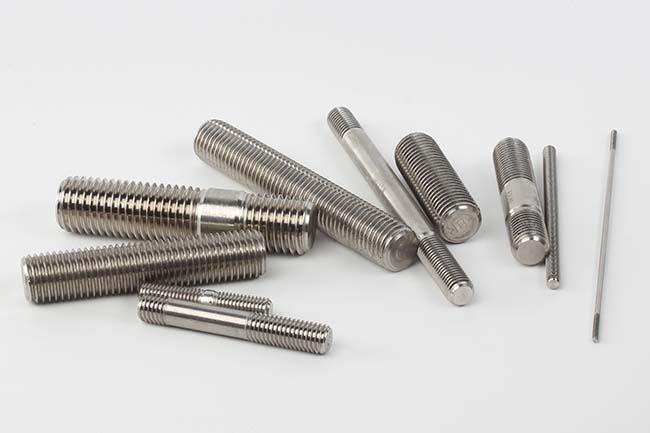
Flybear supplies standard, special, and custom industrial fastening solutions for OEM and project requirements. Buyers comparing stud geometries can review the double-end stud range and provide the applicable standard or drawing, thread dimensions, material, finish, quantity, and application for technical review.
Double End Stud vs Tap End Stud: Quick Comparison
| Selection Factor | Double-End Clamping Stud | Tap-End Stud |
|---|---|---|
| Basic Geometry | Threads on both ends, commonly with equal thread length and configuration | Threads on both ends, usually with different functional thread lengths |
| Primary Installation | Typically clamps two components using a nut at each end | One end is designed to install into a tapped hole; the other generally accepts a nut |
| Thread Function | Both threaded ends normally perform similar clamping functions | Tap end provides engagement in the component; nut end provides external clamping |
| Thread Fit | Normally selected according to the specified external thread system | Tap end may require a specified regular or interference-fit thread depending on the applicable standard and design |
| Typical Applications | Frames, flanges, machinery, structures, and two-sided clamping assemblies | Pumps, valves, housings, engine components, covers, and equipment with tapped bodies |
| Replacement Risk | End lengths and center body must match the joint stack | Tap-end engagement and female thread requirements must match the tapped component |
A key technical point is that a tap-end stud is not completely separate from the double-end stud family. ASME stud standards classify tap-end designs as a type of double-end stud. The practical purchasing distinction is the intended function of the two threaded ends.
What Is a Double-End Stud?
A double-end stud has external threads on both ends with an unthreaded or reduced-body section between them. In the clamping configuration, the threaded ends have the same length and thread configuration and the stud is used to clamp two bodies together with a nut at each end.
This makes a double ended stud bolt useful where a conventional headed bolt is inconvenient or where the equipment design benefits from symmetrical fastening.
Typical uses include:
- Industrial machinery frames and covers.
- Equipment and structural connections.
- Pump and valve assemblies.
- Special flange arrangements.
- Construction and fabricated equipment.
- Maintenance assemblies requiring removable nuts at both ends.
The central body can be full diameter or reduced diameter depending on the applicable standard or drawing. Buyers should not assume that every double-end stud with the same thread diameter has the same center-section dimensions.
What Is a Tap-End Stud?
A tap end stud is designed primarily for installation into a threaded hole in a component. One threaded section, called the tap end, engages the female thread in the equipment body. The exposed end then normally receives a nut that clamps a second component against the tapped body.
This configuration is widely used where repeatedly removing a conventional bolt could wear an expensive tapped housing. The stud can remain installed in the main component while maintenance personnel remove only the nut and attached cover, flange, or bracket.
Applications can include:
- Pump casings.
- Valve bodies and bonnets.
- Gearboxes and machine housings.
- Engine and compressor components.
- Pressure-equipment covers.
- Heavy equipment requiring repeat maintenance access.
The tapped component is an important part of the fastening system. Its material, female-thread depth, thread tolerance, wall thickness, and surrounding geometry influence how the tap end should be designed.
Current ASME Definitions for Double-End and Tap-End Studs
ASME B18.31.2-2014 (R2019) remains in effect for inch-series continuous-thread studs, flange bolting studs, and double-end studs. It distinguishes a double-end clamping type with identical threaded ends from a double-end tap-end type intended for installation in a tapped hole.
For inch-series tap-end studs, the standard includes both regular Unified threads and interference-fit threads at the tap end within its scope. Buyers should therefore never assume that the tap-end thread has the same fit requirement as the exposed nut end.
For metric applications, ASME B18.31.1M-2008 (R2021) remains in effect for metric continuous and double-end studs. It defines clamping-type and tap-end-type double-end studs. Within that standard’s tap-end configuration, both ends use the same thread form and the specified tap-end thread length is approximately 1.5 times the nominal thread diameter.
These ASME references are useful examples of standardized geometry, but an OEM drawing can specify a different thread length, fit, body diameter, or material. The purchase order should follow the actual approved design.
Thread Length Is a Major Geometry Difference
For a clamping-type double-end stud, equal threaded-end lengths are a defining feature in the ASME configuration. For a tap-end stud, the two ends perform different functions, so their thread lengths can differ.
The tap-end length must provide appropriate engagement in the threaded component without bottoming in a blind hole. The nut-end thread must provide enough usable thread for the joint stack, nut height, washer thickness where applicable, and required thread projection.
An RFQ should therefore define:
- Overall stud length.
- Tap-end thread length.
- Nut-end thread length.
- Unthreaded body length.
- Full or reduced body diameter.
- End chamfers or points where controlled.
Using only an overall length can result in a stud that physically fits the package but provides incorrect thread engagement at one end.
Thread Fit at the Tap End Requires Special Attention
The exposed nut end normally needs to assemble freely with the specified nut. The tap end can have a different design objective because it may need to remain fixed in the equipment body.
Depending on the applicable inch-series design, a tap end can use a regular Unified thread or an interference-fit configuration. An interference fit should not be created by randomly combining an oversized stud with a standard tapped hole. Both external and internal threads need to follow the intended thread specification.
Metric tap-end arrangements can instead use the thread and engagement defined by the applicable standard or equipment drawing. Some assemblies may also specify a locking compound rather than a special interference thread.
For replacement projects, buyers should identify the actual thread at both ends instead of assuming they are identical because the nominal diameter is the same.
Tap-End Engagement Depends on the Housing Material
Thread engagement into a cast iron pump body, steel housing, aluminum component, or stainless component should not be treated identically. Female-thread strength and required engagement depend on the material combination, thread geometry, loading, and equipment design.
A stud that is acceptable in a steel tapped component may require a different engagement length in a softer housing. There is no single universal thread-engagement ratio that should be applied to every tap-end stud application.
For critical machinery, engineering should define the required engagement using the actual:
- Stud material and mechanical properties.
- Housing material.
- Thread diameter and pitch.
- Applied preload and external load.
- Available wall thickness.
- Repeated service requirements.
Full-Body vs Reduced-Body Studs
Both inch and metric ASME double-end stud standards recognize full-body and reduced-body configurations. This difference can affect stiffness, available clearance, manufacturing route, and the mechanical behavior of the assembly.
A full-body stud generally has a center-body diameter related closely to the major thread diameter, while a reduced-body design uses a smaller center section according to the applicable standard or drawing.
Buyers should not convert between body styles solely because both products have the same end threads. The body diameter should be included in technical review when the stud passes through close-clearance holes, carries significant cyclic loading, or is drawing-controlled.
Material and Property Class Selection
Stud geometry does not define material strength. A double-end or tap-end configuration can be produced from carbon steel, alloy steel, stainless steel, or other materials according to the application.
For applicable metric carbon and alloy steel studs, ISO 898-1:2013 remains the current published mechanical-property standard and covers specified property classes within its scope. The edition was confirmed in 2025 while a replacement edition remains under development.
Pressure and temperature service may instead require ASTM bolting grades such as those controlled by ASTM A193/A193M or ASTM A320/A320M. These material specifications should not be replaced by a generic property-class designation without technical review.
For stainless or corrosion-resistant custom studs, buyers should state the specific alloy or applicable material standard rather than simply requesting “stainless steel.”
Surface Finish and Coating Selection
Double-end and tap-end studs can use black oxide, zinc plating, hot-dip galvanizing, zinc-flake coatings, passivation for suitable stainless steels, or other project-specific finishes.
Coating choice should consider:
- Indoor or outdoor exposure.
- Corrosion environment.
- Thread fit after finishing.
- Installation friction.
- Tap-end interference or locking requirements.
- Operating temperature.
- Mating nut and housing material.
Thick coatings require particular attention at a tap end because coating buildup changes the effective thread dimensions. A thread system designed for interference or controlled engagement should not be coated without considering its finished fit.
Double End Stud vs Tap End Stud Selection Guide
| Application Requirement | Stud Type to Evaluate | Reason |
|---|---|---|
| Two components clamped with nuts on both ends | Double-End Clamping Stud | Equal-end configuration is suited to symmetrical clamping |
| One end remains installed in a tapped equipment body | Tap-End Stud | One threaded end is specifically intended for tapped-hole engagement |
| Frequent cover removal from an expensive housing | Tap-End Stud | The housing-side thread can remain installed while the outer nut is removed |
| Equal thread lengths required at both ends | Double-End Clamping Stud | Matches the conventional identical-end geometry |
| Different thread fits required at the two ends | Tap-End or Custom Stud | The equipment-side and nut-side interfaces can be specified independently |
| Non-standard body or unequal thread lengths | Drawing-Based Custom Stud | Geometry should follow the approved application drawing |
Common Purchasing Mistakes
- Treating tap-end studs as completely separate from double-end studs. Standards classify tap-end geometry as a type of double-end stud.
- Ordering only by diameter and overall length. Thread length at each end and body dimensions also matter.
- Assuming both ends always use the same thread fit. Inch tap-end designs can use a different fit at the equipment end.
- Ignoring female-thread material. Required engagement depends partly on the tapped component.
- Bottoming the tap end in a blind hole. Hole depth and usable female thread must be checked.
- Changing body diameter without engineering review. Full-body and reduced-body studs are not automatically interchangeable.
- Specifying coating without considering tap-end fit. Coating thickness can alter thread engagement.
- Using a material standard as a complete drawing. Geometry, mechanical properties, finish, and inspection can be controlled by separate requirements.
Quality Control for Double-End and Tap-End Studs
Inspection should verify the features that control assembly. Relevant checks can include overall length, thread length at both ends, body diameter, thread Go/No-Go gauging, material verification, hardness or tensile testing where required, coating thickness, and surface condition.
For tap-end studs, different thread gauges or inspection criteria may be needed for the equipment end and nut end when different thread fits are specified. Drawing revision and end identification can also be important where the two sides are not visually obvious.
Flybear’s quality control process supports dimensional and thread inspection, material verification, hardness and tensile testing, coating inspection, optical inspection, and additional checks according to agreed project requirements.
RFQ Checklist for Double-End and Tap-End Studs
A complete RFQ allows a stud bolt supplier to quote the intended geometry without assumptions. Provide:
- Applicable ASME, DIN, ISO, ASTM-related requirement, or approved drawing.
- Stud type: double-end clamping type, tap-end type, or custom.
- Metric or inch nominal diameter.
- Thread pitch or TPI at each end.
- Thread tolerance or class at each end.
- Tap-end interference-fit requirement where applicable.
- Overall finished length.
- Thread length at each end.
- Full or reduced center-body diameter.
- Material grade or mechanical property class.
- Heat-treatment requirement where applicable.
- Surface finish, coating, or lubrication requirement.
- Mating nut specification.
- Tapped-component material and available thread depth where relevant.
- Order quantity and expected repeat demand.
- Application and operating environment.
- Required dimensional reports, material certificates, mechanical tests, coating reports, marking, traceability, and packaging.
For unequal threads, non-standard engagement lengths, special body diameters, or drawing-specific ends, Flybear can support drawing-based custom fastener requirements. The approved drawing should clearly identify which end installs into the equipment.
FAQ
What is the difference between a double-end stud and a tap-end stud?
A conventional double-end clamping stud has threaded ends with the same length and configuration and commonly uses a nut at each end. A tap-end stud is a double-end configuration designed primarily for one threaded end to install in a tapped component while the opposite end is used for external clamping.
Is a tap-end stud a type of double-end stud?
Yes. ASME B18.31.1M and B18.31.2 classify tap-end configurations within the double-end stud family. The main distinction is the intended function and geometry of the equipment-side threaded end.
Can both ends of a tap-end stud have different thread fits?
They can in suitable designs. ASME B18.31.2 covers regular Unified and interference-fit threads for the tap end of inch-series studs. The actual thread requirement should follow the applicable standard or approved drawing.
How long should the tap-end thread be?
The required length depends on the standard and application. ASME B18.31.1M specifies approximately 1.5 times nominal diameter for the tap end in its covered metric configuration, but OEM drawings and other standards can use different engagement requirements.
What materials are available for double-end studs?
Depending on the application, double-end and tap-end studs can use carbon steel, alloy steel, stainless steel, duplex stainless steel, or other specified materials. Mechanical grade and corrosion suitability should be stated separately from stud geometry.
What should buyers send for a tap-end stud quotation?
Provide the standard or drawing, diameter and thread at both ends, tap-end and nut-end thread lengths, overall length, body diameter, material or property class, finish, quantity, tapped-component information, and required inspection or certificate documents.
Conclusion
The double end stud vs tap end stud decision should begin with how the fastener interfaces with the joint. A clamping-type double-end stud is typically symmetrical and works with nuts at both ends, while a tap-end stud is designed primarily so one end can remain engaged in a tapped machine or equipment component.
For reliable sourcing, buyers should define both threaded ends separately when necessary. Thread length, fit, body diameter, material, coating, female-thread material, available engagement depth, inspection, and documentation can all affect assembly performance. This is especially important for pumps, valves, machinery housings, and maintenance applications where the tap end may remain installed through repeated service cycles.
For standard or project-specific double-end and tap-end studs, Flybear can support technical requirement review and quotation. Send your standard or drawing, size and thread, end-thread lengths, material or property class, finish or coating, quantity, application, and inspection requirements through the Flybear contact page.