Nylon Fasteners Guide: Screws, Nuts, Washers and Spacers
Nylon fasteners are worth considering when an assembly needs a lightweight component, electrical separation at a mounting point, or a nonmetallic contact surface. They can work well in electronics housings, instrument mounts and lightly loaded equipment covers. The choice depends on what the joint must do after installation, especially when it faces humidity, sustained clamping or chemical exposure.
Start with the job each part must perform. A screw that holds an access cover, a washer that separates two surfaces and a spacer that sets a circuit board height have different failure modes. Each needs its own material, dimensions and acceptance criteria.
Choose the Fastener Type by Its Function
| Component | Typical role | What to verify |
|---|---|---|
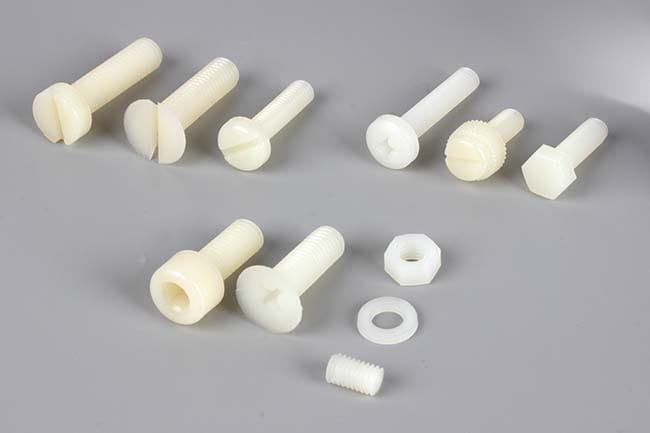
| Nylon screws | Secure covers, housings or lightly loaded internal components | Head clearance, drive engagement, mating thread and installation torque |
| Nylon nuts | Provide a nonmetallic female thread where the assembly permits it | Thread engagement, resistance to stripping and retained clamp force |
| Nylon washers | Separate bearing surfaces, protect a finish or isolate a local contact point | Hole diameter, thickness, bearing area and compression in service |
| Nylon spacers and standoffs | Set a gap or mounting height between components | Length tolerance, end-face seating, load and whether the bore is threaded |
A spacer usually has a clearance bore, while a standoff can have threaded ends for attachment. Catalog terminology varies, so specify the end configuration and how the part is installed. For a board mount, identify the required gap and its tolerance after assembly as well as the loose part’s length.
A solid nylon nut and a metal locknut with a nylon insert also serve different purposes. The former has a nylon body and thread. The latter has a metal body and uses its insert to create resistance to turning. Describe the construction explicitly when requesting a quotation.
Browse Flybear’s nylon fastener range for examples of PA66 screws, hex nuts and flat washers.
Specify the Nylon Grade and the Condition of the Part
Nylon is a family of polyamides. PA6 and PA66 identify different polymer types, and a PA66 designation still leaves choices about the exact resin grade, reinforcement and additives. For an approved production part, record the grade and any restrictions on substitutions. Identify the reinforcement when a filled grade is required.
Specify color and surface appearance when they matter to the application. A color description does not establish UV resistance, electrical properties or a flammability rating. If the assembly requires any of these properties, ask for evidence that applies to the specified material and relevant test conditions.
Check moisture effects before setting fit tolerances
Nylon can absorb moisture from its surroundings. An experimental study of molded PA66 specimens measured swelling and changes in stiffness and strength after conditioning. Those results explain why moisture matters, but the study tested specimens from one commercial grade and does not establish a dimensional allowance for a finished fastener.
For a tight clearance or controlled mounting height, agree on the condition in which dimensions will be inspected. A sample may fit when first unpacked and behave differently after exposure to the service environment. Check critical dimensions and thread fit after representative conditioning where the joint is sensitive to these changes.
Evaluate the Joint After Installation
Separate initial tightening from long-term clamp force
A nylon screw can install successfully and still lose clamp force in service. Under sustained loading, the polymer can deform over time, a behavior known as creep. In an assembled joint, deformation of a nylon washer or spacer can reduce bolt stretch and clamp force even if the metal bolt has not rotated.
ISO 899-1:2017 describes tensile creep testing on standard plastic specimens under defined conditions. Such data can help compare grades. It cannot establish the preload retained by a specific combination of screw, nut, washer and housing. Where retention matters, test the actual assembly over a representative duration and record the conditions.
Use an installation torque approved for the nylon part and its mating component. A torque value for a steel screw of the same nominal size can overload the plastic thread, damage the drive or compress a washer excessively. Check what the joint must retain after use, such as clamp force, gap or resistance to movement.
Check temperature and chemical exposure together
Give the supplier the normal operating temperature, peak temperature, exposure duration and load. A resin’s melting point does not tell you how much a threaded part or spacer will deform while carrying a load. A brief temperature excursion and continuous service require different evaluations.
For chemical equipment, identify the liquid, concentration, temperature, contact duration and whether exposure is by splash, cleaning or immersion. ISO 175:2010 measures changes in plastics after immersion of unrestrained specimens and excludes environmental stress cracking. An immersion result can help screen a grade, but it does not qualify a loaded nylon thread for service.
In water treatment and washdown equipment, distinguish external mounting hardware from wetted or pressure-retaining components. For semiconductor or medical equipment, confirm cleanliness, material documentation and any application-specific approvals separately. A generic PA66 designation does not establish suitability for those uses.
Confirm electrical separation in the assembled joint
A nylon flat washer beneath a metal screw head may separate the head from a panel while leaving contact between the screw shank and the hole wall. If the joint requires electrical isolation, check the entire conductive path. A shoulder washer or sleeve may be appropriate when the design must isolate the shank as well as the bearing surface.
Review the assembled geometry, operating environment and any required electrical tests. The insulating properties of a resin sample do not by themselves establish the performance of the complete joint.
Review Dimensions Before Approving a Replacement
For threaded parts, confirm the thread system, nominal diameter, pitch, thread length and mating component. Check the head shape, drive and seating surface against the drawing. Where a metal fastener standard is used to describe geometry, state which dimensions apply. Similar dimensions do not transfer the metal part’s mechanical rating to nylon.
For washers and spacers, specify the inside diameter, outside dimensions, thickness or length and critical tolerances. A spacer that fits between two components may still be unsuitable if its end faces seat unevenly or it compresses enough to change the required gap.
For a nonstandard shoulder, bore or mounting height, send a drawing and identify the features that control fit. Flybear’s custom fastener range is a starting point for discussing a drawing-based requirement.
What to Include in a Nylon Fastener RFQ
For B2B fastener sourcing, give each plastic fastener supplier the same specification so you can compare quotations on material, fit and inspection as well as price.
- Part type and drawing: Identify the screw, nut, washer or spacer and provide the drawing revision or reference sample.
- Dimensions and threads: Include critical tolerances, thread diameter and pitch, head or drive details, and the mating part.
- Material: Specify the polymer type, approved resin grade, reinforcement and color where relevant. State whether alternatives can be submitted for review.
- Service conditions: Describe humidity, temperature, chemical contact, sustained loads and any electrical isolation requirements.
- Assembly criteria: Identify the installation method and the fit, gap or retained clamp force the joint must achieve.
- Quantity and documents: State sample and production quantities, packaging, traceability and inspection or certificate requirements.
Agree on sample acceptance before production. Depending on the part, checks may include thread fit with the actual mating component, inspection of critical dimensions after conditioning, and limits for flash or other defects on seating surfaces. Use Flybear’s quality control and inspection overview to discuss the checks and records needed for your order.
Frequently Asked Questions
Can nylon screws replace steel screws of the same size?
Only after checking the application. Matching threads can establish fit, but the replacement also needs to meet the joint’s load, torque, temperature and long-term retention requirements.
Are nylon nuts the same as nylon insert locknuts?
No. A solid nylon nut has a polymer body. A nylon insert locknut has a metal body with a polymer insert that adds resistance to turning. Specify which construction you need.
Can a nylon washer provide electrical isolation?
It can separate the surfaces it covers. Check for other contact paths, including the screw shank touching the panel and any exposed metal around the joint.
Why can a nylon spacer’s height change in service?
Moisture uptake, temperature and compression under sustained load can affect the installed height. For a critical gap, verify the dimension on a conditioned assembly under representative load.
Is PA66 suitable for chemical or washdown equipment?
It depends on the grade and the actual exposure. Ask for data for the chemical, concentration and temperature involved, and confirm the loaded part’s performance where failure would affect operation.
Make the Purchase Specification Match the Joint
Choose the fastener form for its function, then define the resin grade, geometry and conditions under which the assembled part must perform. For repeat orders, keep the approved grade, drawing and acceptance criteria together so a visually similar part does not become an undocumented substitution.
Flybear supplies nylon fasteners for industrial sourcing. To request a nylon fastener quotation, send the part type, dimensions or thread specification, material grade, application environment, quantity, drawing or sample, and any inspection or certificate requirements.