Why Blacken Stainless Steel? Benefits and Limitations
Manufacturers blacken stainless steel to give components a dark appearance, reduce unwanted reflections and meet specific surface-finish requirements. For industrial fasteners, this can help visible screws, nuts, washers and rivets coordinate with the equipment around them.
Consider a black equipment enclosure. Stainless steel may suit its operating environment, but bright screw heads can stand out against the housing. A blackened finish allows the designer to retain the selected stainless steel material while achieving a more consistent appearance.
Appearance is only one part of the specification. Corrosion resistance, mechanical strength and installation performance each require their own consideration.
Why Stainless Steel Resists Corrosion Before Blackening
Stainless steel gets its corrosion resistance from its alloy composition and the thin protective film that forms naturally on its surface. Chromium plays a central role in forming this film.
The British Stainless Steel Association explains this natural passive layer and how it can repair itself under suitable conditions. The film is extremely thin and normally allows the familiar metallic appearance of stainless steel to remain visible.
Blackening introduces a deliberate surface finish for a particular purpose. The natural protective film and the specified black finish should be understood as different aspects of the finished component.
Why Blacken Stainless Steel? Three Practical Reasons
1. Coordinate Visible Fasteners with the Finished Product
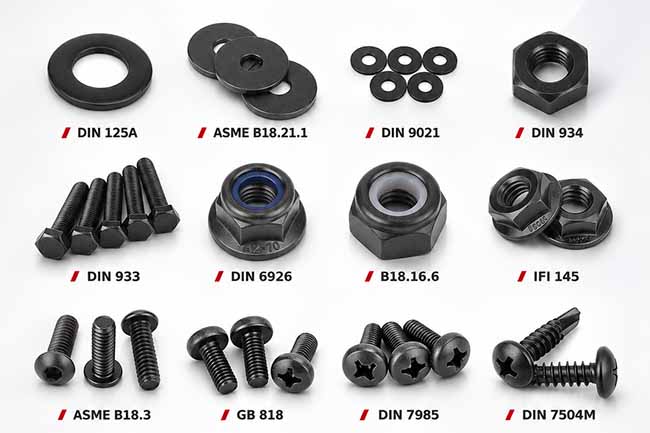
Fasteners are small components, but they can have a noticeable effect on the appearance of an assembled product. Bright hardware can draw attention on a black panel, dark machine frame or painted housing.
Blackened stainless steel helps create continuity between the fasteners and the surrounding surfaces. This can be useful for lighting equipment, electronic enclosures, display systems, instruments and machinery with exposed fastening points.
The effect also depends on the fastener’s shape. A broad washer presents more visible surface area than a small screw head. A flange nut can remain clearly visible beside a mounting bracket. Coordinating these components can make the whole assembly look more consistent.
Products such as a stainless steel black oxide flange nut combine the required fastening geometry with a dark appearance.
2. Reduce Unwanted Reflections
Bright metallic surfaces can produce noticeable reflections under direct lighting. A suitable blackened finish can reduce visible glare compared with a bright finish, which is useful when shiny hardware would be distracting.
For example, a designer may prefer subdued fastening points near a display, viewing area or lighting fixture. The practical aim is to make the hardware less visually prominent under the expected lighting conditions.
Black surfaces can still reflect light. Their appearance depends on surface texture, preparation, finishing process and any final sealer. A smooth black component may have a noticeable sheen, so samples should be assessed under the lighting in which the finished equipment will be viewed.
3. Obtain a Dark Finish with Limited Dimensional Change
Fasteners depend on accurate geometry. Threads must engage correctly, drive recesses must accept their tools, and washers must fit within the available assembly space.
Thin chemical blackening processes can provide a dark appearance with minimal dimensional change. This is a useful characteristic when the component requires color while retaining close control of its functional dimensions.
The finished component still needs to meet its dimensional requirements. Thread gauging, recess checks and other relevant inspections remain part of controlling the supplied fastener.
What Happens During Stainless Steel Blackening?
Chemical blackening uses a controlled treatment to create a dark surface on the metal. Stainless steel requires a process suited to its alloy and surface condition.
A typical stainless-specific process includes cleaning, surface activation, blackening, rinsing and an appropriate final treatment. Cleaning and preparation help the process react consistently across the component. A supplementary sealer or preservative may then be used to achieve the required finished condition.
For an example of this sequence, Birchwood Technologies describes a stainless steel black oxide process that includes activation, blackening and sealing. Other proprietary processes can use different chemistry and operating conditions.
This means that “blackened stainless steel” describes an appearance more broadly than it defines a complete manufacturing specification. The process and final treatment should be identified when their performance matters to the application.
Several Processes Can Produce a Black Surface
Stainless steel can obtain a black appearance through chemical blackening, certain coloring processes, paint systems or deposited coatings such as PVD. These routes produce different surface structures and can have different thickness, wear and environmental characteristics.
A photograph can show color and visible texture, but it cannot reliably identify the finishing process. When a drawing calls for black oxide, the supplier should confirm that specific finish rather than selecting a treatment solely because it looks black.
How Does Blackening Affect Corrosion Resistance?
Corrosion performance depends on the stainless steel grade, surface preparation, finishing process, supplementary treatment and service environment. Color alone provides very little information about that performance.
The scope of MIL-DTL-13924, published through the U.S. Defense Logistics Agency, describes black conversion coatings as providing limited corrosion protection in mildly corrosive conditions. This is useful context when evaluating claims about black finishes.
A specified sealer or preservative may contribute to protection, but the finished system needs to suit the exposure. Moisture, salt contamination, cleaning chemicals and areas that retain deposits should all be considered.
For example, an indoor instrument housing and an outdoor coastal installation present very different conditions. Both may require black hardware, while their material and finish requirements differ substantially. Corrosion requirements should therefore be defined for the actual application and evaluated on the supplied finished components.
Strength and Tightening Performance
Blackening is a surface-finish specification. Fastener strength must be established through the selected material, processing condition and applicable mechanical requirements.
The same distinction applies to fastening function. A nylon insert supplies the prevailing resistance in a nylon insert lock nut. A large washer spreads bearing load. A blind rivet forms its connection through deformation during setting. Their black appearance does not establish those functions.
Final surface treatment can also affect installation. Sealers and lubricants influence friction, which affects the relationship between tightening torque and clamping force. Assembly settings should reflect the actual supplied condition of the fastener.
Black color alone also cannot establish resistance to thread galling. Material pairing, thread condition, lubrication and installation control remain relevant.
Where Blackened Stainless Steel Makes Sense
A black finish is especially useful where the fastener remains visible and its appearance contributes to the finished assembly. Examples include:
- Equipment enclosures: Coordinating screw heads, nuts and washers with dark panels and housings.
- Lighting and display equipment: Reducing the visual prominence of bright hardware around viewing areas.
- Industrial machinery: Matching exposed fastening points to painted frames, covers and brackets.
- Instruments and control equipment: Creating a consistent appearance across visible hardware.
- Fabricated assemblies: Coordinating different fastener types within one finished product.
For example, black oxide flat washers can coordinate with black screws and nuts while providing the bearing area required by the joint.
What Should Be Specified Besides “Black”?
A useful specification describes the material, finish and finished condition separately. This helps the supplier understand which characteristics matter and gives the buyer a clearer basis for inspection.
| Requirement | What to Define |
|---|---|
| Base material | Stainless steel grade and required mechanical properties |
| Black finish | Specified process and any supplementary treatment |
| Appearance | Black tone, sheen and an approved reference sample |
| Assembly condition | Dimensional fit, cleanliness and lubrication requirements |
| Environmental performance | Service exposure and any agreed test requirements |
Terms such as “matte,” “dry to touch” and “free from visible oil residue” describe separate surface requirements. Include them explicitly when they matter. Assess appearance samples under consistent lighting and include representative parts with different shapes, such as screw heads and washer faces.
Inspection can then address the relevant characteristics through material verification, dimensional checks and surface evaluation. See our fastener quality control and inspection support for further information.
Frequently Asked Questions
Does Blackening Change the Stainless Steel Grade?
The specified alloy grade remains a separate material requirement. Blackening should not be used as evidence that a component has a different chemical composition or mechanical-property class. Material identification and the required documentation should establish those characteristics.
Is Blackened Stainless Steel Always Matte?
No. It can have a matte, satin or more reflective appearance depending on the original texture, blackening process and final treatment. Define the required sheen with a sample when appearance consistency is important.
Can Blackened Stainless Steel Be Used Outdoors?
It can be considered when the selected material and finishing system suit the exposure. Outdoor suitability depends on conditions such as moisture, salt contamination and maintenance. Evaluate the complete finished component against the requirements of its intended location.
Can the Black Finish Show Wear?
Yes. Tool contact, rubbing and abrasive cleaning can mark or wear a surface finish. For frequently handled components or repeated assembly, include those conditions in the finish evaluation and assess representative parts after the expected handling.
Choosing Black Stainless Steel Fasteners
Start with the connection’s mechanical and environmental requirements, then define the black appearance and surface condition needed by the finished product.
Flybear supports standard and project-specific fastener requirements, including material and finish selection. Share your drawing, application and appearance requirements to discuss a suitable specification for your assembly.