Set Screw Point Types: Cup, Cone, Dog and Flat Point Compared
Set screw point types determine how a headless screw contacts, grips, locates, or locks the mating component. Cup, cone, dog, and flat points may use the same nominal thread size and similar socket drives, but their contact geometry is different. That difference affects holding action, surface damage, positional accuracy, repeat adjustment, and the preparation required on a shaft or mating part.
For engineers and sourcing teams, selecting a set screw should therefore involve more than specifying “M6 socket set screw.” The point type, thread, length, material or hardness class, surface finish, mating material, contact surface, and application must all be defined. A point intended to bite into a shaft performs differently from one intended to locate in a drilled hole or clamp against a surface with minimal marking.
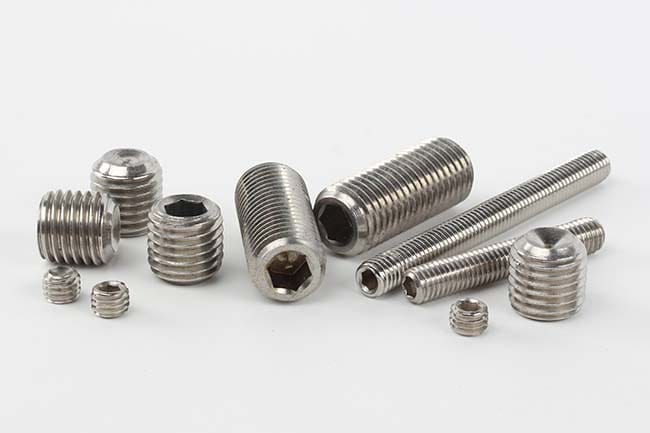
Flybear supplies standard, special, and custom industrial fasteners for machinery, automation, electrical equipment, automotive assemblies, and other OEM applications. Buyers comparing point geometries can review the set screw range and provide the required standard, thread, point type, material, finish, quantity, and application for technical review.
Set Screw Point Types at a Glance
| Point Type | Contact Geometry | Typical Selection Reason | Main Consideration |
|---|---|---|---|
| Cup Point | Concave end with an annular contact edge | General locking on shafts, collars, gears, and knobs | Can mark or indent the mating surface |
| Cone Point | Conical or truncated conical tip | Positive location and concentrated contact | Can penetrate or significantly mark the mating surface |
| Dog Point | Cylindrical projection at the end | Location, indexing, guidance, or engagement with a prepared hole or slot | Requires compatible mating geometry and alignment |
| Flat Point | Flat contact end | Clamping where surface damage should be limited | Provides less penetrating action than cup or cone points |
There is no universally best set screw point. The correct choice depends on whether the design needs frictional clamping, surface penetration, positive mechanical location, frequent adjustment, or protection of the mating surface.
Current ISO Standards for Set Screw Point Types
For metric hexagon socket set screws, the current ISO product standards were revised in 2026. ISO 4026:2026 covers flat-point set screws, ISO 4027:2026 covers set screws with truncated cone point, ISO 4028:2026 covers dog-point set screws, and ISO 4029:2026 covers cup-point set screws.
Within their stated scopes, these 2026 standards cover metric coarse-pitch threads from M1.6 to M30 for steel and M1.6 to M24 for stainless steel, with product grade A. The standards also state that these set screws are not intended for use under tensile load.
| Point Style | Current ISO Reference | Common Legacy DIN Reference |
|---|---|---|
| Flat Point | ISO 4026:2026 | DIN 913 |
| Cone / Truncated Cone Point | ISO 4027:2026 | DIN 914 |
| Dog Point | ISO 4028:2026 | DIN 915 |
| Cup Point | ISO 4029:2026 | DIN 916 |
Legacy DIN numbers are still widely encountered on older drawings and purchasing records. However, buyers should verify the required standard and revision rather than assuming that a historical DIN designation and a current ISO product are automatically interchangeable in every detail.
ISO 4753 also provides standardized forms and dimensions for ends of externally threaded metric fasteners. Where a project uses a custom set screw rather than one of the standard product forms, point geometry can be defined directly on the controlled drawing.
Cup Point Set Screw: General-Purpose Locking
A cup point set screw has a concave end that creates a circular contact edge. When tightened against a shaft or another mating surface, this edge concentrates contact around the perimeter of the point rather than distributing it across the entire end face.
This geometry makes the cup point a common starting choice for locking components such as collars, pulleys, gears, knobs, and similar parts onto shafts. The point can produce localized indentation in a softer mating surface, helping resist relative movement when the joint is correctly designed and tightened.
Typical applications include:
- Shaft collars.
- Pulleys and hubs.
- Gears and sprockets.
- Adjustment knobs.
- Machine components requiring rotational or axial restraint.
- General industrial positioning and locking assemblies.
The same contact action that helps a cup point grip can also damage or mark the shaft. If the shaft surface must remain smooth for bearings, seals, sliding components, appearance, or repeated repositioning, another point type or a prepared contact feature may be more appropriate.
When to Choose a Cup Point
Evaluate a cup point when the design needs general-purpose holding and some surface indentation is acceptable. The mating material, hardness, tightening torque, shaft diameter, vibration, and service requirements should still be considered. A cup point is not automatically a complete anti-loosening solution for a highly dynamic joint.
Cone Point Set Screw: Concentrated Contact for Positive Location
A cone point set screw concentrates contact into a much smaller area. Current ISO 4027:2026 describes a truncated cone point configuration. In practical mechanical design, cone-point styles are commonly selected when the screw needs to engage a prepared depression or create a more concentrated locating contact than a flat or cup point.
A matching drilled or machined seat can provide a more positive location for components that must return to a defined position. This can be useful in adjustment mechanisms, collars, control components, or assemblies where relative movement needs to be restricted mechanically.
Because the contact area is small, local pressure can be high. This means a cone point can significantly mark or deform softer mating materials. It should not be selected solely because stronger “bite” sounds desirable.
Good Applications for Cone Points
- Components requiring positive positioning.
- Assemblies using a prepared locating depression.
- Adjustable mechanisms with defined stop positions.
- Shaft or collar arrangements where localized surface penetration is acceptable.
- Applications where a small contact point is deliberately part of the design.
If the mating component is hardened, thin, brittle, coated, or surface-critical, verify whether the concentrated contact is appropriate before specifying a cone point.
Dog Point Set Screw: Location and Indexing
A dog point set screw has a cylindrical projection extending beyond the threaded body. Unlike a cup or cone point that primarily presses into a surface, the dog point can engage a corresponding hole, slot, groove, or other prepared feature.
This makes the dog point useful for location and guidance. The cylindrical extension can restrict movement mechanically while the threaded portion establishes the screw position.
Potential applications include:
- Indexing mechanisms.
- Locating components on shafts.
- Guides and adjustment assemblies.
- Components with dedicated locating holes or slots.
- Applications requiring repeatable mechanical positioning.
The mating feature is critical. Dog-point diameter, projection length, hole or slot dimensions, clearance, and alignment should be considered as a system. If the dog enters a locating hole before the threaded joint is correctly aligned, installation can become difficult or the point may be damaged.
Dog Point vs Cone Point
A cone point often provides location through concentrated contact or penetration, while a dog point provides location through engagement of a cylindrical projection with prepared geometry. If repeated indexing or defined mechanical engagement is required, a dog point can be easier to control because the mating feature can be dimensioned directly.
Flat Point Set Screw: Clamping with Less Surface Penetration
A flat point set screw ends in a relatively flat bearing surface. Instead of intentionally penetrating the mating component, it develops holding action primarily through clamping pressure and friction at the contact interface.
This makes a flat point useful when damage to the mating surface should be reduced, when components need periodic adjustment, or when the set screw bears against a hardened surface that is not intended to be indented.
Typical applications can include:
- Adjustable collars and stops.
- Components that require repeated repositioning.
- Applications with surface-finish requirements.
- Contact with hardened shafts or inserts.
- Assemblies where intentional penetration is undesirable.
A flat point should not automatically be considered “non-marking.” Contact pressure can still leave marks, especially on soft materials or at high installation torque. The term is better understood as reduced penetration compared with more aggressive point geometries.
How Mating Material Affects Point Selection
The point and mating surface work together. A cup or cone point may indent an aluminum or mild-steel shaft more readily than a hardened steel shaft. A flat point may distribute contact more broadly but can provide different resistance to movement. A dog point depends more heavily on the prepared hole or slot than on penetration.
Before choosing a point type, consider:
- Mating component material and hardness.
- Surface treatment or coating.
- Whether permanent marking is acceptable.
- Whether the component will be repositioned.
- Expected rotational and axial loads.
- Vibration and repeated load cycles.
- Available wall or shaft thickness.
- Whether a locating hole, flat, groove, or depression can be added.
For important joints, application testing with representative production materials can provide more useful information than comparing point shapes in isolation.
Set Screw Materials and Mechanical Properties
Point geometry is only one part of the specification. Carbon and alloy steel set screws can be specified according to appropriate hardness-class requirements. ISO 898-5:2012 is the current ISO mechanical-property standard for applicable carbon and alloy steel set screws and similar threaded fasteners with specified hardness classes.
ISO 898-5 treats these fasteners as components intended for compressive rather than tensile loading. This distinction is important because ordinary bolt property classes and tensile-bolt selection methods should not automatically be applied to set screws.
For corrosion-resistant stainless steel set screws, ISO 3506-3:2025 is the current mechanical-property reference within its scope. It covers specified stainless steel grades and hardness classes for set screws and similar fasteners not under tensile stress.
Buyers should therefore specify both the dimensional product standard and the required material or mechanical-property requirement. A designation such as “ISO 4029 M8 × 12” does not by itself communicate every material, hardness, coating, or environmental requirement.
Coatings and Surface Finishes
Steel set screws may use black finishes, zinc-based coatings, zinc-flake systems, or other project-specific treatments. Stainless steel may be selected where the required corrosion resistance and mechanical properties suit the environment.
The finish should be evaluated for corrosion exposure, friction, dimensional allowance, appearance, and compatibility with the mating assembly. Coating thickness can affect thread fit, especially for small diameters and close tolerances.
Where corrosion testing is specified, the RFQ should identify the test method and acceptance criteria rather than requesting a generic “high corrosion resistance” finish. Actual service performance remains dependent on coating damage, environment, installation, geometry, and maintenance conditions.
Set Screw Point Types: Selection Matrix
| Application Requirement | Point Type to Evaluate First | Reason |
|---|---|---|
| General locking on a shaft | Cup Point | Annular contact can provide localized gripping action |
| Positive location in a prepared seat | Cone Point | Concentrated point can engage a defined depression |
| Indexing into a hole or slot | Dog Point | Cylindrical projection provides mechanical location |
| Frequent adjustment | Flat Point | Reduced penetration can help limit mating-surface damage |
| Surface marking is undesirable | Flat Point | Broad contact is generally less aggressive than cone or cup geometry |
| Strong localized engagement is required | Cup or Cone Point | Both concentrate contact, but mating surface and geometry must be reviewed |
| Exact repeatable position is required | Dog Point or Cone Point with prepared seat | Prepared mating geometry can control location |
Quality Control for Set Screws
Set screw inspection should confirm more than thread diameter. Depending on the applicable standard and order requirements, inspection can include overall length, thread dimensions, socket geometry, point shape, point dimensions, material verification, hardness testing, coating thickness, and surface condition.
Point geometry deserves particular attention because an incorrect cup depth, dog diameter, projection length, flat geometry, or cone shape can change how the fastener contacts the mating component even if the external thread passes inspection.
Flybear’s quality control process supports dimensional inspection, Go/No-Go thread gauging, optical inspection, material verification, hardness testing, torque testing, coating-thickness inspection, salt-spray testing when required, and final shipment checks according to agreed requirements.
Common Purchasing Mistakes
- Specifying only thread size and length. The point type is a functional part of the set screw specification.
- Using cup and cone points interchangeably. Their contact geometry and effect on the mating surface are different.
- Using a dog point without defining the mating feature. Hole or slot diameter, depth, position, and clearance can affect assembly.
- Assuming a flat point cannot mark the shaft. High contact pressure can still damage softer surfaces.
- Using legacy standards without checking their status. Older DIN and ISO references may have been replaced by current editions.
- Applying ordinary bolt strength terminology without verification. Set screws have dedicated mechanical-property standards and are generally intended for non-tensile loading.
- Ignoring material hardness on both sides of the joint. Contact behavior depends on the relationship between the set screw point and mating surface.
- Leaving coating and inspection requirements until after quotation. These requirements can affect manufacturing, dimensional control, testing, and price.
When a Custom Set Screw Is Required
A standard cup, cone, dog, or flat point does not fit every assembly. OEM designs may require an extended dog point, special cone geometry, unusual thread length, fine pitch, reduced diameter section, custom drive, special material, controlled hardness, or a drawing-specific end shape.
For these projects, buyers can submit a controlled drawing or sample for custom fastener review. The drawing should specify the thread, overall length, point geometry, critical tolerances, material, mechanical requirements, finish, and inspection criteria.
RFQ Checklist for Set Screws
To obtain a technically comparable quotation from an industrial screw supplier, provide:
- Applicable standard and edition or controlled drawing.
- Point type: cup, cone, dog, flat, or custom.
- Nominal thread diameter and pitch.
- Overall screw length.
- Dog-point, cone, or other special end dimensions where applicable.
- Drive type and drive size when drawing-controlled.
- Material and required hardness class or mechanical specification.
- Surface finish, coating, lubrication, or corrosion requirement.
- Order quantity and expected repeat demand where relevant.
- Mating component material and hardness where known.
- Application, loading direction, vibration, and adjustment requirements.
- Critical tolerances and inspection scope.
- Material certificates, test reports, traceability, or packaging requirements.
FAQ
What are the four common set screw point types?
Four widely used set screw point types are cup, cone, dog, and flat point. Each provides a different contact condition and should be selected according to the mating surface and required locking or locating function.
Which set screw point is best for a shaft?
A cup point is commonly evaluated for general shaft locking, but the correct choice depends on shaft hardness, acceptable surface damage, loading, vibration, and whether the component needs frequent adjustment. Cone, flat, or dog points can be better for specific locating or surface requirements.
What is a dog point set screw used for?
A dog point set screw has a cylindrical projection that can engage a prepared hole, slot, or groove. It is useful for positioning, indexing, guidance, and applications requiring defined mechanical location.
Which point type causes the least shaft damage?
A flat point is generally less aggressive than a cup or cone point because it does not intentionally penetrate the surface. However, it can still mark softer materials when high contact pressure is applied.
What are the current ISO standards for metric socket set screws?
The current 2026 series includes ISO 4026 for flat point, ISO 4027 for truncated cone point, ISO 4028 for dog point, and ISO 4029 for cup point. Buyers working from older drawings should confirm the required standard edition before substitution.
What information should I provide for a set screw quotation?
Provide the standard or drawing, thread and length, point type, material or hardness requirement, finish or coating, quantity, mating material, application conditions, critical tolerances, and required inspection or certificate documents.
Conclusion
Choosing among set screw point types requires matching the point geometry to the intended mechanical function. Cup points are commonly used for general locking, cone points provide concentrated location, dog points engage prepared holes or slots, and flat points are useful where reduced surface penetration or repeated adjustment is important.
The point type should be specified together with the current product standard, thread, length, material or hardness class, finish, mating component, and inspection requirements. For legacy drawings, buyers should also verify whether older DIN or ISO references need to be retained or updated before ordering.
For standard or project-specific set screws, Flybear can support technical requirement review and quotation. Send your standard or drawing, size and thread, point type, material or hardness requirement, finish or coating, quantity, application, and inspection or certificate requirements through the Flybear contact page.