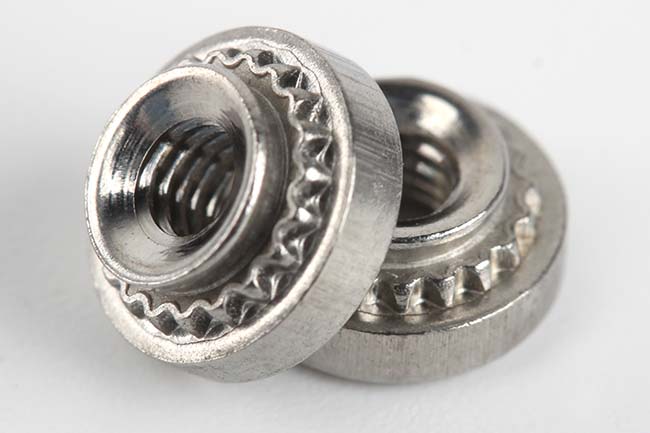
The 304 stainless self clinching nut is a press-in threaded fastener for creating permanent load-bearing threads in thin sheet metal without welding or loose hardware. This page focuses on 304 stainless steel versions with metric threads and a flush installation profile. During installation, the nut is placed into a correctly sized hole and a parallel squeezing force presses the clinching ring into the sheet. Material around the hole flows into the undercut while serrations resist rotation. Typical buyers include enclosure, electronics, and industrial equipment manufacturers.
Product Overview and Key Features
Self-clinching nuts work by controlled cold flow of the parent sheet into an undercut beneath the fastener head. This produces a mechanically retained insert with a flush or nearly flush surface on the installation side and eliminates a separate nut.
- Permanent captive thread: remains mechanically retained in the sheet after installation.
- Anti-rotation clinching ring: serrations engage the sheet to improve torque-out resistance.
- Press installation: no welding, adhesive, or rear-side wrench access is required.
- Thin-sheet capability: selected metric sizes can install in sheets from about 0.8 mm, depending on shank length and product family.
- 304 stainless construction: suitable for many electrical, humid, and general industrial environments.
304 Stainless Self Clinching Nut Specifications
Specification Overview
| Item | Typical Specification |
|---|---|
| Product form | Self-clinching / press-in threaded nut |
| Specified sales material | 304 stainless steel |
| Common metric threads | M2, M2.5, M3, M3.5, M4, M5, M6, M8, M10 |
| Thread form | Metric internal thread, commonly 6H |
| Installation method | Parallel press or squeeze force into a controlled sheet hole |
| Retention features | Clinching undercut and serrated anti-rotation ring |
| Common surface condition | Natural stainless steel; passivation commonly specified |
| Dimensional basis | Manufacturer series or customer drawing; no single universal DIN/ISO product dimension standard covers all self-clinching nuts |
Common Metric Dimensions
The table is a verified market reference based on a 300-series stainless self-clinching nut family with geometry commonly used for 304-type products. Exact 304 chemistry and final dimensions should be confirmed on the purchase drawing. A is maximum shank length, C is maximum clinching-section diameter, E is outside nut diameter, and T is overall nut thickness. Dimensions are millimetres.
| Thread | Pitch (mm) | Shank Code | A Max. (mm) | Min. Sheet (mm) | Hole +0.08 (mm) | C Max. (mm) | E ±0.25 (mm) | T ±0.25 (mm) |
|---|---|---|---|---|---|---|---|---|
| M3 | 0.5 | 0 | 0.77 | 0.8 | 4.22 | 4.20 | 6.35 | 1.50 |
| M4 | 0.7 | 0 | 0.77 | 0.8 | 5.41 | 5.38 | 7.87 | 2.00 |
| M5 | 0.8 | 0 | 0.77 | 0.8 | 6.35 | 6.33 | 8.64 | 2.00 |
| M6 | 1.0 | 0 | 1.15 | 1.2 | 8.75 | 8.73 | 11.18 | 4.08 |
| M8 | 1.25 | 1 | 1.38 | 1.4 | 10.50 | 10.47 | 12.70 | 5.47 |
| M10 | 1.5 | 1 | 2.21 | 2.31 | 14.00 | 13.97 | 17.35 | 7.48 |
Many sizes are available with more than one shank length for different sheet thicknesses. Hole diameter and edge distance must remain controlled because oversize holes or installation too close to an edge can reduce retention and distort the sheet.
Common Materials, Grades and Surface Finishes
304 Stainless Steel Material
This page is for 304 stainless steel. Established self-clinching product families often specify “300 Series Stainless Steel” rather than a single AISI grade, so buyers requiring exact 304 chemistry should state the material specification and request composition verification. The fastener must also be sufficiently harder than the sheet for the clinching feature to displace and lock into the panel.
Surface Finish Options
Natural stainless steel with passivation is a common configuration. ASTM A380-based cleaning or passivation is used in established stainless self-clinching families. Additional appearance treatments may be requested, but they must not interfere with the clinching profile or internal thread. Confirm finish, thread, shank length, and sheet material during quotation.
Typical Applications and Selection Considerations
- Electrical cabinets, control panels, server chassis, and electronics enclosures.
- Automotive brackets, battery housings, interior structures, and equipment panels.
- Appliances, HVAC housings, machinery guards, and sheet-metal frames.
- OEM assemblies requiring reusable threads without welding a nut to the panel.
Flybear’s electrical and electronics fastening solutions discuss threaded inserts and self-clinching hardware for thin panels. A critical selection point is sheet hardness: common 300-series stainless clinching nuts are intended for comparatively softer sheet. For harder stainless panels, a hardened stainless self-clinching series may be necessary instead of an ordinary 304 nut.
Ordering and Quality Documentation
An RFQ should state thread size and pitch, 304 stainless requirement, sheet thickness, sheet material and hardness, hole diameter, shank length, quantity, and surface condition. For controlled applications, also identify minimum pushout or torque-out performance and the test-sheet material. Flybear’s quality control and inspection page covers material verification, dimensional inspection, thread gauging, torque testing, and related checks; exact acceptance criteria should be agreed for the order.
Frequently Asked Questions
How does a self-clinching nut stay in thin sheet?
Press installation forces sheet material into an undercut beneath the nut head while a serrated clinching ring engages the panel. This mechanical interlock provides resistance to pushout and rotation without welding. Correct hole diameter, sheet thickness, hardness, and installation force are essential.
Can a 304 stainless self-clinching nut be installed in 304 stainless sheet?
Not automatically. The insert must be sufficiently harder than the parent sheet for reliable clinching. Common 300-series stainless nuts are often intended for softer aluminum or steel sheet. Hardened stainless self-clinching nuts are available for suitable stainless panels and should be evaluated when the sheet is too hard for ordinary 304 hardware.
What metric sizes are commonly available?
M2 through M10 are common in established metric stainless self-clinching families, with M3, M4, M5, M6, M8, and M10 frequently used in industrial sheet-metal work. Available shank lengths and performance ratings vary by thread size.
Does the installation hole need to be countersunk?
No. Standard self-clinching nuts are normally pressed into a properly sized straight hole. Countersinking or deburring that removes too much material around the hole can reduce the sheet volume needed to flow into the undercut and may weaken retention.
What information should I provide for a quotation?
Provide thread, sheet thickness, panel material and hardness, hole size, 304 stainless requirement, quantity, surface condition, and any pushout or torque-out target. Include the drawing when clinching dimensions, edge distance, or installed height are controlled.
Request a Quote for 304 Stainless Self-Clinching Nuts
Send Flybear Industrial the required thread, sheet thickness, panel material and hardness, installation-hole size, 304 stainless requirement, quantity, finish, and performance criteria. Include drawings for controlled OEM assemblies or special clinching geometry. Submit the project through the Flybear fastener RFQ page for technical review and quotation.