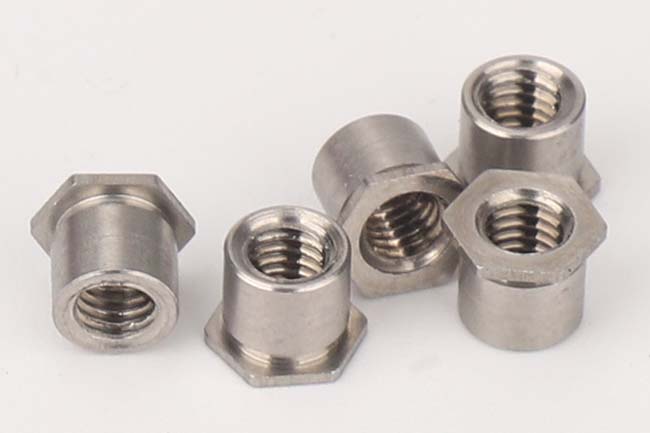
The stainless self clinching standoff is a press-in spacer and threaded mounting feature for thin sheet assemblies, positioning printed circuit boards, covers, modules, and brackets at a controlled distance from a panel. This page focuses on metric, internally threaded through-hole stainless standoffs; blind-threaded and unthreaded forms are separate options. Installation uses parallel squeezing force to displace sheet material into the clinching undercut and lock the standoff in a properly sized round hole.
Product Overview and Key Features
A self-clinching standoff combines a spacing function with a captive threaded attachment point. The clinching end installs flush or nearly flush on the reverse side while the body establishes the required spacing.
- Permanent press-in retention: the undercut and serrated ring mechanically lock into suitable sheet without welding.
- Controlled spacing: specified length supports repeatable PCB, panel, bracket, or module positioning.
- Reusable internal thread: permits mounted components to be removed and reinstalled.
- Round installation hole: simplifies punching compared with non-round insert holes.
- Multiple forms: through-hole threaded, blind threaded, and unthreaded stainless versions are established configurations.
Stainless Self Clinching Standoff Specifications
Specification Overview
| Item | Typical Market Configuration |
|---|---|
| Product form covered | Through-hole internally threaded self-clinching standoff |
| Common material | 300 Series stainless steel |
| Hardened option | 400 Series stainless steel for suitable harder stainless sheet |
| Common metric threads | M3, M3.5, M4, M5; micro and drawing-controlled sizes also exist |
| Internal thread tolerance | 6H in established metric product families |
| Common lengths | 3 to 25 mm depending on thread size and product family |
| Installation method | Parallel squeeze / press into a controlled round hole |
| Common finish | Natural stainless, commonly passivated |
| Dimensional basis | Manufacturer series or customer drawing; no single universal DIN/ISO product standard covers all self-clinching standoffs |
Through-Hole Metric Dimensions
The table is a verified market reference for 300 Series stainless, through-hole threaded self-clinching standoffs. C is clinching-section diameter, H is nominal body width, and L is projecting length. Dimensions are millimetres and should not be applied automatically to blind or hardened-stainless versions.
| Thread | Pitch (mm) | Min. Sheet (mm) | Hole +0.08 (mm) | C Max. (mm) | H Nom. (mm) | Common L (mm) | Min. Edge Distance (mm) |
|---|---|---|---|---|---|---|---|
| M3 | 0.5 | 1.00 | 4.22 | 4.20 | 4.8 | 3, 4, 6, 8, 10, 12, 14, 16, 18 | 6.0 |
| M3.5 | 0.6 | 1.00 | 5.41 | 5.39 | 6.4 | 3, 4, 6, 8, 10, 12, 14, 16, 18, 20, 22, 25 | 6.8 |
| M4 | 0.7 | 1.27 | 7.14 | 7.12 | 7.9 | 3, 4, 6, 8, 10, 12, 14, 16, 18, 20, 22, 25 | 8.0 |
| M5 | 0.8 | 1.27 | 7.14 | 7.12 | 7.9 | 6, 8, 10, 12, 14, 16, 18, 20, 22, 25 | 8.0 |
Not every length is available from every manufacturer. Hole diameter, minimum sheet thickness, edge distance, and panel hardness are critical installation variables.
Blind Threaded and Unthreaded Options
Blind threaded standoffs close the mounting hole at the panel surface, while unthreaded standoffs provide a clearance bore rather than a female thread. Their dimensions should be specified separately on the RFQ.
Common Stainless Materials and Surface Finishes
300 Series Stainless Steel
300 Series stainless is common for corrosion-resistant self-clinching standoffs. Established families typically limit these versions to sheet hardness around HRB 70 / HB 125 or less because the fastener must be harder than the sheet for material to flow into the undercut. If exact 304 or 316 chemistry is required, state the grade directly.
Hardened Stainless Steel Options
For harder stainless sheet, hardened 400 Series stainless standoffs are available in established product families and can be rated for sheet hardness up to about HRB 88 / HB 176. They should not be substituted automatically for 300 Series parts because hardness, installation force, and available configurations differ.
Surface Finish Options
Natural stainless with passivation is common. Certain hardened stainless families may also use a specified nickel finish. Zinc plating is not the default for stainless hardware. Confirm material, finish, thread, length, and mating sheet during quotation.
Typical Applications and Selection Considerations
- Printed circuit board spacing in electrical and electronic enclosures.
- Control cabinets, switchgear, power conversion equipment, and communication racks.
- Automotive electronics, battery systems, sensors, and sheet-metal modules.
- Industrial controls, instrumentation, appliances, and machinery housings.
Flybear’s electrical and electronics fastening solutions cover related inserts, standoffs, and panel hardware. Select by thread, length, panel thickness, hole size, sheet hardness, edge distance, corrosion environment, and required retention. Do not install a standard 300 Series clinching standoff into harder stainless sheet without verifying compatibility.
Ordering and Quality Documentation
An RFQ should state through-hole or blind form, internal thread and pitch, standoff length, stainless grade or series, panel material and hardness, sheet thickness, installation-hole diameter, quantity, and surface condition. For controlled applications, specify pushout, torque-out, perpendicularity, thread-gauge, or installation-force requirements. Flybear’s quality control and inspection page describes dimensional, thread, material, and hardness inspection support; exact acceptance criteria should be agreed for the order.
Frequently Asked Questions
How does a self-clinching standoff stay in the sheet?
A press pushes the clinching feature into the prepared hole. Sheet material flows into the undercut while the serrated section resists rotation, creating a permanently retained spacer without welding, adhesive, or rear-side hardware.
Can a stainless standoff be installed into stainless steel sheet?
Only when the hardness relationship is suitable. Common 300 Series stainless standoffs are intended for comparatively softer sheet. Harder stainless panels may require a hardened 400 Series version designed for the higher sheet-hardness range.
What is the difference between through-hole and blind standoffs?
A through-hole standoff has an internal thread extending through the body. A blind-threaded version has a closed end and preserves a closed outer panel surface. Select according to screw engagement, appearance, contamination control, and component clearance.
What metric sizes are common?
M3, M3.5, M4, and M5 are established metric sizes in common stainless self-clinching standoff families, with lengths from a few millimetres to about 25 mm depending on size. Micro and drawing-controlled variants also exist.
What information should I provide for quotation?
Provide thread, pitch, length, product form, stainless requirement, sheet thickness, panel material and hardness, hole size, quantity, finish, and any pushout or torque-out target. Include a drawing where clinching geometry is critical.
Request a Quote for Stainless Self-Clinching Standoffs
For a stainless self clinching standoff quotation, send Flybear Industrial the required thread, length, product form, stainless grade or series, quantity, panel thickness, sheet hardness, installation-hole size, and inspection requirements. Include drawings for controlled electronics or OEM assemblies. Submit the project through the Flybear fastener RFQ page for technical review and quotation.