DIN 25201 Wedge Lock Washer for Vibration-Resistant Bolted Joints
DIN 25201 wedge lock washer solutions are used to secure critical bolted joints against rotational loosening caused by vibration, transverse movement, and dynamic loading. These washers are particularly relevant to railway vehicles, transportation equipment, industrial machinery, energy systems, and other applications where joint reliability and controlled preload are important.
In commercial fastener sourcing, the term “DIN 25201 wedge lock washer” is often used for paired wedge-locking washers intended for demanding bolted connections. However, buyers should understand that DIN 25201 is primarily a design guideline for bolted joints in railway vehicles and their components. It should not be treated simply as a dimensional washer standard. The applicable DIN 25201 part, joint risk category, test requirements, materials, dimensions, and project specifications must all be reviewed before purchasing.
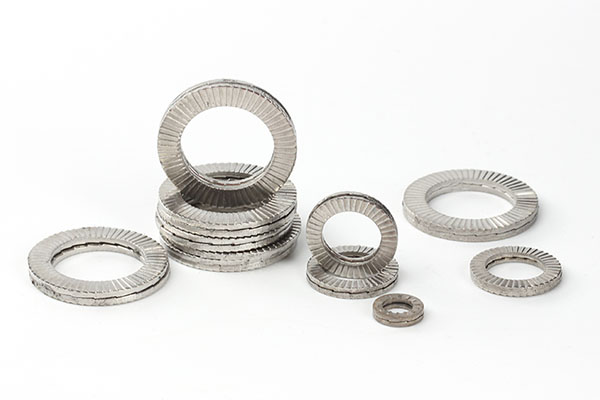
What Is a DIN 25201 Wedge Lock Washer?
A wedge lock washer consists of two matched washers installed as a pair. Each washer normally has radial serrations on its outer surface and specially designed cams on the inner surface. The cam faces are positioned against each other, while the serrated faces contact the bolt head or nut and the clamped component.
When the bolt is tightened, the external serrations grip the adjoining contact surfaces. Any tendency for the bolt or nut to rotate loose forces movement between the internal cam faces. Because the cam geometry creates a rise greater than the corresponding thread movement, loosening would require an increase in the distance between the bolt head and nut. This produces a wedge effect that helps maintain the clamping force.
The primary locking action is therefore based on geometry and bolt tension rather than relying only on friction between the threads. This makes wedge-locking washers suitable for joints exposed to repeated vibration, shock, movement, and fluctuating service loads.
Understanding the DIN 25201 Standard Series
The original DIN 25201 standard addressed the securing of bolted assemblies in railway vehicles. That earlier document has been withdrawn and replaced by a multipart standard series covering the design and assessment of bolted joints for railway vehicles and their components.
DIN 25201-1 classifies bolted joints according to their risk and functional significance. DIN 25201-4 focuses on securing bolted joints and provides guidance for selecting appropriate locking methods. Other parts of the series address subjects such as design, calculation, manufacturing, assembly, and documentation.
For sourcing managers, this distinction is important. A washer should not be described as suitable for a DIN 25201 application based only on its appearance. The complete bolted joint must be assessed, including the bolt, nut, washer pair, clamped components, surface condition, preload, tightening method, service environment, and consequences of joint failure.
How DIN 25201 Wedge Lock Washers Prevent Loosening
Bolted joints can lose preload for several reasons. Rotational loosening may occur when transverse forces create relative movement between the connected parts. Preload may also decrease because of settlement, embedding, deformation, temperature changes, or unsuitable tightening procedures.
Wedge lock washers are designed mainly to resist rotational loosening. Their serrated outer faces engage with the adjoining surfaces, while the internal cams oppose reverse rotation. When correctly selected and installed, the washer pair converts loosening movement into increased tension in the bolt.
This operating principle differs from conventional split lock washers, wave washers, and toothed washers. Those products may add spring action or surface resistance, but they do not use the same paired cam geometry. For critical vibration-resistant joints, the locking principle should be evaluated together with the operating load and required safety level.
Materials and Surface Finishes
DIN 25201 wedge lock washers may be produced from hardened steel, stainless steel, or special corrosion-resistant alloys, depending on the application. Material selection should consider the bolt property class, hardness of the contact surface, operating temperature, corrosion exposure, and maintenance conditions.
Hardened steel washer pairs are commonly considered for general industrial machinery and transportation equipment. Zinc flake coatings may be selected where corrosion resistance is required without the dimensional effects associated with thicker coatings. Stainless steel can be suitable for wet, outdoor, food-processing, chemical, or marine-related environments, provided that the selected grade is compatible with the mating fasteners and service conditions.
The washer hardness should be sufficient for the serrations to engage the adjoining surface. If the contact surface is harder than the washer, excessively soft, or easily damaged, the locking performance may be affected. Painted surfaces, thick coatings, composite materials, and soft metals require special attention during product selection.
Standard and Enlarged Outer Diameter Washers
Wedge lock washers are commonly available with a standard outer diameter or an enlarged outer diameter. Standard-size washers are suitable for many conventional hexagon bolts and nuts where the bearing surface provides adequate support.
Enlarged outer diameter washers distribute the clamping force over a wider area. They may be preferred for flanged bolts and nuts, oversized holes, slotted holes, soft materials, sensitive surfaces, or components with a large bearing face.
The selected outer diameter must fit within the available installation space. Engineers should check for interference with nearby components, recesses, curved surfaces, welds, and tooling access. The washer pair should rest on a stable, flat bearing surface to support consistent tightening and effective serration engagement.
Typical Applications of Wedge Locking Washers
DIN 25201-related wedge locking washers are particularly associated with railway vehicles and railway equipment. Potential application areas include bogies, braking systems, couplings, doors, underframe equipment, interior assemblies, electrical equipment supports, and other bolted connections exposed to vibration.
Beyond railway applications, wedge lock washers are widely considered for construction machinery, mining equipment, wind turbines, industrial gearboxes, conveyors, pumps, compressors, heavy vehicles, agricultural machinery, robotic equipment, and power-generation systems.
Application suitability should always be determined by the joint designer. A locking washer cannot compensate for an incorrectly sized bolt, insufficient thread engagement, unsuitable preload, weak clamped material, excessive joint settlement, or an incorrect tightening process.
Correct Installation of Wedge Lock Washer Pairs
The two washers must be installed as a matched pair with the cam faces positioned against each other. The serrated surfaces should face outward toward the underside of the bolt head or nut and toward the clamped component.
The joint should be tightened using an approved torque or tension procedure. Torque values should be based on the bolt size, property class, thread condition, lubrication, coating, washer material, and required preload. A generic torque chart should not replace a project-specific tightening calculation.
Wedge lock washers should not normally be separated and installed as single washers. They should also not be combined with additional plain washers unless the joint design and product instructions permit that arrangement. During maintenance, the washers should be inspected for deformation, damaged cams, worn serrations, corrosion, contamination, and changes to the contact surfaces.
Information to Include in a Purchase Inquiry
A complete request for quotation should identify the washer type, nominal bolt size, inner diameter, outer diameter, material, hardness, surface finish, quantity, packaging, and intended application. Buyers should also state whether standard or enlarged outer diameter washers are required.
For railway projects, the inquiry should include the relevant DIN 25201 part, joint classification, drawing reference, technical specification, inspection requirements, and documentation expectations. If testing according to a particular method is required, the test standard and acceptance criteria should be stated clearly.
Buyers should avoid requesting “DIN 25201 washers” without further details. The phrase does not fully define the dimensions, material, coating, performance, or verification requirements. Supplying a drawing or approved sample can reduce the risk of misunderstandings during quotation and production.
Quality Considerations for Wedge Lock Washer Sourcing
Reliable washer performance depends on controlled cam geometry, consistent serration form, material properties, heat treatment, dimensional accuracy, and surface finish. Product identification and batch traceability may also be important for transportation and other safety-related industries.
Inspection can include dimensional checks, hardness testing, coating evaluation, visual examination, and functional testing according to the purchase specification. The required inspection level should reflect the risk classification and operating conditions of the bolted joint.
Through a one-stop industrial fastener sourcing service, Flybear can support inquiries involving wedge lock washers, compatible bolts and nuts, material options, surface finishes, custom dimensions, packaging, and project documentation. Final requirements should be agreed before production so that the supplied components match the technical and commercial needs of the application.
Choosing the Right Wedge Locking Solution
Selecting a DIN 25201 wedge lock washer requires more than matching the washer to the nominal bolt diameter. Engineers and purchasing teams should evaluate joint risk, bolt grade, contact-surface hardness, hole geometry, available bearing area, corrosion exposure, temperature, tightening method, and maintenance requirements.
For critical railway or industrial joints, the washer pair should be considered as one element of the complete fastening system. Correct joint design, controlled preload, suitable materials, accurate installation, and documented inspection are all necessary for dependable service.
By providing detailed specifications at the inquiry stage, buyers can obtain a wedge-locking solution that is easier to install, inspect, maintain, and integrate into the finished assembly. This approach supports safer procurement and more reliable bolted connections in vibration-intensive applications.