DIN 125 vs ISO 7089 Flat Washers: Legacy DIN and ISO Selection Guide
The practical question behind DIN 125 vs ISO 7089 is whether a washer specified on an older drawing can be replaced by a currently specified ISO washer. The answer requires checking the washer form, dimensions, material, hardness and finish. A supplier’s cross-reference alone does not establish complete interchangeability.
DIN 125 remains common in catalogs, maintenance records and purchasing systems, although its relevant standards have been withdrawn. ISO 7089 is the reference generally associated with the unchamfered form, while ISO 7090 covers the chamfered form.
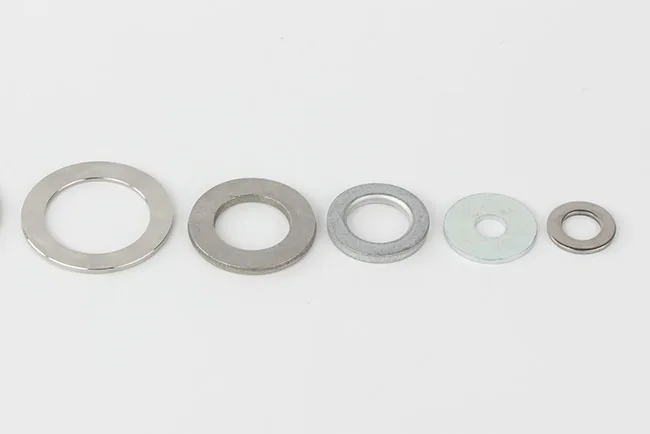
For OEM procurement teams, the goal is to translate an older requirement into a clear, verifiable specification without changing the function of the joint. This guide explains the distinctions that matter when selecting and ordering metric flat washers.
DIN 125 vs ISO 7089: What Is the Current Standard Status?
DIN 125-1:1990-03 and DIN 125-2:1990-03 are withdrawn standards. DIN Media identifies DIN EN ISO 7089:2000-11 and DIN EN ISO 7090:2000-11 as their replacement documents.
The older DIN parts distinguished hardness-related requirements: DIN 125-1 covered product grade A washers with hardness up to 250 HV, while DIN 125-2 addressed washers with hardness from 300 HV. These part numbers should not be confused with the washer form letters A and B.
At the time of writing, ISO 7089:2000 remains the published standard for normal-series plain washers of product grade A. ISO has a revision project under development, but a draft does not automatically replace the published edition.
For new drawings, specify the applicable published standard and edition. For existing equipment, use the approved drawing or maintenance specification as the starting point and document any accepted substitution.
Distinguish DIN 125 Form A from Form B
The phrase “DIN 125 washer” is incomplete when the required form is unclear. The traditional A and B forms describe different edge configurations.
| Legacy Description | Configuration | ISO Reference to Review |
|---|---|---|
| DIN 125 Form A | Plain washer without the specified chamfer of Form B | ISO 7089 |
| DIN 125 Form B | Plain washer with chamfer | ISO 7090 |
| DIN 125 without form or complete designation | Requirement needs clarification | Check the drawing, original specification and application |
This mapping identifies the relevant standards for comparison. It does not mean that every commercially available DIN-labeled washer satisfies all requirements of the corresponding ISO standard.
There is also an important terminology distinction: the “A” in DIN 125 Form A identifies a form, while “product grade A” concerns dimensional accuracy and tolerances. Product grade A does not identify a stainless-steel grade or establish a washer’s hardness class.
When reviewing flat washers for industrial assemblies, compare the complete product specification rather than relying on the headline standard number.
Which Dimensions Must Match Before Replacement?
A washer’s nominal size normally relates to the intended fastener size. It is not the same as the actual hole diameter. A washer intended for an M10 bolt, for example, needs clearance around the fastener rather than an exactly 10 mm hole.
Check the following features against the applicable standard tables and approved drawing:
- Inside diameter: Confirm clearance around the fastener and any adjacent shoulder or transition.
- Outside diameter: Confirm bearing coverage and clearance from nearby walls, recesses or components.
- Thickness: Check the joint stack and available thread engagement.
- Dimensional tolerances: Compare permitted limits, not only nominal catalog values.
- Form and surface condition: Check chamfers, flatness and applicable edge-quality requirements.
Many commonly supplied DIN 125 Form A and ISO 7089 washers share nominal dimensions. However, matching nominal dimensions does not establish matching tolerances, hardness, material or finish.
For automated assembly, small differences can also affect feeding and seating. A washer that passes a manual installation check may still require evaluation in a bowl feeder, recessed pocket or controlled assembly station.
A Practical Replacement Review
Suppose an older bill of materials calls for a DIN 125 Form A steel washer, and a supplier offers an ISO 7089 washer in the same nominal size. Compare the original dimensions and tolerances, identify the required hardness, and confirm the finish before approving the change.
If the original hardness requirement is missing, refer the decision to the responsible engineer. An old sample can help establish geometry, but wear, corrosion and an unknown production history make it an incomplete specification.
Record the approved replacement in the drawing or purchasing system so later orders do not repeat the same uncertainty.
Hardness Can Matter More Than the Standard Number
ISO 7089:2000 specifies hardness classes 200 HV and 300 HV. Commercial products sold under legacy DIN 125 descriptions can include other hardness levels, so buyers should not assume that a DIN-labeled washer automatically meets an ISO hardness requirement.
For example, a washer specified as 140 HV cannot be accepted as a 200 HV washer merely because its dimensions appear identical. Hardness must be confirmed through the product specification and the agreed verification method.
Washer hardness influences resistance to local indentation beneath the bolt head or nut. Excessive local deformation can contribute to settlement and loss of clamp load. The suitability of the complete joint also depends on the bearing area, connected material and installation conditions.
Match the Washer to the Joint Requirements
Within the scope of ISO 7089, 200 HV washers are associated with specified hexagon fasteners up to bolt property class 8.8, while 300 HV washers cover specified applications up to property class 10.9. These associations should be applied within the standard’s scope and the governing joint design.
Do not extend them automatically to every head style, structural bolting system or higher-strength fastener. A specialized assembly may require a different washer specification, geometry or mechanical requirement.
Specify Stainless Steel Separately
For stainless metric flat washers, identify the required material grade or group and mechanical requirements. Descriptions such as “stainless,” “A2” or “A4” do not independently confirm a particular washer hardness.
Likewise, do not copy a bolt designation such as A2-70 onto a washer order without identifying the applicable washer requirements. Bolts and washers have different functions and verification criteria.
If brass, aluminum or another material is required, distinguish a washer made to particular dimensions from a product claimed to comply fully with a standard. Dimensional similarity alone does not establish complete conformity.
Select the Finish for the Actual Environment
A flat washer standard does not provide a universal corrosion-life guarantee. The purchase order should identify the finish separately, including the coating specification and any required thickness, treatment or inspection details.
Common procurement descriptions include plain steel, zinc-plated steel, zinc-flake-coated steel and stainless steel. These options should be evaluated against the exposure conditions and the materials of the mating components.
Consider the following when selecting a finish:
- Exposure to moisture, chemicals or outdoor conditions.
- Compatibility with the bolt, nut and connected components.
- Coating thickness where installation clearance is limited.
- Bearing-surface friction where tightening performance is controlled.
- Applicable coating-process controls for hardened steel washers.
Changing the washer finish may change conditions beneath the rotating bolt head or nut. Where torque is used to control assembly, review the tightening procedure for the actual combination of surfaces and lubricant.
If salt-spray testing is required, specify the test method and acceptance criteria. Test hours should not be presented as an equivalent number of years in service.
Buyer Selection Table
| Purchasing Situation | Recommended Approach | Key Check |
|---|---|---|
| New general-purpose assembly requiring an unchamfered normal-series washer | Evaluate ISO 7089 | Size, material, hardness and finish |
| Existing drawing specifies DIN 125 Form A | Review ISO 7089 as a replacement candidate | Complete dimensional and functional comparison |
| Existing drawing specifies DIN 125 Form B | Review ISO 7090 | Required chamfer and remaining specification |
| Soft connected material or an oversized hole | Check whether a larger bearing area or different washer design is needed | Bearing pressure, support and deformation |
| Restricted outside diameter or special thickness | Consider a drawing-defined washer | Clearance, stack height and tolerances |
| Joint requires sealing or resistance to rotational loosening | Select a component designed and validated for that function | Application-specific performance |
A general-purpose flat washer provides a bearing interface and can distribute load over a larger area. It should not be treated as a sealing washer or a dedicated locking device.
This distinction matters in hydraulic, pump and valve equipment, where external mounting washers and pressure-boundary sealing components serve different purposes. Where standard geometry does not meet the design, drawing-based custom fasteners and washers can be reviewed against the application requirements.
Inspection and RFQ Checklist
A useful RFQ gives the supplier enough information to quote the required washer without choosing an unspecified hardness or finish on the buyer’s behalf.
- Standard and edition: State ISO 7089, ISO 7090 or the exact legacy requirement.
- Size and geometry: Identify nominal size and any drawing-controlled dimensions.
- Material: Specify steel, stainless grade or another agreed material.
- Hardness: State the required class and any additional mechanical requirements.
- Finish: Include coating specification, thickness and supplementary treatment where required.
- Application: Describe the mating fastener and relevant joint conditions.
- Quantity and packing: Give order quantity, pack quantity and labeling requirements.
- Inspection documents: Define dimensional reports, hardness results, material records and traceability requirements.
At receiving inspection, check identity, dimensions, form, visible defects and coating condition. Where hardness verification is required, use an appropriate test method and sampling plan. Appearance alone cannot distinguish otherwise similar hardness classes.
Keep different materials and hardness classes separated and labeled during storage. This is particularly useful when several washer variants share the same nominal size.
Agree on the inspection scope before ordering. Flybear’s quality control and inspection support can help define the checks and records required for the supply specification.
Frequently Asked Questions
Is DIN 125 still a current standard?
DIN 125-1:1990-03 and DIN 125-2:1990-03 are withdrawn. The designation remains common commercially, so buyers should clarify whether the order requires a legacy specification or an approved ISO replacement.
Is every DIN 125 washer interchangeable with ISO 7089?
No. First identify the form, then compare dimensions, tolerances, material, hardness and finish. Form B requires consideration of the chamfered ISO 7090 configuration.
Does product grade A mean stainless steel?
No. Product grade A concerns dimensional accuracy and tolerances. Material grade and hardness are separate specifications.
Can a 140 HV washer replace a 200 HV washer?
It does not meet a 200 HV requirement simply because it fits. Any proposed departure from the specified hardness requires technical review and approval.
Can ISO 7089 washers prevent loosening or seal a joint?
The standard defines plain washers, not a dedicated locking or sealing system. Those functions require suitable components and validation for the specific assembly.
Make the Replacement Decision from the Complete Specification
The DIN 125 vs ISO 7089 comparison is most useful when it leads to a complete purchasing requirement. Identify the legacy form, review the relevant ISO standard, and verify geometry, material, hardness and finish before approving substitution.
Flybear supplies standard and custom fastening products and supports order-specific requirement review. Send your washer standard or drawing, size, material, hardness, finish, quantity and inspection requirements through the washer quotation request page for review.