A193 B7 A194 2H: Stud Bolt and Nut Pairing Basics for Buyers
An A193 B7 A194 2H assembly combines ASTM A193 Grade B7 stud bolts with ASTM A194 Grade 2H nuts. This pairing is commonly specified for industrial flange connections, valves, pressure equipment and related applications. However, specifying the two grades alone does not define a complete, ready-to-install fastening set.
Buyers must also confirm thread compatibility, nut geometry, stud length, coating, inspection requirements and traceability. Two quotations described as “B7 studs with 2H nuts” can therefore represent different products, documentation packages and assembly conditions.
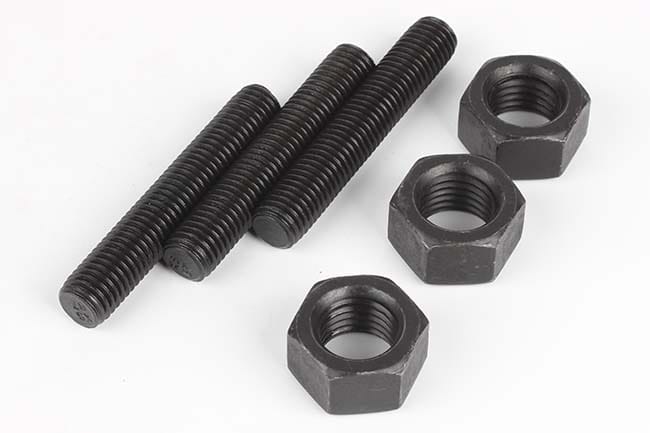
This guide focuses on purchasing the stud and nuts as a coordinated assembly, helping procurement teams identify missing information before an order reaches production or installation.
What Does A193 B7 A194 2H Mean?
The designation refers to two separate component specifications. ASTM A193/A193M addresses alloy-steel and stainless-steel bolting for elevated-temperature, pressure and other specified applications. ASTM A194/A194M addresses nuts for high-pressure or high-temperature service, or both.
| Item | B7 Stud Bolt | 2H Nut |
|---|---|---|
| Specification | ASTM A193/A193M, Grade B7 | ASTM A194/A194M, Grade 2H |
| Material description | Quenched and tempered chromium-molybdenum alloy steel | Quenched and tempered carbon steel |
| Function in the connection | Carries tensile load generated during tightening | Transfers load through the engaged threads and bearing face |
| Important verification | Chemistry, mechanical properties, dimensions and thread conformity | Chemistry, hardness, applicable proof-load requirements, dimensions and threads |
B7 and 2H are grade designations. They do not, by themselves, specify a thread pitch, stud length, coating system or complete dimensional configuration. An A194 2H nut should not be described as alloy steel simply because its mating B7 stud is alloy steel.
The current ASTM catalog editions at the time of writing are A193/A193M-26 and A194/A194M-26. Purchase documents should identify the edition required by the contract, together with any supplementary requirements.
Why Are B7 Studs Commonly Paired with 2H Nuts?
Grade 2H nuts are commonly selected with B7 bolting because their specified mechanical performance supports this established fastening combination. Correct pairing helps the nut sustain the assembly load without becoming an inadequately specified component in the connection.
Nut selection is not a matter of matching the stud’s tensile-strength number. Nut proof-load performance, hardness, geometry, thread engagement and dimensional condition all matter. A nut that screws onto a stud has demonstrated basic assembly fit, but this does not establish grade conformity or load capability.
The pairing also does not assign a pressure rating to the completed joint. Suitability depends on the equipment design, flange, gasket, service conditions and assembly procedure. Engineering requirements take priority over a supplier’s standard pairing practice.
For a product example, review the B7 stud bolt with 2H nut assembly, then confirm the finish and inspection scope required for the actual project.
Confirm Threads and Dimensions Before Comparing Prices
Specify the Complete Thread Designation
Nominal diameter alone is insufficient. The stud and nut must have compatible thread systems, pitches, forms and tolerance classes. Inch threads should be identified by their full designation; metric threads require the diameter, pitch and applicable tolerance information.
UNC and 8UN threads are both encountered in pressure-bolting procurement. Do not assume that every inch-series B7 stud uses UNC, or allow a supplier to substitute an available pitch without approval.
For inch Unified threads, ASME B1.1 provides the relevant thread framework. The purchase specification should establish the required thread series and fit, including how the finished coating condition will be accommodated and inspected.
Hand assembly is a useful practical check, but it does not replace specified thread gauging. A loose assembly can still be dimensionally unacceptable.
Confirm Nut Geometry Separately from Grade
Heavy hex nuts are commonly used in B7/2H pressure-bolting assemblies. Nevertheless, the order should identify the required nut style and dimensional standard. ASME B18.2.2 covers inch-series nut dimensions, including heavy hex configurations.
Nut height, width across flats and bearing-face geometry affect engagement and installation clearance. Replacing a specified heavy hex nut with a thinner or smaller nut changes the assembly, even when the replacement has the same nominal thread.
Define Stud Length and the Measurement Method
Confirm whether the drawing defines overall length or another length convention. Point and chamfer geometry can affect usable thread engagement, so an unclear length description can produce different interpretations.
The approved length must accommodate the joint stack, both nuts, any specified washers and the required thread projection. Access for sockets or tensioning equipment may impose additional requirements.
Fully threaded studs, double-end studs and tap-end studs should not be treated as identical purchasing items. Where the configuration is unclear, provide a drawing alongside the relevant industrial stud bolt requirements.
Treat Coating and Tightening as Assembly Requirements
A finish selected for the stud must be considered together with the nut. Coating thickness can affect thread fit, while coating and lubrication influence the relationship between applied torque and resulting stud tension.
Before approving a coated B7 2H stud bolt set, confirm:
- The coating specification and thickness requirements for each component.
- The permitted thread allowance or nut-tapping arrangement.
- The final inspection condition after coating.
- The lubricant or integral lubricating topcoat, where specified.
- The temperature and chemical compatibility of the complete coating system.
- Applicable process controls for hydrogen-embrittlement risk.
“Zinc plated,” “hot-dip galvanized” and “PTFE coated” describe different finish categories. They should not be accepted as equivalent alternatives without technical review. Likewise, a coating color does not identify its specification or friction characteristics.
Do not transfer a torque value from a plain assembly to a lubricated or coated assembly without validation. The installation procedure must address the actual surface condition and joint requirements. ASME PCC-1 provides an assembly framework for pressure-boundary flange joints within its scope; it does not create one universal torque value for B7/2H fasteners.
Inspect and Document Both Components
Check the Stud and Nut Records Independently
One assembled set may contain a stud and nuts produced from different heats and manufacturing lots. That is not automatically a problem, provided the specified conformity and traceability requirements are maintained for each component.
A B7 material certificate does not establish that the accompanying nuts conform to A194 Grade 2H. Request records that clearly identify which components, sizes and batches they cover.
The agreed inspection plan should address stud chemistry and mechanical properties, nut chemistry and applicable hardness and proof-load requirements, dimensional inspection, thread gauging and coating verification. Test frequency and sampling should follow the applicable standards and purchase requirements.
Maintain Traceability Through Packing
Check required grade and manufacturer identification markings against the supplied documents. Marking is useful for identification, but it does not replace supporting records.
For mixed-size orders, label each package with the purchase-order item, stud size, length, nut grade, quantity and relevant traceability references. Avoid combining visually similar nuts from different grades in one unsegregated container.
Agree on the certificate format, inspection reports and any witness requirements before production. Buyers can use Flybear’s fastener quality control and inspection information as a starting point for defining an order-specific inspection scope.
Common Purchasing Mistakes
- Ordering only by grade: “B7 with 2H” leaves thread, length, nut geometry and finish unresolved.
- Confusing sets with pieces: Define how many nuts and washers, if any, belong to each stud.
- Accepting unapproved substitutions: A different nut grade or dimensional configuration requires review.
- Treating B7M or 2HM as spelling variants: These are distinct grades, not automatic replacements for B7 and 2H.
- Approving finish by appearance: Similar-looking coatings can have different specifications and assembly behavior.
- Checking documents only at shipment: Missing inspection or traceability requirements may be difficult to resolve after production.
RFQ Checklist for an A193 B7 A194 2H Assembly
A useful RFQ defines the complete supply unit and separates mandatory requirements from alternatives offered for review.
- Stud specification: ASTM standard, edition, Grade B7 and applicable supplementary requirements.
- Nut specification: ASTM standard, edition, Grade 2H, nut style and dimensional standard.
- Thread: Diameter, pitch or threads per inch, series, tolerance class and direction.
- Stud geometry: Configuration, length convention, tolerances and end details.
- Set composition: Studs, nuts and any separately specified washers per set.
- Finish: Coating specification, thickness, lubrication and final thread-fit requirements.
- Application: Equipment type, operating conditions and governing project specification.
- Inspection: Required tests, reports, traceability and any third-party involvement.
- Commercial scope: Set quantity, packing, delivery destination and requested schedule.
For example, an RFQ for 500 sets should explicitly state whether each set contains one stud and two nuts. If so, the quotation must cover 500 studs and 1,000 nuts, with additional spares listed separately.
When comparing suppliers, check whether their prices cover the same documents, coating system, inspection scope and packing arrangement. Ask each supplier to identify deviations explicitly instead of embedding assumptions in a short product description.
Frequently Asked Questions
Are 2H nuts mandatory for every B7 stud?
No. Grade 2H is a common pairing, but the governing design and project specification determine the required nut. Confirm any alternative through the purchaser’s technical approval process.
Is an A194 2H nut made from the same material as a B7 stud?
No. B7 is a chromium-molybdenum alloy-steel bolting grade. Grade 2H is a quenched and tempered carbon-steel nut grade. Compatible components do not need identical chemical compositions.
Can metric and inch components be combined?
They must not be paired simply because their nominal diameters appear close. The mating threads must share a compatible system, pitch, form and fit. Clearly distinguish metric dimensions from inch dimensions converted for reference.
Does a 2H marking confirm that a nut is suitable?
The marking helps identify the grade, but suitability also requires the correct dimensions, thread, finish and supporting conformity records. It does not independently establish project acceptance.
Can one torque chart be used for all B7/2H sets?
No. Required tightening depends on the joint design, target preload, size, lubrication, coating and assembly method. Use the approved procedure for the actual connection and supplied surface condition.
Specify the Complete Assembly Before Ordering
An A193 B7 A194 2H designation is a useful starting point. A complete purchasing specification connects those grades to the correct geometry, threads, finish, inspection records and set composition.
As an industrial fastener supplier, Flybear supports standard and drawing-based requirements, specification review and order-specific inspection coordination. Send your stud and nut specifications, quantities, application details and documentation requirements through the fastener quotation request page for review.