PTFE Fasteners: When Low Friction and Chemical Resistance Matter
PTFE fasteners are worth considering when chemical exposure, electrical isolation, or low-friction contact matters more than high mechanical strength. They can be useful for lightly loaded equipment components, insulating connections, and assemblies exposed to compatible chemicals. Their main limitation is deformation under sustained load: a PTFE screw, nut, or washer can change shape over time even when the material shows no chemical damage.
That makes material selection a question about the complete joint. A screw holding a small sensor bracket has a different job from a bolt maintaining pressure on a gasket. Both may encounter the same cleaning liquid, but they do not necessarily need the same fastener. This guide explains where PTFE helps, where creep becomes important, and what buyers should confirm before ordering.
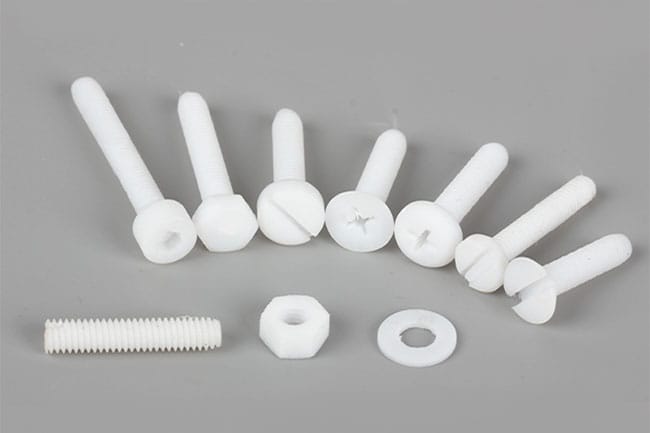
Table of Contents
- What are PTFE fasteners?
- What low friction contributes
- How to assess chemical resistance
- Why creep affects clamping
- Unfilled, modified, and filled PTFE
- Applications and selection examples
- Testing and ordering requirements
- Frequently asked questions
What Are PTFE Fasteners?
PTFE stands for polytetrafluoroethylene, a fluoropolymer known for chemical resistance, electrical insulation, and a low-friction surface. Solid PTFE fasteners use the polymer as the body of the part. Depending on the drawing, this can include screws, bolts, nuts, washers, spacers, and other machined components.
AGC’s Fluon PTFE technical brochure describes these material characteristics and publishes test data for the polymer. Those data help screen materials; they do not establish a tightening torque or load rating for a finished threaded part. The grade, manufacturing process, geometry, and mating components all contribute to performance.
Solid PTFE and PTFE-coated metal are different products
A solid PTFE bolt has a polymer head and threaded body. A PTFE-coated steel bolt has a metal body with a surface coating. The metal provides the principal structural strength of the coated bolt, while the coating changes surface behavior. The two products cannot be selected or installed on the same basis simply because both descriptions contain “PTFE.”
For a nonmetallic connection, specify solid PTFE and the required grade. For a coated metal connection, specify the metal grade and coating system separately. Buyers can review the PTFE fastener range when identifying a solid-polymer configuration.
What Low Friction Contributes to an Assembly
A low-friction surface can be useful where a washer, spacer, or retaining component contacts a moving part. For example, a lightly loaded guide assembly may use a PTFE contact surface to reduce resistance to movement. The benefit depends on the contact pressure, surface finish, speed, and counterpart material. A friction value from one laboratory test should not be treated as a fixed value for every joint.
Low friction is also different from wear resistance. If the part experiences repeated sliding, assess how much material it loses and whether that loss changes the assembly clearance. A component may move freely at first yet wear beyond its acceptable dimensions during service. A representative movement test is more useful than selecting solely from a coefficient-of-friction figure.
For threaded parts, use low friction as a reason to review installation rather than as permission to tighten harder. PTFE screws and nuts still have limits at their threads, drive features, and bearing faces. Do not transfer a torque setting from a steel screw or another plastic grade without evaluating the finished assembly.
How to Assess Chemical Resistance
PTFE resists many chemical environments that are difficult for other materials. That is a reason to shortlist it for chemical-resistant plastic screws and related hardware. Compatibility still needs to be checked for the exact medium and grade. A broad description such as “acid service” or “chemical equipment” leaves too much unspecified.
Give the supplier the chemical name, concentration, temperature, and duration of exposure. Include cleaning fluids and rinse cycles as well as the normal process medium. Intermittent splashes on an open bracket differ from continuous immersion or liquid retained around a threaded recess. Where the fluid is a mixture, identify the relevant constituents instead of assuming that a resistance rating for one ingredient covers the mixture.
Chemical compatibility does not establish mechanical suitability
A PTFE component may remain chemically intact while deforming under load. Consider a nut securing a small probe holder. The material may resist the fluid, but the assembly still needs enough usable thread engagement and dimensional stability to hold the probe in position. Chemical compatibility and mechanical function should therefore have separate acceptance criteria.
ISO 175 describes immersion testing of plastic specimens without external restraint. It does not cover environmental stress cracking. When reviewing a report based on that method, check what properties were measured after immersion and whether the test represents the exposure of interest. An unloaded specimen result does not establish the performance of a tightened fastener.
For a new application, use compatibility information to select candidates, then expose finished parts or representative assemblies to the expected conditions. Check the function that matters: thread fit, retained position, spacer height, or clamp force. Looking only for visible chemical attack can miss a mechanically unacceptable change.
Why Creep Matters in PTFE Fasteners
PTFE can continue to deform under sustained stress, a behavior commonly called creep or cold flow. It can occur without melting and can be relevant at room temperature. Under a roughly constant compressive load, a washer may gradually change thickness. In a constrained joint, time-dependent deformation can reduce the initial clamping force. Temperature, stress, time, and grade all affect the result.
This matters because many fasteners are expected to maintain a connection for months or years. A successful installation proves that the part assembled; it does not prove that the joint will retain its required condition throughout service. A PTFE spacer might remain in one piece while compressing enough to alter a component gap.
Check the loaded contact area
Examine where force enters the polymer. A narrow bearing face or an uneven mating surface can concentrate contact pressure. A larger, smooth bearing area may help distribute the load, but it does not eliminate creep. The drawing should define the contact geometry, acceptable movement, and required function of the joint.
For a washer beneath a metal bolt, ask whether the washer is only an isolating interface or part of a joint that must retain a defined preload. If its thickness changes, what happens to the assembly? For a PTFE nut, check whether the thread engagement and load are compatible with the required service life.
Test the joint after time under load
A useful trial includes a defined holding period at the expected temperature and load. Measure an appropriate result before and after exposure. For a spacer, that may be height. For a retaining screw, it may be whether the attached part stays within its positional tolerance. For a clamped assembly, evaluate retained clamp force or another approved functional measure.
If the trial fails, changing the grade is only one option. The design may need a different load path, bearing geometry, or material. Repeatedly tightening the same part to compensate for deformation is not a substitute for an agreed assembly and maintenance procedure.
Unfilled, Modified, and Filled PTFE
“PTFE” does not identify a single set of properties. Unfilled PTFE, chemically modified PTFE, and compounds containing fillers can differ in creep, stiffness, wear, conductivity, and permeability. Ask which material is being offered before comparing quotations or test reports.
| Material description | Why it may be considered | What to confirm |
|---|---|---|
| Unfilled PTFE | Applications emphasizing the base polymer’s chemical and electrical characteristics. | Exact resin grade, material traceability, and deformation under the intended load. |
| Modified PTFE | Applications needing a different balance of creep, stiffness, or permeation behavior. | The specific modified grade and evidence for the property that matters. |
| Filled PTFE | Applications where a selected filler improves wear or deformation behavior. | Filler type and content, chemical compatibility, electrical properties, and any cleanliness requirements. |
AGC’s PTFE filler guide explains how fillers change performance. For example, bronze can improve wear behavior and conductivity while reducing chemical inertness. An improvement in one property can therefore affect another requirement. If electrical isolation is essential, do not approve a compound solely because its description includes PTFE.
Modified grades can offer reduced creep compared with conventional PTFE, but that does not make them interchangeable with every unfilled or filled grade. Record the approved material on the drawing or purchase specification so later orders can be checked against the same requirement.
Temperature, Insulation, and Cleanliness
PTFE material literature often lists a broad temperature capability. A threaded connection needs a narrower question answered: at the actual temperature, how much load can the finished part sustain for the required time? A polymer can remain thermally intact while becoming too compliant for the joint. Include continuous temperature, short peaks, and thermal cycling when evaluating the part.
Thermal expansion also matters where a polymer fastener or spacer is constrained by metal components. A room-temperature fit check will not show every change during heating and cooling. Trial the complete assembly when clearances or component position are important.
For electrical equipment, verify the selected grade and the required insulating function. For semiconductor, laboratory, or other cleanliness-sensitive equipment, identify the applicable cleaning, packaging, and material-document requirements separately. Neither a white appearance nor a PTFE label establishes a particular purity level, cleanroom classification, or regulatory approval.
Where PTFE Fasteners Are Worth Evaluating
| Application example | Reason to consider PTFE | Main verification point |
|---|---|---|
| Chemical dosing or laboratory equipment | Small retaining parts exposed to a compatible reagent or cleaning fluid. | Exposure conditions and the load needed to maintain position. |
| Electrical and instrumentation assemblies | Insulating screws, washers, or spacers where the selected grade meets electrical requirements. | Insulation performance, local temperature, and dimensional change. |
| Lightly loaded guides and moving interfaces | Low-friction contact at a washer, spacer, or retaining component. | Wear, clearance, and deformation over the expected movement cycle. |
| Process equipment accessories | Nonmetallic attachment points where chemical exposure drives material selection. | Whether the connection is lightly loaded or must maintain a defined clamping force. |
Consider a sensor mount in a chemical treatment system. PTFE may be a candidate for the exposed retaining hardware if the fluid is compatible and the load is modest. A nearby joint maintaining gasket compression has a different duty. The appropriate fastener material and load-carrying arrangement should be assessed separately for each connection.
When sustained stiffness or tight dimensional control is the main requirement, compare alternatives within the engineering plastic fastener range. Chemical resistance alone should not determine the choice between PTFE, PEEK, nylon, or another polymer.
What to Include in a PTFE Fastener Inquiry
Give suppliers enough information to quote the same part and material. A useful inquiry includes:
- Geometry: Fastener type, diameter, pitch, length, head or drive, and a drawing for non-standard features.
- Material: Unfilled, modified, or filled PTFE; the required grade and any restrictions on fillers or recycled content.
- Service conditions: Load, time under load, continuous and peak temperatures, and movement or maintenance cycles.
- Chemical exposure: Medium, concentration, temperature, contact duration, and cleaning sequence.
- Acceptance requirements: Critical dimensions, thread fit, functional tests, material records, cleanliness, and packaging.
- Commercial details: Quantity and delivery requirements.
Agree on the condition and temperature for dimensional inspection if tight tolerances matter. For threads, define how fit will be checked rather than relying only on nominal size. A sample should also be evaluated in its intended mating component. The quality control and inspection overview can help buyers prepare an order-specific inspection scope.
Frequently Asked Questions
Are PTFE fasteners and Teflon fasteners the same?
PTFE is the polymer name. Teflon is a brand used for fluoropolymer products. A description such as “Teflon fasteners” should be clarified to identify the actual polymer, grade, and whether branded resin is required. Solid PTFE and fluoropolymer-coated metal parts should also be distinguished.
Can PTFE bolts replace stainless steel bolts at the same size?
Not on dimensions alone. The strength, stiffness, time-dependent deformation, and installation behavior differ. Review the load and function of the joint before considering the change, then test the finished assembly where required.
Does low friction prevent loosening?
Low friction does not establish resistance to loosening. Joint movement, retained clamp force, and the fastening arrangement still matter. If loosening is a concern, evaluate the assembly under representative operating conditions.
Is filled PTFE always better than unfilled PTFE?
No. A filler may improve wear or creep behavior while changing conductivity or chemical compatibility. Select the compound against all relevant requirements, not only the property improved by the filler.
Can a PTFE washer also act as a seal?
Only when the washer and joint are designed and qualified for that function. Material compatibility does not establish sealing performance. Surface condition, geometry, compression, pressure, and deformation over time need separate evaluation.
Select PTFE for the Function It Performs
PTFE fasteners are useful candidates when chemical resistance, electrical isolation, or low-friction contact drives the design. Their value is strongest when the required load and dimensional stability are compatible with the selected grade. Check creep and the finished joint before treating a successful assembly as proof of long-term performance.
To discuss an application, send your drawing and operating requirements to Flybear. Include the material preference, size and thread, quantity, load, temperature, chemical exposure, and any insulation or inspection requirements.