PEEK vs Nylon Fasteners: Strength, Temperature and Chemical Resistance
When comparing PEEK vs nylon fasteners, start with what the joint must do after months of service. Nylon is often the practical choice for light-duty covers, spacers, and electronic assemblies in moderate conditions. PEEK is worth evaluating when heat, moisture, chemical exposure, or sustained load makes it difficult for nylon to hold its dimensions or maintain the required clamp force.
The choice is rarely as simple as buying the stronger plastic. A screw holding an access cover and a washer carrying a continuous compressive load can need different materials, even on the same machine. This guide compares representative grades of unfilled PEEK and PA66 nylon and explains how to use their datasheets without mistaking resin test results for finished fastener ratings.
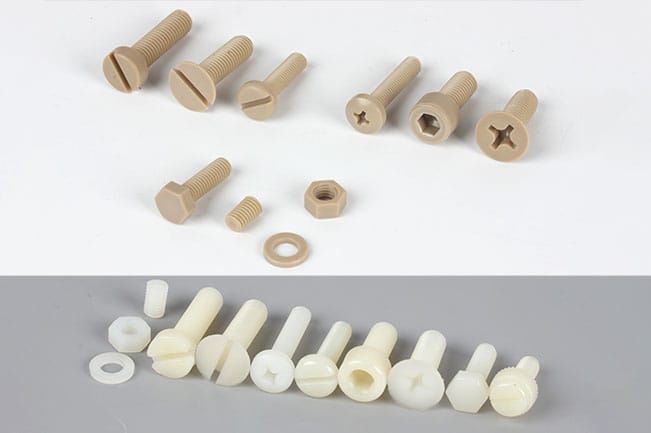
Table of Contents
- PEEK vs nylon fasteners at a glance
- Strength, stiffness, and clamp load
- Temperature limits under load
- Moisture and chemical exposure
- Application examples
- Sample testing and ordering
- Frequently asked questions
PEEK vs Nylon Fasteners at a Glance
PEEK stands for polyetheretherketone. Nylon is a family of polyamides that includes PA6 and PA66, as well as grades formulated for specific conditions. A description such as “nylon screw” leaves the grade open. Likewise, a PEEK screw may be made from an unfilled or reinforced grade, and those versions can behave differently in the same joint.
The table uses two published resin grades as examples: VICTREX 450G unfilled PEEK and BASF Ultramid A3K unfilled PA66. The values are typical material data. They do not identify the grade used in any specific Flybear product or state what a finished screw, nut, or washer can carry.
| Property | Unfilled PEEK: VICTREX 450G | Unfilled PA66: Ultramid A3K | Why it matters |
|---|---|---|---|
| Tensile yield stress at 23°C | 98 MPa | 85 MPa dry; 50 MPa conditioned | For nylon, check whether the quoted value reflects the expected moisture condition. |
| Tensile modulus at 23°C | 4,000 MPa | 3,000 MPa dry; 1,100 MPa conditioned | Stiffness affects how much the part deforms under load. |
| Deflection temperature at 1.8 MPa | 152°C, unannealed specimen | 75°C | Useful for screening resin grades. The numbers are not operating limits for an installed fastener. |
| Water absorption at saturation, 23°C | 0.45%, ISO 62 | 8–9%, method listed as similar to ISO 62 | The difference flags moisture as a design variable for PA66. These figures do not directly predict thread swelling or fit. |
The most useful comparison is often the dry and conditioned data for the same nylon grade. In this example, conditioning changes both strength and stiffness. If a fastener arrives dry but operates in a humid enclosure, a trial run on a new part at the workbench may miss the behavior that matters in service.
Strength, Stiffness, and Clamp Load
Strength and stiffness answer different questions. Strength helps describe when the material yields or fails in a test. Stiffness describes how much it deforms under load. A cover screw needs enough strength to survive assembly and service. A spacer under a circuit board may need to keep a set height without tilting or compressing too far. A washer beneath a screw head may matter mainly because it must retain its thickness over time.
Check what happens after tightening
Plastics can creep under sustained load. A washer or spacer can compress gradually, and a threaded assembly can lose part of its initial clamp force. Heat can make time-dependent deformation more important. PEEK may give the design more room to meet a stiffness or temperature requirement, but it still needs to be assessed at the expected load, temperature, and duration.
For example, an insulating washer under a metal screw may look undamaged after assembly while the joint slowly loses clamp force as the washer compresses. Comparing tensile strength alone will not resolve that problem. Compare the finished washers at the intended thickness and contact area, using a representative joint and the expected thermal cycle.
Review the thread and drive as part of the assembly
For PEEK screws and nylon screws, the limit may be the drive recess, the screw thread, the mating thread, or the material beneath the head. Diameter and pitch identify the thread. They do not establish an installation torque. A plastic screw fitted into a metal insert can behave differently from the same screw fitted into a plastic housing.
If the assembly will be opened during maintenance, include removal and reinstallation in the evaluation. Check for damaged drives, worn threads, and changes in fit. When changing from nylon to PEEK in an existing design, verify that the existing tool setting and mating parts work with the new screw.
How to Compare Temperature Limits
Heat deflection temperature, or HDT, is one useful screening value for engineering plastic fasteners. ISO 75-1 describes a test in which a specimen deflects under a defined bending load as temperature rises. Compare the stated test load and specimen conditions. A value measured at 0.45 MPa should not be presented as directly equivalent to a figure measured at 1.8 MPa.
HDT, melting point, and continuous service temperature are separate values. A screw does not have to melt to lose its ability to clamp a joint. A washer can deform, a mating thread can soften, or a spacer can move outside its dimensional tolerance while the assembly remains intact. For loaded joints, look for data relevant to the duration and temperature of service, then verify the part in the joint.
Measure the temperature where the fastener sits. In an electronics enclosure, a screw near a heat sink or power component may run warmer than one holding a panel farther away. In process equipment, a short cleaning cycle may expose a fastener to a higher temperature than normal operation. Record the continuous temperature, peak temperature, time at peak, and frequency of cycling before selecting high temperature plastic fasteners.
Moisture and Chemical Exposure
Humidity and water can change nylon fit
Nylon can absorb moisture from humid air or liquid water. As moisture content changes, the material can become less stiff and its dimensions can change. The impact on a fastener depends on its grade, shape, and conditioning. A slight dimensional change may be acceptable for a loose cover but relevant to a spacer that sets a precise gap or a screw that fits a close-tolerance tapped hole.
PEEK generally absorbs less water than conventional PA66, which makes it a useful candidate when close fit must be maintained through changes in humidity. For a tight-tolerance part, agree on the condition in which dimensions will be checked. A dry inspection can establish the as-supplied size; it cannot show how the part will fit after an extended period in service.
Name the chemical and the way it reaches the joint
“Chemical resistant” is too broad to specify a plastic fastener. Identify the liquid or vapor, its concentration and temperature, and whether exposure is occasional, repeated, or continuous. A joint that sees a brief cleaning spray and then drains is different from a threaded recess that retains the same liquid. The time in contact and the stress on the fastener both matter.
PEEK is often shortlisted for chemical exposure, but compatibility still depends on the specific medium. Nylon may remain suitable where the grade data and part testing support it. For a plant that uses several cleaning fluids, list each relevant fluid and the sequence of cleaning, rinsing, and drying. When reviewing a resistance chart, check how the test was run. A result from an unloaded specimen in a single liquid should not be treated as evidence for a preloaded fastener exposed to a changing mixture.
Which Material Fits the Application?
| Application | Where nylon is worth evaluating | Where PEEK is worth evaluating | What to verify |
|---|---|---|---|
| Electronics and instrumentation | Light-duty enclosure screws and spacers in moderate indoor conditions. | Hardware near heat sources or spacers with tight dimensional requirements. | Local temperature, required electrical properties, and fit after conditioning. |
| Chemical processing and water treatment | External fittings with limited exposure where compatibility has been verified. | Hardware exposed to elevated temperatures or repeated chemical contact, subject to grade and joint evaluation. | Medium, concentration, temperature, exposure time, and mechanical load. |
| Semiconductor and clean equipment | General hardware outside areas with specific cleanliness or purity requirements. | Close-tolerance components where heat or chemical exposure rules out simpler materials. | Exact grade, fillers, and any cleanliness, extractables, or documentation requirements. |
| Precision machinery | Covers and lightly loaded spacers with generous fit tolerances. | Dimensionally sensitive washers, spacers, or fasteners exposed to heat and sustained load. | Dimensional change, creep, and repeat assembly in a representative joint. |
A single machine may justify both materials. For example, nylon may meet the needs of an outer access panel, while PEEK is worth testing for an insulating spacer near a hot component. Review the duty of each part before applying one material choice across the assembly. The engineering plastic fastener range includes several polymer families to consider when the choice extends beyond PEEK and nylon.
What to Test Before Approving a Material Change
- Define the part and the joint. Record the thread size and pitch, head or drive, clamped thickness, mating material, and whether the joint needs insulation or a defined clamp force.
- Define the actual exposure. Record operating and peak temperatures, humidity or immersion, chemicals, and the expected time under load. Include cleaning or maintenance cycles if they change the conditions.
- Confirm the candidate grade. State PA66 or the required PEEK grade, whether fillers are allowed, and any requirements for color, cleanliness, or electrical properties. If electrical isolation matters, verify that the selected formulation meets the requirement.
- Trial the finished fastener. Use the actual mating parts where possible. Check installation, fit after exposure, and the function that matters most, such as retained clamp force, spacer height, or successful removal.
- Agree on inspection and records. Identify which dimensions, thread checks, material records, and test results are required. The fastener inspection overview can help define the checks for a drawing-based inquiry.
Make the acceptance criteria specific to the function. For a spacer, that may mean an agreed height after a heat and humidity cycle. For a cover screw, it may mean that the screw can be removed and refitted without drive damage or thread stripping. For a clamping joint, it may mean that the assembly retains a specified minimum clamp force after a defined time. “The sample looked fine” leaves those decisions open.
Frequently Asked Questions
Are PEEK fasteners always stronger than nylon fasteners?
No. Compare the exact grades, conditioning, and form of the part. Unfilled and reinforced grades can differ substantially. A resin tensile result is also not a thread pull-out or torque rating for a finished screw.
Can I replace a nylon screw with PEEK at the same size?
Possibly. Check the fit, mating thread, installation setting, and required electrical properties. Test the replacement if the screw maintains clamp load or has to withstand repeated service.
Does a higher HDT mean a higher safe operating temperature?
HDT shows how a specimen behaves in a defined test. Use it to screen candidates, then review the actual temperature, load, time, and acceptable deformation of the assembly.
Is PEEK always the better choice for wet or chemical service?
No. Its low water absorption can help where moisture affects fit, but chemical compatibility depends on the medium and exposure. If either grade lacks relevant data, test the finished part under representative conditions.
Can reinforced PEEK be used where electrical insulation is required?
Check the exact grade and filler. Carbon-filled formulations can have different electrical behavior from unfilled PEEK. Specify the electrical requirement rather than relying on the PEEK name alone.
Choose the Material for the Joint
The practical decision in PEEK vs nylon fasteners is whether the finished part can keep doing its job under the real load, temperature, moisture, and chemical exposure. Use nylon where it meets those requirements. Evaluate PEEK where the conditions demand more stiffness, lower moisture uptake, or better performance at elevated temperatures, then verify the fit and function in the actual assembly.
Browse the fastener product range or send your drawing and application requirements to Flybear. Include the size and thread, preferred resin grade, quantity, load, temperature, chemical exposure, and any insulation or inspection requirements.