Washer Hardness for High Strength Bolts: Why It Matters
Washer hardness for high strength bolts matters because the bearing surfaces must withstand the pressure created during tightening. A bolt can meet its strength specification while an unsuitable washer indents, bends or allows the joint to settle. The result can be a loss of preload even when the bolt has not visibly rotated.
For designers and procurement teams, the task is to specify a washer that supports the intended clamp load within the complete assembly. Hardness, thickness, geometry, mating material and installation conditions all influence that decision.
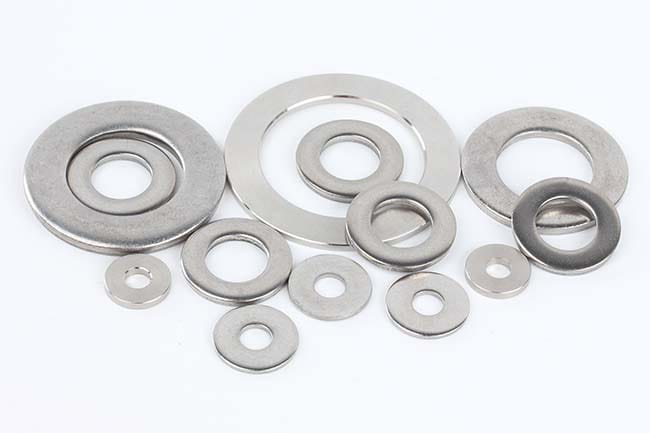
What Washer Hardness Controls
Hardness describes resistance to localized indentation. A hardened washer provides a bearing surface intended to resist permanent deformation beneath the bolt head or nut. However, “hardened” alone is not a complete purchasing specification: the applicable standard, hardness requirements and verification method must be defined.
Keep three properties separate:
- Bolt property class: identifies specified mechanical properties of the bolt.
- Washer hardness class: identifies a hardness requirement for the washer under its governing specification.
- Washer geometry: determines fit, support and resistance to bending in the particular joint.
HV identifies Vickers hardness, while HRC identifies a Rockwell hardness scale. Values on different scales are not interchangeable purchasing descriptions. Use the acceptance criteria and test method required by the washer specification rather than an informal conversion.
How a Soft Washer Can Reduce Preload
Tightening stretches the bolt and compresses the connected parts. The resulting preload holds the assembly together. If a bearing surface permanently deforms after tightening, the joint stack can shorten and reduce the bolt’s elastic stretch.
Two mechanisms deserve attention:
Local indentation
High contact pressure can produce an impression beneath the head or nut. If the washer or connected material cannot support that pressure, permanent deformation can change the seating condition.
Embedding at the interfaces
Real surfaces contact through small high points rather than perfectly flat faces. Flattening of these high points contributes to settlement. Adding washers also introduces additional interfaces, so using more washers does not automatically improve preload retention.
The magnitude of preload loss depends on the joint’s stiffness, surface condition and deformation. A hardened washer can help control one source of settlement; it cannot eliminate every source of relaxation in the assembly.
Preload loss and rotational loosening are different problems. A hard flat washer provides bearing support, but it is not automatically a locking device. If the application requires resistance to vibration-induced rotation, specify and validate that function separately.
How to Specify Washer Hardness for High Strength Bolts
Begin with the bolt, nut and joint requirements, then identify the washer specification. Descriptions such as “heavy duty,” “high tensile” or “high strength bolt washer” do not establish a recognized hardness class.
ISO 7089 hardness classes
ISO 7089:2000 remains the current published edition for normal-series, product-grade-A plain washers. The ISO 7089 scope published by ANSI identifies 200 HV and 300 HV classes and their intended combinations with specified hexagon fasteners.
| ISO 7089 hardness class | Listed steel fastener compatibility | Application boundary |
|---|---|---|
| 200 HV | Product-grade A/B hexagon bolts and screws up to class 8.8; hexagon nuts up to class 8 | Apply within the standard’s scope and check the joint design |
| 300 HV | Product-grade A/B hexagon bolts and screws up to class 10.9; hexagon nuts up to class 10 | Does not establish suitability for every higher-strength assembly |
This table is not a universal selection rule for every head style or bolting system. Soft connected materials and large clearance holes need additional suitability checks. For a class 12.9 assembly, do not assume that an ISO 7089 300 HV designation alone establishes compatibility.
ASTM hardened steel washers
ASTM F436/F436M-24 covers chemical, mechanical and dimensional requirements for hardened steel washers used in mechanical and structural applications. An ASTM washer should be purchased against the specified type, style, size, finish and inspection requirements.
An ISO hardness class does not by itself establish ASTM conformity. Likewise, matching hole diameter and outside diameter does not make an ASTM and ISO washer interchangeable.
Why Hardness Cannot Compensate for the Wrong Geometry
A hard washer can still perform poorly if its dimensions or support conditions are unsuitable. Review the complete load path through the bolt head, washer and connected material.
- Hole diameter: provide the required clearance without compromising support.
- Thickness: assess resistance to bending, particularly around oversized or slotted holes.
- Outside dimensions: check coverage, edge distances and available seating space.
- Flatness and burrs: confirm that the washer seats as intended.
- Chamfer and orientation: follow the specified arrangement and avoid interference with the under-head transition.
A larger outside diameter does not guarantee uniform pressure over the entire washer face. A thin washer spanning a large opening may bend, while a hard washer on a softer plate may remain intact as the plate deforms. Increasing hardness alone does not resolve either condition.
Review standard options in the industrial washer range. Where the load path requires different thickness, coverage or seating geometry, define the dimensions and mechanical requirements on a controlled drawing.
Structural Washer Requirements Depend on the Connection
A structural washer belongs to a specified connection arrangement. Whether washers are required, where they are placed and whether extra-thick or plate washers are needed can depend on the bolt group, hole type, connected material and installation method.
Section 6 of the 2025 RCSC Specification for Structural Joints Using High-Strength Bolts addresses these distinctions. Follow the project-adopted specification and approved connection details rather than applying a blanket rule that every high-strength bolt requires the same washer under both ends.
For global purchasing, identify the governing standard system before comparing quotations. A washer accepted in one assembly specification is not automatically an approved substitute in another.
Coating and Tightening Conditions Still Matter
A corrosion-protection finish does not establish substrate hardness. Specify the material and mechanical requirements separately from zinc plating, galvanizing or another finish.
The washer also forms part of the bearing interface during tightening. Surface roughness, coating and lubricant can influence friction beneath the turning head or nut. Changing these conditions can change the relationship between installation torque and achieved preload.
When substituting a washer, review:
- The specified hardness and finished dimensions.
- The coating system and approved lubrication condition.
- The actual turning element and washer location.
- Any required assembly verification or torque-preload testing.
Do not transfer a torque value from another finish or fastener combination without checking its applicability. A torque wrench reaching its setting does not independently prove the intended clamp load.
Common Purchasing and Inspection Mistakes
| Mistake | Why it creates uncertainty | Better purchasing requirement |
|---|---|---|
| Ordering by size and appearance only | Similar-looking washers can have different mechanical properties | State the governing standard, material and hardness |
| Accepting “heat treated” as the full specification | The description does not establish hardness acceptance limits | Define the required properties and inspection evidence |
| Approving a larger washer solely because it covers the hole | Coverage does not prove adequate thickness or bending resistance | Review geometry and support under the intended load |
| Replacing steel with stainless without mechanical review | The material name does not confirm the required washer hardness | Approve the complete material and property specification |
| Mixing hardness classes in one storage bin | Assembly staff may select an unsuitable but visually identical part | Maintain separate identification and lot traceability |
Where hardness testing is required, agree the applicable method, test conditions, sampling and acceptance criteria. Request results linked to the supplied lot rather than relying on an unrelated sample report.
Flybear’s quality control and inspection information outlines inspection areas including dimensional checks, hardness testing and material verification. Confirm which checks and documents apply to the particular order.
RFQ Checklist for Hardened Washers
Give the industrial washer supplier enough information to quote the required component without choosing an unspecified hardness or assembly arrangement on your behalf.
- Standard or drawing: include the edition, drawing revision and any project-specific requirements.
- Fastener combination: identify bolt and nut standards, size, property classes and head style.
- Washer geometry: specify hole diameter, outside dimensions, thickness, tolerances and required form.
- Mechanical requirements: state material, hardness class or acceptance limits, and heat treatment where specified.
- Surface system: define finish, coating requirements and lubrication condition.
- Application: describe connected materials, hole type, preload requirements and installation method.
- Supply scope: provide quantities, packaging and labeling requirements.
- Inspection documents: identify hardness results, dimensional reports, material records and traceability needs.
If a supplier proposes a different standard or hardness, obtain technical approval before purchase. Record the accepted specification so repeat orders do not reopen the same uncertainty.
Frequently Asked Questions
Is a 300 HV washer always better than a 200 HV washer?
No. Select the specified class for the complete joint. Greater hardness does not compensate for inadequate thickness, unsuitable geometry or a softer connected part that cannot support the bearing load.
Can an ordinary flat washer be used with a high-strength bolt?
Only when its complete specification satisfies the assembly requirements. “Flat washer” describes a general form and does not establish hardness or suitability for the intended preload.
Does a hardened washer prevent bolt loosening?
It can help resist bearing deformation, but hardness alone does not provide a validated locking function. Evaluate preload retention and resistance to rotational loosening separately.
Must washers be fitted under both the bolt head and nut?
Follow the governing assembly specification and drawing. Washer location depends on the connection, seating surfaces and installation method; there is no single rule covering every industrial and structural joint.
What should be checked when bolt preload falls after assembly?
Investigate washer indentation, connected-material deformation, surface settlement and installation conditions. Do not assume a harder washer or additional tightening will resolve the cause without reviewing the joint.
Specify the Bearing Interface Alongside the Bolt
Effective bolt washer compatibility connects hardness, geometry, mating materials and tightening conditions. Define these requirements together so the washer supports the intended preload throughout the application.
Flybear supplies industrial washers and supports standard and custom fastening requirements. To request a hardened washer quotation, send your standard or drawing, fastener size and class, washer dimensions, material, hardness, finish, quantity and inspection requirements for review.