DIN 436 Square Washers: Applications in Structural and Timber Assemblies
A DIN 436 square washer provides a broad bearing surface beneath a bolt head or nut, especially in timber connections. Its square outline can help distribute clamping force over the supported area, but the result depends on washer thickness, material and the condition of the surface beneath it.
For designers and buyers, the important question is whether the complete washer specification suits the joint. Matching the bolt diameter alone leaves bearing dimensions, stiffness and corrosion protection unresolved.
This guide from Flybear explains the current standard, representative dimensions and practical selection requirements for timber, brackets and structural assemblies.
What Does the DIN 436 Square Washer Standard Cover?
DIN 436:2024-10 is the current edition for square washers, especially for wood constructions. It replaces DIN 436:1990-05. The standard addresses dimensions, technical delivery conditions and product designation.
DIN describes the 2024 revision as an editorial update with revised normative references. Purchasing documents should identify the applicable edition, particularly when an older drawing still references the 1990 version.
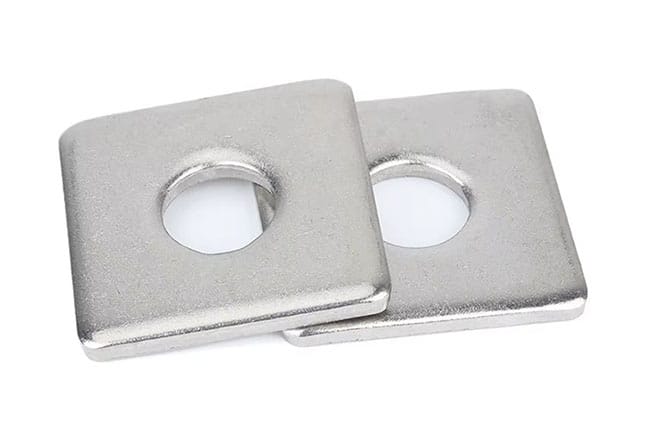
The product has a square external profile, a round clearance hole and flat bearing faces. It is a different geometry from a tapered washer intended to accommodate an inclined contact surface.
A DIN 436 designation does not establish the load capacity of an entire connection. The joint design still needs to account for the bolt, nut, washer, connected materials and applicable structural requirements.
Representative DIN 436 Dimensions
The principal dimensions are hole diameter, square side length and thickness. The following values are representative published catalog dimensions for selected sizes; all measurements are in millimeters.
| Suitable bolt thread | Hole diameter | Square side length | Nominal thickness |
|---|---|---|---|
| M10 | 11 | 30 | 3 |
| M12 | 13.5 | 40 | 4 |
| M16 | 17.5 | 50 | 5 |
| M20 | 22 | 60 | 5 |
Nominal values are not complete acceptance limits. For example, the referenced M12 catalog item has a nominal thickness of 4 mm and a stated thickness range of 3.4–4.6 mm. Confirm all applicable tolerances against the controlling specification.
Do not round the hole dimensions to a convenient whole number when preparing an order. Also check that a supplier’s broader commercial size range actually falls within the cited standard; an additional catalog size may require a separate drawing.
Review the square washer product category for available product families, then confirm the required size, material and finish during quotation.
Bearing Area and Thickness Must Work Together
A square plate washer can spread the force beneath a bolt head or nut across a wider supported region. For a given force, increasing the effective bearing area reduces average bearing pressure.
However, the effective area depends on contact and stiffness. An oversized washer that overhangs a narrow timber member does not transfer load through its unsupported corners. Similarly, a thin plate can bend rather than distribute pressure evenly across its full outline.
Review these factors together:
- Side length: Does the footprint provide the required bearing area within the available space?
- Thickness and material: Can the plate resist the bending and local deformation expected in the joint?
- Hole and nut contact: Does the hole provide clearance while preserving adequate support beneath the nut or bolt head?
- Supporting surface: Can the connected material carry the bearing load without unacceptable deformation?
A large square washer is therefore a geometry choice that must be checked against the connection requirements, rather than a universal increase in joint capacity.
Applications in Timber Connections
Distributing load beneath heads and nuts
Timber connections may use broad washers to limit concentrated bearing beneath a bolt head or nut. Suitable applications include specified through-bolted timber joints and connections between timber and metal brackets.
The wood species or engineered timber product, grain direction and bearing condition affect the connection assessment. A timber washer cannot compensate for inadequate fastener spacing, insufficient edge distance or damaged wood.
Allowing for moisture-related movement
Wood dimensions change with moisture content. This movement can affect contact and clamping conditions over the service life of a bolted assembly.
Specify the installation and inspection procedure for the actual timber system. A rigid washer does not automatically maintain clamp force as timber shrinks. Any later adjustment should follow the connection designer’s instructions.
Where the washer sits near an edge, recess or adjacent fitting, confirm its orientation and supported footprint. The drawing should show enough detail for installers to reproduce the intended arrangement.
Use in Structural Brackets and Machinery Assemblies
A structural square washer may be specified beneath a nut on a bracket, support plate or equipment frame. Its suitability depends on the particular assembly, including the bearing surface and required mechanical properties.
Do not assume a general timber washer can replace a hardened washer or a specially designed structural plate. The required washer may have different thickness, strength, hardness or hole geometry.
Oversized and slotted holes need particular attention. Covering the opening visually does not demonstrate that the washer can bridge it under load. Confirm the plate dimensions, thickness and material required by the connection design.
If the assembly requires a special plate, submit the controlled drawing for a custom fastener and component review. Identify departures from the standard geometry clearly.
Distinguish Flat, Tapered and Custom Square Washers
| Washer design | Selection purpose |
|---|---|
| Flat square washer | Provides a broad bearing surface on the intended flat seat |
| Square taper washer | Accommodates a specified inclined bearing face; the taper must match the assembly |
| Custom square plate washer | Provides drawing-defined dimensions, thickness, hole position or material properties |
The external square outline does not make these designs interchangeable. Check the side view and hole details, not only a photograph of the upper face.
The square shape also does not independently lock a threaded joint against loosening. Any restraint provided by a pocket or adjacent feature belongs to the assembly design and should not be assumed from the washer alone.
Materials and Corrosion Protection
Specify the required material and mechanical requirements separately from the finish. “Steel, galvanized” does not fully define a structural component, while “stainless steel” leaves the specific grade unresolved.
Commercial square washers may be offered in steel or stainless steel, with plain, zinc-plated or hot-dip galvanized options depending on the product. These choices should be assessed against the environment and the project specification.
Consider treated timber and moisture exposure
Preservative treatment, retained moisture, salt exposure and contact with other metals can influence corrosion. Obtain the timber treatment information and consider the washer together with the bolt, nut and connector.
Do not treat electroplated zinc and hot-dip galvanizing as identical specifications. Identify the coating system and required acceptance criteria. For stainless steel, specify the grade suited to the service environment.
Corrosion protection also needs to remain compatible with fit and seating. Confirm the required finished dimensions and inspect for coating accumulations that could interfere with assembly.
Installation and Inspection Points
Before assembly, confirm that the washer matches the drawing and that the bearing faces are clean and suitable for contact. Check for burrs, distortion, damaged coating and interference with welds, corners or adjoining components.
Use the specified washer location beneath the bolt head, nut or both. Confirm adequate thread engagement after the washer is included in the stack. Do not add washers simply to compensate for an incorrect bolt length without reviewing the assembly.
Follow the tightening method specified for the connection. A general torque value based only on bolt diameter does not establish acceptable bearing pressure in timber.
Where inspection identifies indentation, bending or loss of contact, investigate the cause. Repeated tightening is not a substitute for checking the washer, supporting material and joint geometry.
Quality Requirements for Purchasing
Incoming inspection should reflect the approved drawing and standard edition. Useful checks include hole diameter, both side dimensions, thickness, flatness where specified, edge condition and surface finish.
Confirm the material documentation and any required hardness or mechanical testing. These requirements should be agreed before production; a dimensional report alone does not establish every material property.
Review the available quality control and inspection information and specify the reports needed for the order. Include lot identification and packaging labels when traceability is required.
RFQ Checklist for a DIN 436 Square Washer
An industrial washer supplier can evaluate the requirement more accurately when the enquiry includes:
- Standard or drawing: Applicable DIN edition, drawing number, revision and any special requirements.
- Dimensions: Bolt size, hole diameter, square side dimensions, thickness and tolerances.
- Material: Required grade and relevant mechanical or hardness requirements.
- Finish: Plain condition, coating specification or stainless-steel surface requirements.
- Application: Timber or other supporting material, connection details and exposure conditions.
- Quantity: Quantity per size, packaging and identification requirements.
- Inspection: Dimensional reports, material records, certificates and traceability requirements.
Ask suppliers to identify deviations separately. An offer for a similar square plate should be compared against the full requirement before being accepted as equivalent.
Frequently Asked Questions
Is DIN 436 still current?
Yes. DIN 436:2024-10 is the current edition and replaces DIN 436:1990-05. Identify the required edition in purchasing documents.
Does a DIN 436 square washer have a square hole?
No. The square description refers to the external outline. The standard product has a round clearance hole.
Is a square washer always stronger than a round washer?
No. Performance depends on dimensions, material, thickness, contact and the connected components. Compare the actual designs rather than their outlines alone.
Can DIN 436 washers be used in every structural steel joint?
No. The connection specification determines the required washer. Some joints require different mechanical properties, dimensions or approved assembly components.
Can a flat square washer replace a taper washer?
Only after confirming the bearing geometry and receiving design approval. A flat washer does not provide the wedge geometry needed for a specified inclined seat.
Select the Washer as Part of the Joint
A DIN 436 square washer can provide useful bearing support in timber and other specified assemblies. Reliable selection combines the current standard with the required geometry, material, corrosion protection and installation conditions.
Send Flybear your square washer enquiry with the standard or drawing, size, material, finish, quantity, application and inspection requirements. Include the mating connection details when evaluating a substitute or a custom plate washer.