Sealing Washers for Hydraulic Fittings: What to Specify
When purchasing sealing washers for hydraulic fittings, a clear RFQ helps suppliers quote the same requirement. A request for “hydraulic washers, assorted sizes” may produce offers with different materials, profiles, finishes and inspection coverage. Those differences can remain hidden until samples arrive or assembly begins.
The useful starting point is a defined connection: the fitting, port, sealing arrangement, operating conditions and approved part specification. From there, buyers can build a quotation package that supports technical review and purchasing decisions.
This guide from Flybear explains what to include, how to evaluate supplier responses and how to connect sample approval with production orders.
Start with the Connection and the Required Seal
Identify where the connection seals before choosing a washer. A thread designation alone does not define the sealing arrangement. Connections with similar threads may use different contact faces, recesses or seal profiles.
For an existing machine, obtain the approved part number, drawing or equipment specification. For a new design, provide a section drawing showing the fitting and port together. Mark the intended sealing faces and any restrictions on the seal’s position.
| Seal type | Details the RFQ should identify |
|---|---|
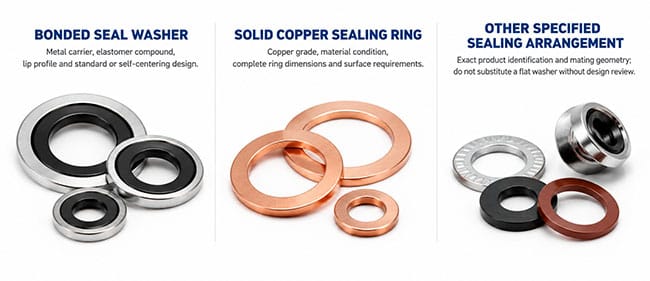
| Bonded seal washer | Metal carrier, elastomer compound, lip profile and standard or self-centering design |
| Solid copper sealing ring | Copper grade, material condition, complete ring dimensions and surface requirements |
| Other specified sealing arrangement | Exact product identification and mating geometry; do not substitute a flat washer without design review |
A bonded seal combines a metal carrier with an elastomer sealing element. A solid copper ring seals through deformation of the metal under clamping load. These differences matter when reviewing alternatives, even if the nominal sizes match.
Use the sealing washer range to identify relevant product families, then confirm the individual specification.
Define Standards, Drawings and Dimensions
Identify the controlling documents
List the drawing number, revision and applicable product standard. Distinguish the seal specification from the fitting or port specification: each describes a different part of the connection.
For example, DIN 7603:2001-05 is a current standard for sealing rings. An order referencing it still needs the applicable form, material and size. A standard number alone is not a complete purchasing description or an assembly-performance approval.
If a drawing changes a standard feature, identify that change explicitly. Agree which document governs each requirement and resolve conflicts before approving the quotation.
Provide the geometry needed for review
Include inside diameter, outside diameter, thickness and tolerances. For a bonded design, distinguish carrier thickness from overall seal height and identify any centering feature. For the mating parts, show the sealing land, recess, shoulder and relevant chamfers.
Label dimensions consistently. A nominal thread size, a nominal washer designation and a measured inside diameter are different pieces of information. Include units on every drawing and size list.
When only a used sample is available, tell the supplier that it has been installed. Compression, wear or damage may have changed its geometry. Ask for a proposed specification for review rather than assuming the sample defines the original part.
For a geometry that needs development, submit the assembly details for a custom component review.
Specify Materials and Finish as Separate Requirements
Bonded seals: define both components
Specify the metal carrier material and the elastomer separately. Descriptions such as “steel and rubber” leave too much open. Even a polymer designation such as NBR or FKM does not identify every property of a particular compound.
Where available, provide the approved compound code, hardness requirement and material specification. For an alternative compound, request supporting data and identify the tests needed to assess suitability.
Confirm whether the design includes a self-centering feature. This is a product-profile detail, not merely a packaging or handling preference.
Metal rings: define grade and condition
For a copper sealing ring, specify the required grade and material condition, including annealing where required. Appearance is insufficient to establish material identity or softness.
If hardness is an acceptance criterion, state the requirement and agreed test method. Avoid importing a value from an unrelated product simply because both parts are described as copper washers.
Make finish requirements measurable
For a coated carrier, identify the coating system and any specified thickness or corrosion-test acceptance criteria. A color description alone does not define a finish.
For an uncoated ring, define the required surface condition and cleanliness. Ask suppliers to disclose proposed changes to material, coating or compound before supply. Keep those changes visible in the quotation and approval records.
Describe the Actual Hydraulic Service Conditions
A hydraulic sealing washer should be assessed against the conditions at the connection. Give suppliers enough information to distinguish routine operation from occasional exposure or testing.
- Fluid: Exact fluid name or specification, concentration where relevant, and additional cleaning or flushing fluids.
- Temperature: Minimum start-up temperature, normal operating range and peak exposure with its duration.
- Pressure: Working pressure, relevant pressure peaks and cycling information.
- Environment: External moisture, chemicals or other conditions that affect exposed materials.
- Maintenance: Expected disassembly and the equipment’s replacement requirements.
Fluid compatibility and temperature capability should be reviewed together. Published material limits do not automatically describe performance with every fluid, geometry or exposure duration.
Keep working pressure, proof pressure and burst pressure separate. Supplier evidence should identify the tested part and connection. A rating for another size or configuration is not enough to qualify the requested assembly.
Set Inspection and Documentation Requirements
Agree on acceptance criteria before samples or production are made. “Quality checked” is too broad to show what will be measured, which lot will be represented or what records will be delivered.
For bonded washers, define dimensional and visual criteria for the carrier, sealing lip and bond interface. Identify any additional bond or material testing required by the project. For metal rings, define dimensional, surface and material-condition checks.
Match each document to its purpose
| Requested record | What to establish |
|---|---|
| Dimensional inspection report | Drawing revision, measured features, acceptance limits and sample identification |
| Metal material report | Material specification, reported results and traceability to the supplied material or lot |
| Elastomer compound data | Compound identity, test methods and whether results are typical data or batch-specific results |
| Certificate of conformity | The order, part, revision and requirements covered by the supplier’s declaration |
| Assembly test report | Actual test configuration, conditions, procedure, results and acceptance criteria |
A company quality-system certificate, material report and assembly leak-test report serve different purposes. Ask for the evidence needed by the project rather than treating them as interchangeable.
Review the available quality control and inspection information, then confirm which checks are included and which require a separate arrangement. Include document costs and delivery timing in the quotation review.
Evaluate the Supplier’s Response
A useful response shows how the offered product matches the requirement. Ask the supplier to identify its part number, specification revision, proposed materials and any deviations. An unexplained statement of “equivalent” should lead to a technical comparison.
For supplier evaluation, ask practical questions:
- Which drawing or product specification controls the offered part?
- How will material, compound and production-lot identity be maintained?
- Which inspection results can be supplied with samples and production?
- How are changes to materials, tooling, processes or manufacturing sources communicated?
- How will an identified nonconforming lot be investigated and contained?
Clarify which operations and tests the supplier performs and which are provided through other parties. The objective is to understand responsibility and traceability across the supply route.
When comparing prices, align order quantity, packaging, included reports, testing, tooling charges, delivery basis and lead-time assumptions. Separate one-time development costs from recurring unit prices.
Use Samples to Confirm a Defined Specification
Samples are most useful when the acceptance plan exists before they arrive. Define what will be reviewed, who will perform the checks and which results are needed to release production.
- Complete the document review. Resolve dimensions, materials, finish, deviations and the assembly procedure.
- Inspect identified samples. Record their part revision, lot identity and relationship to the intended production process.
- Check fit in the actual connection. Confirm location, contact and assembly access using representative mating parts.
- Validate performance. Use the agreed leak and other application tests, with defined conditions and acceptance criteria.
- Record the release. Link approval to the exact specification and state what changes require further review.
Agree who supplies the mating hardware or test fixture and who issues the results. A supplier’s component inspection and the customer’s assembly validation answer different questions.
If samples use a different process from series production, document the difference. Approval should make clear which production requirements remain to be confirmed.
RFQ Checklist: Sealing Washers for Hydraulic Fittings
Use one line item per controlled part number or drawing. For multiple sizes, attach a schedule that ties each quantity to its specification.
| RFQ field | Information to provide |
|---|---|
| Part identification | Product type, approved part number, drawing number and revision |
| Standard or drawing | Applicable edition, form and clearly identified special requirements |
| Dimensions and thread | Complete washer dimensions, tolerances, fitting thread and mating details |
| Materials | Metal grade and condition; elastomer compound and hardness where applicable |
| Finish and cleanliness | Required coating or uncoated condition, cleanliness and defect criteria |
| Application | Fluid, pressure, temperature, external environment and service expectations |
| Assembly and validation | Approved installation method, mating hardware and required tests |
| Inspection and certificates | Acceptance criteria, sampling requirements, traceability and deliverable records |
| Quantities and packaging | Sample quantity, production quantity per size, pack units and label requirements |
| Commercial response | Unit prices, separate charges, lead-time basis, delivery terms and quotation validity |
| Exceptions | A separate list of proposed substitutions, deviations and unresolved questions |
Where information is missing, identify the gap and the person responsible for resolving it. Suppliers can quote a clearly stated assumption, but that assumption should remain visible until it is accepted or corrected.
Keep the Approved Requirement Consistent Through Delivery
After approval, make the purchase order reference the accepted specification and quotation revision. Ensure purchasing, engineering, incoming inspection and the supplier are working from the same documents.
Specify package identification that supports receiving and later traceability, such as part number, revision, quantity and lot reference. Define storage and shelf-life requirements where applicable to the supplied material and the manufacturer’s instructions.
For repeat orders, retain the approved specification rather than relying only on a previous invoice description. Require notification of agreed categories of change so a repeat purchase does not silently become a different product.
Frequently Asked Questions
Can a supplier quote from a photograph?
A photograph can help identify the likely product family. A firm technical offer needs dimensions, materials and application requirements, or an approved part number that defines them.
Is the fitting thread enough to select a sealing washer?
No. The thread is only part of the connection. Provide the sealing geometry and complete washer specification so the offered part can be reviewed for the intended assembly.
Can a bonded seal washer replace a copper sealing ring?
Such a change requires evaluation of the sealing profile, mating surfaces, material compatibility and installation requirements. Treat it as a proposed alternative until the design owner approves it.
Which certificates should an RFQ request?
Request the documents required by the project and identify their scope. Depending on the specification, these may include material records, compound data, dimensional reports, conformity declarations and assembly test results.
How should buyers compare two similar quotations?
First confirm that the technical requirements and exceptions match. Then compare quantities, inspection coverage, sample costs, packaging, delivery assumptions and recurring price.
Prepare a Complete Enquiry
Well-specified sealing washers for hydraulic fittings are easier to quote, inspect and approve. A fluid connection washer enquiry should connect the component drawing with its materials, operating conditions, assembly requirements and acceptance evidence.
When selecting an industrial washer supplier, look for a clear response to those requirements. Send Flybear your sealing washer RFQ with the standard or drawing, size and thread details, material, finish, quantities, application and required inspection documents. Identify any open technical questions so they can be addressed during quotation review.