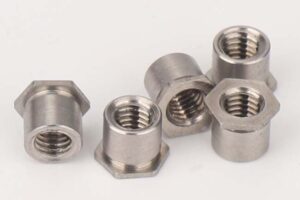
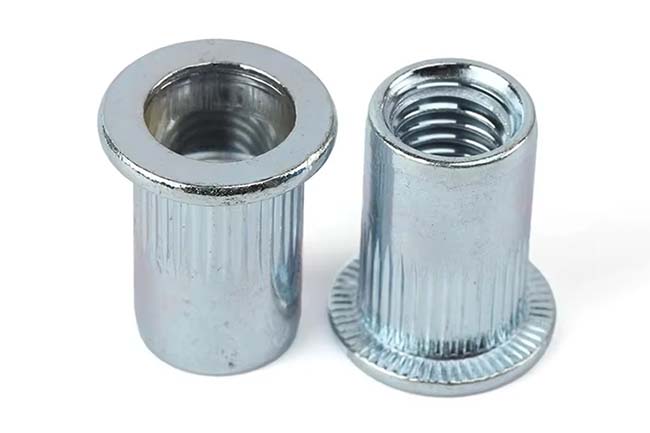
The knurled round rivet nut is a blind threaded insert for creating a reusable internal thread in thin sheet, tubing, panels, and hollow sections when access is available from only one side. This page focuses on carbon-steel versions with an externally knurled round body. The knurl can improve resistance to rotation in suitable parent materials while retaining a simple round installation hole. Common metric market sizes run from M3 to M12, with zinc-plated steel widely used for corrosion protection. Exact head style, end configuration, grip range, and mechanical performance remain product-specific and should be confirmed during quotation.
Product Overview and Key Features
A rivet nut is installed by threading a setting mandrel into the insert and applying axial force. The deformable body collapses behind the panel, creating a blind-side bulge while the flange bears against the accessible face. After the tool is removed, the insert accepts a conventional mating screw or bolt.
- Knurled round body: external serrations can increase resistance to spin in suitable sheet, aluminum, plastic, and composite materials.
- Round-hole installation: does not require the non-round hole used by hex-body rivet nuts.
- One-sided setting: useful for closed sections and assemblies where a loose nut cannot be held from the rear.
- Reusable female thread: allows covers and service parts to be removed and refitted.
- Multiple flange options: large/flat, reduced, and countersunk heads are common market configurations.
Knurled Round Rivet Nut Specifications
Specification Overview
| Item | Typical Configuration |
|---|---|
| Product form | Blind rivet nut / threaded insert |
| Body style | Round body with external knurling |
| Specified material | Carbon steel |
| Common metric threads | M3, M4, M5, M6, M8, M10, M12 |
| Common thread series | ISO metric coarse thread |
| Common head styles | Large or flat flange, reduced head, countersunk |
| End styles | Open end or closed end, depending on product family |
| Common finish | Zinc plated; other drawing-controlled coatings are also used |
Common Dimensions and Grip Ranges
The following table is a verified market reference for a zinc-plated steel, flat/large-flange, open-end, knurled round-body configuration. It is not a universal DIN or ISO dimensional standard and should not be applied to reduced-head, countersunk, closed-end, or proprietary designs. Dimensions are millimetres.
| Thread | Pitch (mm) | Grip Range (mm) | Hole Dia. (mm) | Body Dia. (mm) | Flange Dia. (mm) | Flange Thickness (mm) |
|---|---|---|---|---|---|---|
| M3 | 0.5 | 0.5-1.5 | 5.0 | 4.9 | 8.0 | 0.8 |
| M4 | 0.7 | 0.5-2.0 | 6.0 | 5.9 | 9.0 | 0.9 |
| M5 | 0.8 | 0.5-2.5 | 7.0 | 6.9 | 10.0 | 1.0 |
| M6 | 1.0 | 0.5-3.0 | 9.0 | 8.9 | 12.3 | 1.3 |
| M8 | 1.25 | 1.0-3.5 | 11.0 | 10.9 | 14.5 | 1.5 |
| M10 | 1.5 | 1.0-4.0 | 13.0 | 12.9 | 17.0 | 1.7 |
| M12 | 1.75 | 1.0-4.0 | 16.0 | 15.9 | 22.0 | 2.0 |
Different lengths of the same thread size cover different panel-thickness ranges. Keep the prepared hole within the supplier tolerance: an oversized hole can reduce anti-rotation and pull-out performance, while an undersized hole can prevent seating or damage the insert. Knurling does not replace proper hole and setting control.
Common Materials, Grades and Surface Finishes
Carbon Steel Construction
Low-carbon steel is widely used for general industrial rivet nuts because it combines formability during setting with useful installed mechanical performance. Commercial families may use grades such as steel 1008 or other cold-forming steels, but exact chemistry is supplier-specific. This page is limited to carbon steel rather than stainless or aluminum variants.
Coating and Finish Options
Zinc plating with clear, blue, or trivalent passivation is a common market finish for carbon-steel rivet nuts. Zinc-nickel, zinc-flake, or other coatings may be specified when dimensional fit and setting behavior are validated. Because the body deforms during installation, coating condition should also be considered after setting. Confirm finish and grip combination during quotation.
Typical Applications and Selection Considerations
- Electrical cabinets, control panels, machine guards, and removable access covers.
- Automotive brackets, body structures, interior assemblies, and equipment panels.
- HVAC housings, appliance frames, and fabricated sheet-metal products.
- Round or rectangular tubing where rear access for a conventional nut is unavailable.
Flybear’s rivet nuts for thin sheet metal guide explains grip range, round versus hex bodies, and installation-hole control. Buyers can also review the rivet nut range. Select by thread, panel thickness, hole diameter, head style, torque-out requirement, pull-out requirement, substrate hardness, and installation tooling rather than thread size alone.
Ordering and Quality Documentation
An RFQ should state thread size and pitch, grip range, head style, open or closed end, carbon-steel requirement, coating, quantity, panel material, and installation-hole diameter. For demanding applications, identify required pull-out or torque-out performance and the test panel. Flybear’s quality control and inspection page outlines dimensional, thread, material, coating, torque, and other inspection support; exact reports should be agreed for the order.
Frequently Asked Questions
Why use a knurled body instead of a smooth round body?
The external knurl can improve resistance to rotation by engaging the hole wall. Actual benefit depends on panel hardness, thickness, hole size, and setting quality. Application testing is recommended when torque-out performance is critical.
What sizes are common for carbon-steel knurled rivet nuts?
M3, M4, M5, M6, M8, M10, and M12 are common metric sizes. Different flange styles, grip ranges, and end configurations are not necessarily available in every thread size, so confirm the complete configuration.
What is the difference between a large flange and reduced head?
A large or flat flange provides a broader bearing surface. A reduced head lowers installed projection for clearance-sensitive assemblies. Because bearing conditions differ, the two styles should not be substituted without reviewing the panel and service load.
Can a knurled round rivet nut replace a hex-body rivet nut?
Not automatically. A knurled round body uses a simple round hole, while a hex body gains positive mechanical engagement from a matching non-round hole. Required torque-out performance and production-hole capability should determine the selection.
What information is needed for a quotation?
Provide the thread, grip range or panel thickness, head style, end style, carbon-steel requirement, finish, quantity, hole diameter, mating screw, and any pull-out or torque-out target. Include a drawing when dimensions or performance are customer controlled.
Request a Quote for Knurled Round Rivet Nuts
Send Flybear Industrial your required thread, grip range, head style, end configuration, carbon-steel material requirement, coating, quantity, panel material, and hole size. Include drawings and functional test requirements for controlled OEM applications. Submit the project through the Flybear fastener RFQ page for technical review and quotation.