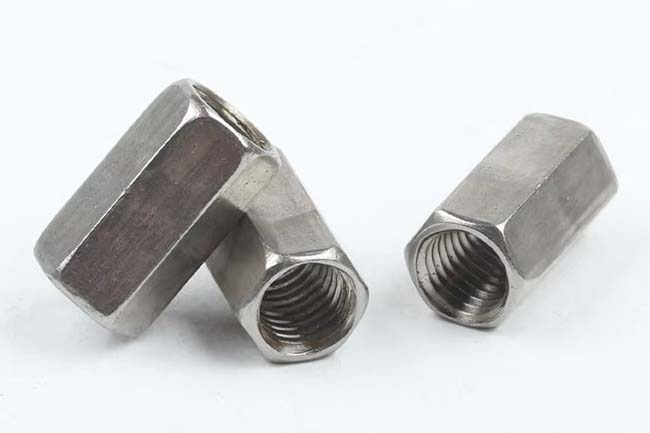
The DIN 6334 coupling nut is a long hexagonal connector used to join two externally threaded parts, commonly threaded rods, studs, or other metric threaded components. DIN 6334 remains widely used as a legacy trade designation for coupling nuts with a nominal height of approximately three times the thread diameter, even though current fastener references treat it as a withdrawn or legacy specification rather than a current harmonized DIN/ISO product standard. Typical buyers include machinery builders, installers, fabricators, maintenance teams, and distributors that need extended internal thread engagement in metric assemblies.
Product Overview and Key Features
The elongated hex body provides more internal thread length than a conventional hex nut while retaining external wrench flats for installation and adjustment. It is primarily a connecting component, not an automatic substitute for a standard nut in every load-bearing joint.
- Long hexagonal body: the traditional DIN 6334 dimensional convention uses a nominal nut height of about 3d.
- Through-threaded design: allows two compatible threaded parts to enter from opposite ends.
- Metric coarse threads: common catalog sizes use standard coarse pitches.
- External wrenching flats: standard hex geometry allows assembly with conventional spanners or sockets.
- Multiple market materials: carbon steel, zinc-plated steel, A2 stainless, and A4 stainless are common configurations.
DIN 6334 Coupling Nut Specifications
Specification Overview
| Item | Specification / Market Practice |
|---|---|
| Product form | Long hexagon coupling / connecting nut |
| Legacy designation | DIN 6334 |
| Current status | Legacy / withdrawn trade specification; still widely used for dimensional identification |
| Nominal height | m = 3 × d |
| Thread system | ISO metric coarse thread in common catalog configurations |
| Common size range | M6 to M36 in established dimensional tables; additional market sizes may exist |
| Common materials | Carbon steel, A2 stainless steel, A4 stainless steel |
| Common finishes | Plain steel, zinc plated, hot-dip galvanized by separate specification, natural/passivated stainless |
Dimensions and Thread Details
The table below follows the established DIN 6334 dimensional convention. d is nominal thread size, P is coarse thread pitch, s is nominal width across flats, e is minimum width across corners, and m is nominal nut height. Dimensions are millimetres.
| Thread d | Pitch P (mm) | s Nom. (mm) | e Min. (mm) | m Nom. (mm) |
|---|---|---|---|---|
| M6 | 1.00 | 10 | 11.05 | 18 |
| M8 | 1.25 | 13 | 14.38 | 24 |
| M10 | 1.50 | 17 | 18.90 | 30 |
| M12 | 1.75 | 19 | 21.10 | 36 |
| M14 | 2.00 | 22 | 24.49 | 42 |
| M16 | 2.00 | 24 | 26.75 | 48 |
| M20 | 2.50 | 30 | 33.53 | 60 |
| M24 | 3.00 | 36 | 39.98 | 72 |
| M30 | 3.50 | 46 | 50.85 | 90 |
| M36 | 4.00 | 55 | 60.79 | 108 |
Legacy and supplier tables can differ for peripheral dimensions or available sizes, so controlled drawings should take precedence when interchangeability is critical. Fine-pitch, left-hand, reducing, or special-length coupling nuts should be treated as separate drawing-controlled products rather than assumed to comply with the traditional DIN 6334 form.
Common Materials, Grades and Surface Finishes
Material and Grade Options
Carbon steel is common for general machinery, supports, and fabrication. Commercial catalogs frequently offer zinc-plated steel versions identified with supplier-declared strength classes such as class 6 or class 8. A2 stainless is common for general corrosion-resistant service, while A4 stainless is selected where stronger resistance to chlorides or aggressive environments is needed. Because DIN 6334 is a legacy dimensional designation, required material and mechanical properties should be stated separately rather than inferred from the DIN number alone.
Coating and Finish Options
Zinc plating is a common carbon-steel finish. Plain steel may be selected when subsequent coating or controlled indoor service is planned. Hot-dip galvanized coupling nuts are also used with compatible galvanized threaded rods, but coating thickness and thread allowance must be matched. Stainless versions are normally supplied natural or passivated. Confirm material, finish, thread fit, and mating rod combination during quotation.
Typical Applications and Selection Considerations
- Joining two metric threaded rods to extend a support or suspension assembly.
- Connecting studs in machinery, fabrication, maintenance, and adjustable fixtures.
- Pipe, cable-tray, HVAC, ceiling, and equipment-support systems where the engineering design permits coupling nuts.
- General industrial assemblies requiring extended female thread engagement or axial adjustment.
Buyers can review Flybear’s threaded rods and studs range and the threaded rod versus stud bolt guide when selecting mating parts. Required thread engagement must be determined from the rod material, nut material, loads, and project specification. Do not assume that nut length alone establishes the allowable joint load.
Ordering and Quality Documentation
An RFQ should state DIN 6334 as the dimensional reference, thread size and pitch, material, required mechanical properties or supplier grade, surface finish, quantity, and mating threaded-rod specification. State fine pitch, left-hand thread, special length, or reducing thread explicitly. Buyers may request material verification, dimensional inspection, Go/No-Go thread gauging, coating checks, and mechanical documentation where applicable. Flybear’s quality control and inspection page describes available inspection support; exact acceptance criteria should be agreed for the order.
Frequently Asked Questions
Is DIN 6334 still a current DIN standard?
DIN 6334 is best treated as a legacy trade and dimensional designation rather than a current harmonized product standard. It remains widely used by fastener suppliers for long hex coupling nuts, so buyers can retain the familiar DIN 6334 callout while also specifying material, thread, finish, and required performance.
How long is a DIN 6334 coupling nut?
The traditional dimensional convention uses a nominal height equal to three times the nominal thread diameter. For example, M10 is 30 mm long, M16 is 48 mm, and M24 is 72 mm. Special coupling nuts may use other lengths and should be identified separately.
What is the difference between a coupling nut and a normal hex nut?
A coupling nut has a much longer body and is intended primarily to connect externally threaded components. A conventional hex nut is substantially shorter and is normally used to clamp a joint against a bearing surface. Their dimensions and intended functions are therefore different.
Can DIN 6334 coupling nuts be stainless steel?
Yes. A2 and A4 stainless versions are common market configurations. Stainless grade should be specified separately because the DIN 6334 dimensional designation does not by itself establish an exact stainless alloy, corrosion rating, or mechanical property set.
What should I include in a coupling nut RFQ?
Provide the DIN 6334 reference, thread size and pitch, material or grade, finish, quantity, mating rod specification, and any mechanical or documentation requirements. Include a drawing for special lengths, reducing threads, left-hand threads, or controlled tolerances.
Request a Quote for DIN 6334 Coupling Nuts
Send Flybear Industrial your DIN 6334 coupling nut thread size, material, required mechanical properties, finish, quantity, and mating threaded-rod specification. Include a drawing for special lengths or nonstandard threads. Submit the project through the Flybear fastener RFQ page for technical review and quotation.