DIN 127 Spring Washer: Legacy Standard, Uses, Limitations and Alternatives
A DIN 127 spring washer is a split-ring component still found in equipment drawings, spare-parts lists and industrial purchasing catalogues. Its familiar shape should not be treated as evidence that it will prevent a bolted joint from loosening under vibration. DIN 127 is a withdrawn standard, and the product’s limitations matter when maintaining existing equipment or selecting fasteners for a new design.
For engineers and buyers, the first decision is whether the order must reproduce an approved legacy component or solve a fastening problem. Those tasks require different information. A dimensional match may satisfy a replacement drawing, while a vibration problem requires assessment of the complete joint.
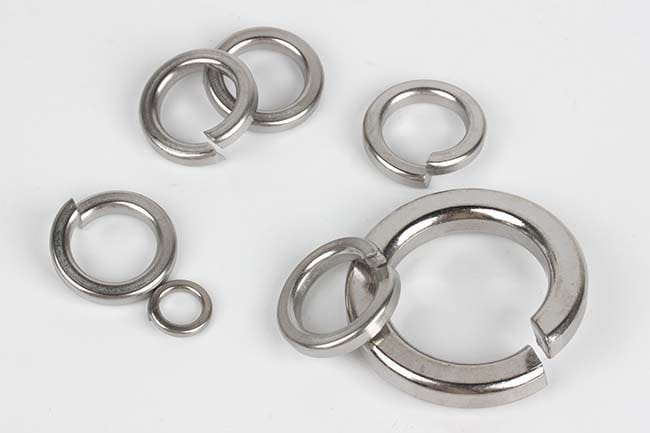
DIN 127 Spring Washer: Standard Status and Original Scope
DIN Media identifies DIN 127:1987-10 as withdrawn. It covers spring lock washers with square ends or tang ends. The DIN record does not identify a direct successor standard, so buyers should not assume that an ISO number can simply replace DIN 127 on a purchase order.
The historical scope described use with bolt-and-nut assemblies involving fasteners of property class 5.8 or lower. This is an important limitation when reviewing older drawings that combine split spring washers with higher-strength bolts.
For a legacy requirement, retain the specified edition, form and material in the enquiry until engineering approves a change. For a new design, define the required joint performance before selecting a retention method. Continued commercial availability does not establish suitability for a particular load case.
What the Split Ring Does During Tightening
A conventional spring lock washer has a split, helically formed ring. Compression closes the axial gap as the nut or bolt head is tightened. The component therefore provides spring action over part of its compression travel.
That movement should not be confused with reliable locking after tightening. NASA’s Fastener Design Manual explains that a typical helical spring washer is normally flattened by full tightening and then provides no effective locking action. Its unloaded shape does not establish the available spring travel in the assembled joint.
This distinction helps explain common lock washer limitations: a washer can meet its dimensional specification yet fail to provide the retention performance expected by the equipment designer. Part conformity and joint performance need separate acceptance criteria.
Forms A and B: Specify the Geometry Clearly
The historical DIN 127 drawing distinguishes two end configurations:
- Form A: Tang ends with the raised end configuration shown in the standard.
- Form B: Square ends without the Form A tang configuration.
The letters describe form, not material strength. A request for “DIN 127 washer” should therefore identify the required form rather than leaving it to the supplier’s catalogue convention.
For products such as a DIN 127B split spring washer, check the following dimensions against the controlled drawing or historical standard:
| Characteristic | Why it matters |
|---|---|
| Inside diameter | Provides clearance around the associated bolt or screw. |
| Outside diameter | Determines clearance to nearby features and the available bearing footprint. |
| Section thickness and width | Define the ring cross-section and affect its compression behaviour. |
| Free height and end form | Distinguish the unloaded geometry from its condition after tightening. |
Nominal size refers to the associated fastener size. It is not a substitute for the actual hole diameter or dimensional tolerances. Avoid treating free height as installed thickness when checking bolt length and thread engagement.
Why Vibration and Preload Loss Need Different Solutions
A joint can lose clamp force through settlement, creep or relaxation without the nut visibly turning. It can also loosen through relative movement that permits rotation of the threaded components. These mechanisms can occur together, but a measure intended to address one does not automatically control the other.
Before ordering vibration resistant washers, establish what has happened in the assembly. Look for evidence of rotation, indentation under the bearing surface, movement between parts, coating compression or an inconsistent tightening process.
Consider a pump mounting bracket that repeatedly becomes loose. Replacing the split washer with another washer of the same dimensions does not establish whether the original problem was inadequate initial preload, joint movement or local deformation. The corrective action should follow that investigation.
Similarly, preventing a nut from falling off does not prove that adequate clamp force remains. Define whether the application needs maintained preload, resistance to rotation, prevention of component loss, or a combination of these functions.
Where DIN 127 Washers Still Appear
Buyers encounter these washers in legacy machinery, enclosure hardware, equipment accessories and maintenance kits. Their presence in an existing assembly provides a reference for identification; it does not, by itself, validate their performance.
- Maintenance replacement: Match the approved part specification and follow the equipment maintenance procedure.
- OEM repeat production: Confirm whether the drawing remains unchanged or engineering has approved another retention method.
- Distributor supply: Separate forms, materials and finishes so that visually similar parts are not mixed.
- Equipment redesign: Review the joint and document the selected fastening system before changing the bill of materials.
A split spring washer should not be assigned pressure-sealing or electrical-bonding performance merely because it is installed on hydraulic or electrical equipment. Those functions require their own specified components and validation.
Choosing a DIN 127 Replacement by Function
There is no single automatic DIN 127 replacement for every assembly. Alternatives use different mechanisms and may change the required installation process, space envelope or maintenance procedure.
| Alternative | Main function | Checks before selection |
|---|---|---|
| Wedge-locking washer pair | Uses interacting cam faces to oppose rotational loosening. | Pair orientation, bearing surfaces, geometry, material compatibility and installation instructions. |
| Prevailing-torque locknut | Adds resistance to rotation through a locking feature in the nut. | Thread compatibility, installation torque, temperature, reuse requirements and available space. |
| Anaerobic threadlocker | Bonds mating threads after curing. | Surface condition, cure requirements, operating environment and planned disassembly. |
| Engineered disc spring arrangement | Provides a defined spring response over a selected working range. | Load-deflection characteristics, installed height and whether separate rotational locking is required. |
Wedge-Locking Washers
In a wedge-locking pair, cam faces meet internally and external serrations engage the mating surfaces. The cam geometry is designed to oppose loosening rotation. Use a matched system and the manufacturer’s installation instructions; two ordinary spring washers do not create this mechanism.
Prevailing-Torque Nuts and Threadlockers
A prevailing-torque nut provides turning resistance independently of clamp force. The tightening procedure must account for the selected nut’s behaviour, and reuse should follow its specified acceptance rules.
An anaerobic threadlocker fills the thread interface and cures between mating metal surfaces. Select the adhesive grade for the substrate, service conditions and removal requirements. Follow its technical data sheet for cleaning, activation where needed and curing before service.
Disc Springs and Other Spring Components
Disc springs can provide controlled axial compliance when selected for a defined load and deflection. A smooth disc spring does not automatically provide rotational locking. Flybear’s spring washer product range includes different spring geometries, which should be compared by function rather than treated as interchangeable.
Materials and Finishes: Preserve the Full Specification
Spring steel and stainless steel are common purchasing descriptions, but neither fully defines a washer’s acceptance requirements. State the material designation, condition, hardness where specified and required spring characteristics. A stainless version should not be assumed to duplicate the mechanical behaviour of a spring-steel version.
For coated spring steel, identify the coating system and inspection requirements. The historical DIN document specifically flags hydrogen embrittlement concerns associated with electroplating. Review appropriate process controls for the selected material and hardness; a coating colour or a generic statement about baking is not a complete process specification.
Corrosion resistance and loosening resistance are separate properties. A different finish does not turn a conventional split ring into a validated vibration-locking system. Any finish change should also be reviewed against the assembly’s tightening procedure.
What Inspection and Performance Evidence Should Buyers Request?
Receiving inspection can confirm dimensions, end form, material evidence, surface condition and specified mechanical characteristics. These checks answer whether the supplied part meets the order. They do not establish how the assembled joint behaves under service loading.
When resistance to vibration is the objective, request relevant assembly-level evidence. A transverse vibration test, commonly called a Junker test, monitors preload while the joint experiences transverse displacement. Ask for the test setup and acceptance criteria, not just a photograph or an unexplained “passed” statement.
Useful information includes fastener size, initial preload, clamping length, contact materials, displacement conditions, cycle count and retained clamp force. Engineering should decide whether those conditions represent the intended application.
Flybear’s fastener inspection and quality control information can support discussions about dimensional, hardness, material and coating checks. Agree separately on any application testing, documentation and responsibilities required for the project.
RFQ Checklist for Legacy Parts and Alternatives
Tell the industrial washer supplier whether you need an exact legacy part or a proposed alternative. For a comparable quotation, include:
- Part reference: DIN 127 edition and form, or an approved drawing and revision.
- Size: Nominal fastener size and critical dimensional requirements.
- Material: Grade, condition and required mechanical characteristics.
- Finish: Coating designation, appearance requirements and inspection criteria.
- Assembly: Bolt property class, mating materials, tightening procedure and service conditions.
- Objective: Legacy conformity, maintained preload, rotational locking or another defined function.
- Order details: Quantity by size, packaging, identification, delivery destination and required records.
Ask suppliers to identify deviations and proposed substitutions explicitly. Approve the revised part and installation instructions together before implementing a change.
Frequently Asked Questions
Is DIN 127 a current standard?
No. DIN 127:1987-10 is withdrawn. It remains a useful historical reference for identifying specified parts, but should be described accurately as a legacy standard.
Can DIN 127 washers be assumed suitable for class 8.8 bolts?
No. The historical scope addressed fasteners through property class 5.8. A matching diameter does not establish mechanical or functional suitability for a higher-strength bolted joint.
Does a stainless spring washer provide better vibration resistance?
Material choice alone does not establish vibration performance. Check the actual locking mechanism, joint design and relevant test evidence.
Can a used split washer be reused if it still looks springy?
Appearance alone is insufficient. Follow the equipment’s replacement procedure and specified acceptance criteria. Visible recovery does not prove that all mechanical and dimensional requirements remain satisfied.
Can I replace DIN 127 with a wedge-locking pair without changing anything else?
Only after checking the selected system. Installed height, bearing surfaces, available thread engagement and tightening instructions may differ. Obtain approval for the complete assembly change.
Conclusion: Match the Solution to the Joint
A DIN 127 spring washer should be sourced with clear legacy-standard context and realistic performance expectations. For recurring loosening, investigate the joint and select a retention method supported by its intended function and relevant evidence.
Flybear supports standard and custom fastener sourcing. Send your washer drawing or fastening requirements for review and quotation, including size, material, finish, quantity, application and inspection requirements.