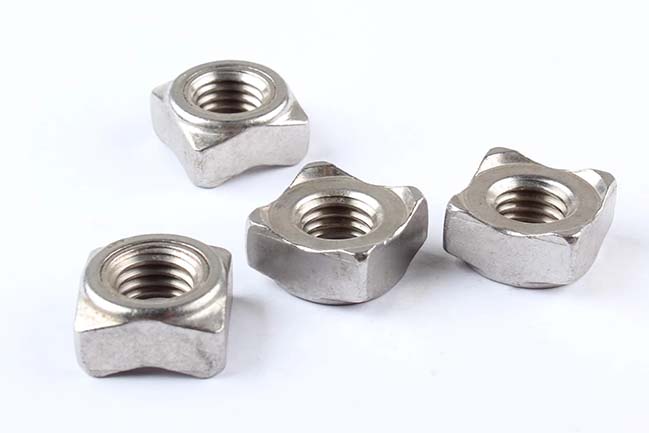
The DIN 928 square weld nut is a metric projection-welding nut used to create a permanent threaded attachment point on sheet metal and fabricated steel parts. DIN 928:2013-12 is the current standard and covers square weld nuts with metric coarse threads from M4 to M16 and fine-pitch metric threads from nominal diameter 8 mm to 16 mm, product grade A. Four welding projections concentrate current and pressure during resistance projection welding, while the square body provides a broad footprint and stable orientation in fixtures. Typical buyers include automotive, enclosure, machinery, appliance, and metal-fabrication manufacturers.
Product Overview and Key Features
DIN 928 square weld nuts are designed for resistance projection welding rather than use as loose nuts. The projections collapse under controlled welding force and current, attaching the nut before final bolt assembly.
- Four welding projections: concentrate heat at defined contact points for repeatable projection-welding setup.
- Square body: provides a broad welding footprint and convenient orientation in automated or fixture-based assembly.
- Metric thread range: coarse sizes M4 through M16, with selected fine-pitch threads from M8 to M16.
- Product grade A: dimensions are controlled for industrial interchangeability.
- Weldable low-carbon steel: the standard specifies steel with a maximum carbon mass fraction of 0.25%, unless another steel is agreed.
DIN 928 Square Weld Nut Specifications
Specification Overview
| Item | Specification |
|---|---|
| Standard | DIN 928:2013-12 |
| Product form | Square projection weld nut with four welding projections |
| Product grade | A |
| Coarse thread range | M4 to M16 |
| Fine-pitch range | M8 to M16 in specified fine-pitch combinations |
| Thread tolerance | 6G |
| Standard material | Steel with maximum 0.25% carbon by mass |
| Standard surface condition | Plain; electroplating may be specified according to DIN EN ISO 4042 |
| Bolt compatibility | Standard proof loads are intended for fully loadable joints with bolts below property class 8.8 |
Dimensions and Thread Details
The table below summarizes the coarse-thread series. P is coarse thread pitch, s is nominal square width across flats, e is minimum width across corners, m is nut height, and h is nominal welding-projection height. The sheet-thickness range is DIN connecting-dimension guidance. Dimensions are millimetres.
| Thread | P (mm) | s (mm) | e Min. (mm) | m (mm) | h (mm) | Sheet Thickness (mm) |
|---|---|---|---|---|---|---|
| M4 | 0.70 | 7 | 9 | 3.5 | 0.6 | 0.75-1.50 |
| M5 | 0.80 | 9 | 12 | 4.2 | 0.8 | 0.88-2.00 |
| M6 | 1.00 | 10 | 13 | 5.0 | 0.8 | 0.88-2.50 |
| M8 | 1.25 | 14 | 18 | 6.5 | 1.0 | 1.00-3.00 |
| M10 | 1.50 | 17 | 22 | 8.0 | 1.2 | 1.25-4.00 |
| M12 | 1.75 | 19 | 25 | 9.5 | 1.4 | 1.50-5.00 |
| M14 | 2.00 | 22 | 28 | 11.4 | 1.4 | 2.00-6.00 |
| M16 | 2.00 | 24 | 32 | 13.0 | 1.6 | 2.00-6.00 |
Specified fine-pitch combinations include M8×1, M10×1.25, M10×1, M12×1.25, M12×1.5, M14×1.5, and M16×1.5. M14 and M16 are non-preferred sizes and should be used when required by the drawing. DIN 928 also contains a 7/16-20 UNF-2B variant for a specific automotive seat-belt application.
Common Materials, Grades and Surface Finishes
Material and Mechanical Options
The standard default is weldable steel with no more than 0.25% carbon by mass. DIN 928 does not assign the nut a conventional property class; instead, it specifies proof loads. A2 stainless DIN 928 products are established market configurations, but stainless is an agreed option rather than the standard default. When stainless is required, specify the exact grade and validate the welding process for the parent material.
Coating and Finish Options
Plain steel is the standard surface condition because clean weld interfaces simplify projection welding. Zinc-plated versions are commercially available, but coating type and thickness can influence contact resistance, weld current, fumes, electrode life, and thread condition. Fabricated assemblies may instead receive painting, electrocoating, powder coating, or another qualified finish after welding. Confirm material and finish during quotation.
Typical Applications and Selection Considerations
- Automotive brackets, seat structures, body panels, and welded subassemblies.
- Electrical cabinets, control panels, appliance frames, and equipment housings.
- Machinery guards, fabricated supports, rail equipment, and industrial sheet-metal assemblies.
- High-volume production where a captive metric thread is needed before final assembly.
Flybear’s weld nut types guide compares square, hex, and other projection-weld forms, while the weld nut range provides related sourcing options. Welding parameters must be established with the actual nut, sheet, coating, electrodes, force, current, and welding time. DIN 928 dimensions alone do not guarantee a successful welded joint.
Ordering and Quality Documentation
An RFQ should state DIN 928:2013-12, thread size and pitch, material, surface condition, quantity, sheet material and thickness, and any proof-load or weld-validation requirements. State fine pitch or stainless steel explicitly when required. Buyers may request dimensional inspection, thread gauging, material verification, proof-load testing, coating checks, and projection inspection. Flybear’s quality control and inspection page describes available inspection support; project-specific weld tests should be agreed separately.
Frequently Asked Questions
Is DIN 928 still a current standard?
Yes. DIN 928:2013-12 is currently listed by DIN as the active standard for square weld nuts. It covers coarse M4-M16 threads, selected fine-pitch sizes, and product grade A.
Does DIN 928 specify property class 8?
No. Earlier editions used property-class language, but the current standard does not assign a conventional property class. It specifies material limits and proof loads instead, with the standard nuts intended for fully loadable connections using bolts below property class 8.8.
Can DIN 928 square weld nuts be zinc plated?
Yes, electroplated versions are commercially available, and DIN 928 refers to DIN EN ISO 4042 for electroplating. The welding process still needs validation because a coating can change electrical contact, heat generation, fumes, and electrode behavior.
Are stainless steel DIN 928 weld nuts available?
A2 stainless steel versions are established market options. They should be specified separately because standard DIN 928 material is carbon-limited steel. Stainless welding also requires compatible parent material and a validated welding procedure.
What information should be included in an RFQ?
Provide the DIN 928 designation, thread and pitch, material, finish, quantity, parent sheet material and thickness, and required inspection documentation. Include the drawing and welding requirements when projection geometry, proof load, coating, or automated assembly conditions are controlled.
Request a Quote for DIN 928 Square Weld Nuts
Send Flybear Industrial your DIN 928 square weld nut thread size, pitch, material, finish, quantity, sheet material, thickness, and inspection requirements. Include drawings or welding specifications for controlled OEM production. Submit the requirements through the Flybear fastener RFQ page for technical review and quotation.