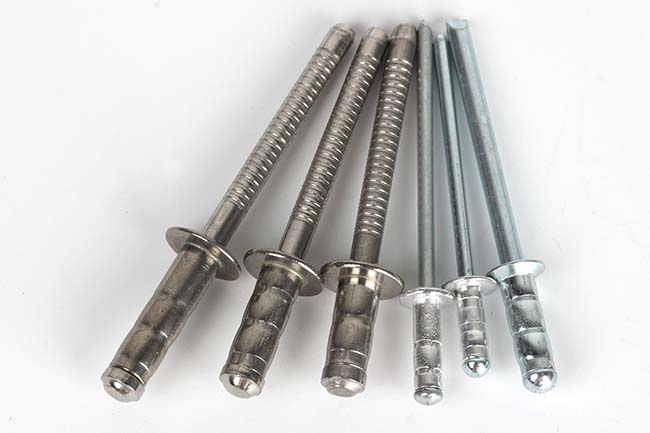
The multi-grip blind rivet is a break-mandrel fastener designed to cover a wider material-thickness range than a conventional single-grip blind rivet. It is installed from one side of the joint, making it useful for panels, closed sections, housings, and production assemblies where rear access is limited. IFI-116-2015 is the relevant active inch-series standard for multi-grip break mandrel blind rivets from size 4 (0.125 in.) through size 8 (0.250 in.). Metric multi-grip products are also widely used, but their exact grip ranges, head dimensions, mandrel retention, and performance should be confirmed from the selected product specification.
Product Overview and Key Features
These designs reduce the number of rivet lengths needed across variable stack thicknesses. Depending on the design, radial body expansion can improve hole fill and support thin or slightly irregular materials.
- Wide grip range: one size can cover several stack thicknesses that would otherwise require multiple rivet lengths.
- One-sided installation: setting requires access only to the installation side.
- Hole-filling behavior: many designs expand radially during setting, helping accommodate modest hole or alignment variation.
- Multiple head forms: dome, large-flange, and countersunk configurations are common.
- Material choice: aluminum/steel, aluminum/stainless, steel/steel, and stainless configurations are common.
Multi-Grip Blind Rivet Specifications
Specification Overview
| Item | Specification / Market Practice |
|---|---|
| Product form | Multi-grip break mandrel blind rivet |
| Relevant inch standard | IFI-116-2015 |
| IFI-116 nominal size range | Size 4 to Size 8, equivalent to 0.125 to 0.250 in. |
| Installation access | One side of the joint |
| Common head styles | Dome, large flange, and countersunk |
| Common body materials | Aluminum alloy, steel, stainless steel |
| Common mandrel materials | Steel or stainless steel, depending on product family |
| Common market finishes | Plain aluminum or stainless; zinc-plated steel components; colored coatings by specification |
Dimensions, Hole Sizes and Grip Range
The table below is a market reference for an aluminum-body, steel-mandrel dome-head series. It is not the complete IFI-116 table or a Flybear inventory statement. Dimensions and grip ranges are in inches; strength values apply only to this configuration.
| Nominal Dia. | Grip Range | Hole Dia. | Head Dia. | Head Height | Body Length | Min. Shear / Tensile (lbf) |
|---|---|---|---|---|---|---|
| 1/8 | 0.039-0.197 | 0.129-0.136 | 0.256 | 0.032 | 0.315 | 173 / 258 |
| 1/8 | 0.059-0.256 | 0.129-0.136 | 0.256 | 0.032 | 0.374 | 173 / 258 |
| 5/32 | 0.039-0.256 | 0.161-0.166 | 0.315 | 0.039 | 0.394 | 263 / 405 |
| 5/32 | 0.138-0.375 | 0.161-0.166 | 0.315 | 0.039 | 0.512 | 263 / 405 |
| 3/16 | 0.039-0.256 | 0.192-0.197 | 0.374 | 0.051 | 0.394 | 370 / 540 |
| 3/16 | 0.177-0.433 | 0.192-0.197 | 0.374 | 0.051 | 0.591 | 370 / 540 |
| 3/16 | 0.433-0.768 | 0.192-0.197 | 0.374 | 0.051 | 0.984 | 370 / 540 |
| 1/4 | 0.059-0.354 | 0.256-0.275 | 0.512 | 0.071 | 0.591 | 607 / 899 |
Grip range is the total thickness of all layers being clamped. Keep the hole within the specified range for the selected product. Confirm grip, blind-side clearance, head seating, tool stroke, and mandrel size together.
Common Materials, Grades and Surface Finishes
Material and Grade Options
Aluminum-alloy bodies with zinc-plated steel mandrels are a common general-purpose combination. Steel/steel versions provide higher strength in many families. Aluminum/stainless and A2 stainless configurations are used where corrosion resistance is more important. Exact alloy, hardness, and mechanical performance are product-specific rather than defined by “multi-grip” alone.
Coating and Finish Options
Aluminum bodies are commonly plain, while steel mandrels or bodies may be zinc plated. Stainless versions are typically natural. Colored coatings are also used for visible panels and cladding. Consider joint materials, corrosion exposure, hole fit, and setting behavior when selecting a finish. Confirm material, finish, head, size, and grip during quotation.
Typical Applications and Selection Considerations
- Automotive body panels, trailers, vehicle interiors, and transportation equipment.
- HVAC ducting, electrical cabinets, appliance housings, and equipment covers.
- Sheet-metal brackets, signs, enclosures, profiles, and light industrial fabrications.
- Production assemblies with variable stack thicknesses where rivet-part consolidation can simplify inventory.
Flybear’s rivet range shows related blind-fastener options, while automotive fastening solutions gives vehicle and sheet-metal context. Wide grip capability does not automatically make a rivet structural or sealed. Match load, vibration, parent material, hole quality, corrosion, and tooling to the approved joint.
Ordering and Quality Documentation
An RFQ should state the standard or drawing, diameter, grip range, head style, body and mandrel materials, finish, quantity, hole diameter, parent materials, and mechanical requirements. For IFI-116 orders, specify compliance explicitly. Inspection can include dimensions, grip checks, mandrel behavior, shear or tensile testing, and coating inspection. Flybear’s quality control and inspection page outlines available support; agree exact tests and documents for the order.
Frequently Asked Questions
What does multi-grip mean on a blind rivet?
Multi-grip means one rivet configuration can accommodate a broader total material thickness than a conventional narrow-grip rivet. The benefit is fewer part numbers across assemblies with different stack thicknesses. Always use the published minimum and maximum grip for the exact rivet being ordered.
What standard applies to this rivet type?
IFI-116-2015 is active for inch-series products from size 4 through size 8. Commercial metric families are also common, but their exact dimensions and performance should be identified by the applicable manufacturer specification or controlled drawing.
Can one wide-grip rivet replace several standard rivets?
Often yes. A wide grip range can consolidate several conventional lengths, simplifying purchasing and line-side inventory. Still validate hole diameter, head style, blind-side formation, strength, corrosion, and installation conditions.
Are wide-grip blind rivets waterproof?
Not automatically. Some designs provide improved hole fill or splash resistance, but an open-end version is not guaranteed watertight without application testing. Closed-end or sealing designs may be more appropriate when leakage control is a primary requirement.
What information should I provide for a quotation?
Provide diameter, grip range, head type, body and mandrel materials, finish, hole size, quantity, parent materials, and required shear or tensile performance. Include the governing standard or drawing and any installation-tool or inspection requirements that control the assembly.
Request a Quote for Multi-Grip Rivets
For a multi-grip blind rivet quotation, send Flybear Industrial the required diameter, grip range, head style, material combination, finish, quantity, hole size, joint materials, and performance requirements. Include IFI-116 or a controlled drawing when applicable. Submit the details through the Flybear fastener RFQ page for technical review and quotation.