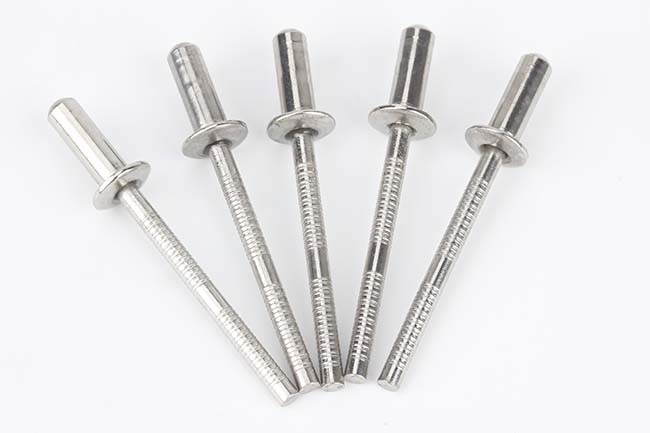
The 304 stainless closed end rivet is a corrosion-resistant blind fastener for permanent one-sided assembly where the rear of the joint cannot be reached. For the protruding-head stainless/stainless configuration covered here, ISO 16585:2002 is the relevant current product standard. It specifies an A2 austenitic stainless-steel body with a stainless-steel break-pull mandrel in nominal diameters from 3.2 to 6.4 mm. In commercial sourcing, A2 is commonly associated with 304-type stainless steel, but ISO 16585 does not simply state “AISI 304.” Buyers requiring 304 chemistry should identify that material requirement separately in the RFQ.
Product Overview and Key Features
A closed-end blind rivet has a sealed body at the blind end. During installation, the rivet is inserted into a prepared hole and the setting tool pulls the mandrel, expanding the body behind the joint until the mandrel breaks.
- One-sided installation: useful for tubes, box sections, cabinets, housings, and panels.
- Stainless/stainless construction: combines an austenitic stainless body with a stainless mandrel.
- Closed-end body: improves resistance to liquid, dust, and vapor passage compared with a conventional open-end rivet, subject to joint design and testing.
- Protruding head: ISO 16585 uses a dome-style head with a broad bearing area.
- Defined performance: the standard specifies minimum shear and tensile loads for each nominal diameter.
304 Stainless Closed End Rivet Specifications
Specification Overview
| Item | Specification |
|---|---|
| Product form | Closed-end blind rivet with break-pull mandrel and protruding head |
| Relevant standard | ISO 16585:2002 / DIN EN ISO 16585:2003-04 |
| Standard material | A2 stainless body / stainless mandrel (A2/SSt) |
| Specified sales material | 304 stainless steel; exact chemistry to be confirmed in the purchase specification |
| Nominal diameters | 3.2, 4.0, 4.8, and 6.4 mm |
| Head form | Protruding / dome head |
| Surface condition | Plain / natural stainless steel |
Dimensions, Hole Sizes and Mechanical Values
d is body diameter, dk is head diameter, and k is maximum head height. Mechanical values below are standard minimum shear and tensile loads.
| d (mm) | Body d Min-Max (mm) | dk Min-Max (mm) | k Max (mm) | Hole (mm) | Shear Min (N) | Tensile Min (N) |
|---|---|---|---|---|---|---|
| 3.2 | 3.05-3.28 | 5.8-6.7 | 1.3 | 3.3-3.4 | 2000 | 2200 |
| 4.0 | 3.85-4.08 | 6.9-8.4 | 1.7 | 4.1-4.2 | 3000 | 3500 |
| 4.8 | 4.65-4.88 | 8.3-10.1 | 2.0 | 4.9-5.0 | 4000 | 4400 |
| 6.4 | 6.25-6.48 | 11.6-13.4 | 2.7 | 6.5-6.6 | 6000 | 8000 |
Selected Standard Length and Grip Combinations
Grip range is the total thickness of the materials being joined. These are selected ISO 16585 combinations, not a continuous range for every diameter.
| Diameter (mm) | Nominal Length (mm) | Recommended Grip Range (mm) |
|---|---|---|
| 3.2 | 8 | 1.5-3.0 |
| 3.2 | 12 | 5.0-6.5 |
| 4.0 | 10 | 3.0-5.0 |
| 4.0 | 16 | 10.5-12.5 |
| 4.8 | 8 | 0.5-3.0 |
| 4.8 | 20 | 9.0-12.0 |
| 6.4 | 12 | 1.5-6.5 |
| 6.4 | 20 | 8.0-12.0 |
Common Materials, Grades and Surface Finishes
Material and Grade Options
This page is specifically for 304 stainless construction. ISO 16585 describes the body as A2 austenitic stainless steel and the mandrel as stainless steel. A2 and 304-type stainless are commonly associated in trade, but they are different designation systems. If a drawing requires AISI 304 or specific composition limits, state that requirement directly.
Surface Finish Options
Natural or plain stainless steel is the standard starting condition. Passivation may be requested when the project requires controlled surface cleanliness or additional corrosion-processing requirements. Other appearance treatments should be separately qualified for the stainless substrate. Confirm the required material, finish, diameter, length, and grip combination during quotation.
Typical Applications and Selection Considerations
- Electrical cabinets, control panels, stainless housings, and equipment covers.
- HVAC, ventilation, ducting, and fabricated sheet-metal assemblies.
- Transportation panels, trailers, equipment bodies, and enclosed sections.
- Outdoor or humid-service equipment where stainless blind fastening is specified.
Buyers can review Flybear’s rivet product range. Select diameter from the joint design, then choose a length whose grip range covers the material stack. Stainless steel in contact with aluminum or other metals can require galvanic-corrosion review in wet environments. A closed-end design can improve sealing resistance, but it should not be described as automatically watertight, gas-tight, or pressure-tight without an installed-joint test.
Ordering and Quality Documentation
An RFQ should state 304 stainless steel, closed-end blind rivet, protruding head, diameter, nominal length or grip range, quantity, joint material, hole size, and surface condition. If ISO 16585 compliance is required, state it explicitly and distinguish A2/SSt terminology from an exact AISI 304 material callout. Flybear’s quality control and inspection page explains available dimensional and material-verification capabilities; rivet-specific mechanical or setting tests should be requested when required.
Frequently Asked Questions
What standard applies to a stainless closed-end blind rivet?
ISO 16585:2002 covers closed-end blind rivets with a break-pull mandrel, protruding head, A2 stainless body, and stainless mandrel from 3.2 to 6.4 mm. DIN EN ISO 16585:2003-04 is the German adoption.
Is A2 stainless exactly the same as 304 stainless?
No. A2 is an ISO fastener material designation, while 304 is an AISI stainless-steel grade designation. They are commonly associated commercially, but an order requiring exact 304 chemistry should state the material specification or composition requirement.
Are closed-end blind rivets waterproof?
The closed body reduces the open passage through the rivet, but sealing also depends on hole quality, head seating, installation, and any gasket or sealant. Specify a leakage test if verified sealing is required.
How should I select the correct grip range?
Measure the total thickness of every layer being clamped and select a diameter-and-length combination whose recommended grip range contains that thickness. Different lengths of the same diameter have different intended grip ranges.
Can the rivet be used in aluminum sheet?
It can be installed in suitable aluminum sheet when hole and setting conditions are correct, but stainless-to-aluminum contact may require galvanic-corrosion review in wet or conductive environments. Isolation, coatings, drainage, and exposure should be considered together.
Request a Quote for 304 Stainless Closed End Rivets
Send Flybear Industrial the required diameter, length or grip range, exact 304 material requirement, quantity, joint material, hole size, surface condition, and inspection needs. Include a drawing when head geometry, sealing, or mechanical requirements are controlled. Submit the details through the Flybear fastener RFQ page for technical review and quotation.