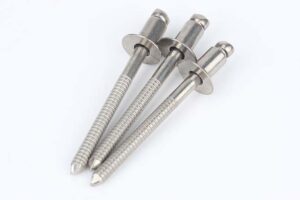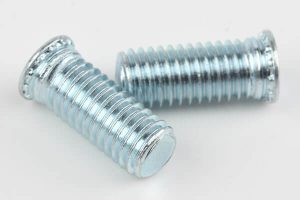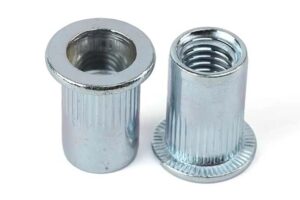
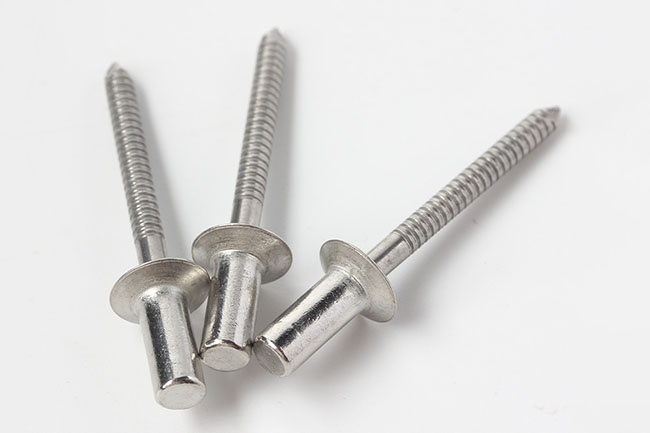
The closed end countersunk rivet nut is a blind threaded insert for creating a reusable internal thread in thin sheet, panels, tubing, and hollow sections when access is available from only one side. Its sealed blind end prevents the mating screw from projecting beyond the insert and can provide an additional physical barrier behind the joint, while the countersunk head is intended for flush or near-flush installation in a correctly prepared recess. No single DIN or ISO product standard defines every closed-end countersunk rivet nut, so dimensions and performance must be tied to the selected specification or drawing.
Product Overview and Key Features
During installation, a dedicated tool applies axial force. The deformable body collapses behind the panel while the countersunk head seats against the front face, producing a captive female thread without rear-side access.
- Closed blind end: prevents the mating screw from extending through the rear of the insert and can help isolate the thread cavity from the blind side.
- Countersunk head: supports a low-profile or flush installation when the panel has the correct countersink geometry.
- One-sided setting: suitable for closed tubes, box sections, cabinets, housings, and assembled structures.
- Reusable internal thread: allows covers, brackets, and service components to be removed and reinstalled.
- Multiple material options: zinc-plated steel, stainless steel, and aluminum are established market configurations.
Closed End Countersunk Rivet Nut Specifications
Specification Overview
| Item | Typical Configuration |
|---|---|
| Product form | Blind rivet nut / threaded insert |
| End style | Closed end |
| Head style | Countersunk head |
| Common body style | Round / cylindrical body; knurled or hex variants are also available in some product families |
| Common metric threads | M3 to M12, depending on manufacturer and material |
| Thread series | ISO metric coarse thread is common |
| Common materials | Carbon steel, A2/A4 stainless steel, aluminum alloy |
| Common finishes | Zinc-plated steel, natural/passivated stainless, natural aluminum |
| Dimensional basis | Manufacturer specification or customer drawing; no single universal DIN/ISO product dimension standard |
Common Dimensions and Grip Ranges
The table below is a verified market reference for a zinc-plated steel, closed-end, large countersunk-head series. It is not a universal standard table or a Flybear inventory statement. d1 is body diameter, d2 is maximum head diameter, K is maximum head thickness, and L is overall length. Dimensions are millimetres.
| Thread | Pitch (mm) | Grip Range (mm) | Hole Size (mm) | d1 (mm) | d2 Max (mm) | K Max (mm) | L (mm) |
|---|---|---|---|---|---|---|---|
| M4 | 0.7 | 1.5-4.0 | 6.0 | 5.9 | 8.4 | 1.5 | 18.0 |
| M5 | 0.8 | 1.5-4.0 | 7.0 | 6.9 | 9.4 | 1.5 | 20.0 |
| M6 | 1.0 | 1.5-4.0 | 9.0 | 8.9 | 11.4 | 1.5 | 23.0 |
| M8 | 1.25 | 1.5-4.0 | 11.0 | 10.9 | 13.4 | 1.5 | 27.5 |
| M10 | 1.5 | 2.0-4.5 | 12.0 | 11.9 | 14.7 | 1.7 | 30.5 |
| M12 | 1.75 | 2.0-4.5 | 16.0 | 15.9 | 19.2 | 1.9 | 35.0 |
Other lengths of the same thread size cover different grip ranges. Grip is the total thickness clamped by the insert. Hole diameter, countersink angle and depth, panel thickness, and setting stroke must all match the selected rivet nut. Do not interpolate unlisted grip ranges or assume that dimensions from one manufacturer apply to another.
Common Materials, Grades and Surface Finishes
Material Options
Zinc-plated carbon steel is common for general industrial use. A2 and A4 stainless steel versions are used where corrosion resistance is more important, with A4 commonly considered for more aggressive chloride exposure. Aluminum versions reduce weight and setting force but have different mechanical performance. Match material to the panel, environment, mating screw, and required performance.
Coating and Finish Options
Carbon-steel rivet nuts commonly use zinc plating with passivation. Stainless products are normally natural and may be passivated when required. Aluminum is commonly natural. Because the body deforms during setting, coating condition after installation should be considered. Confirm the material, finish, head, thread, and grip combination during quotation.
Typical Applications and Selection Considerations
- Electrical cabinets, control panels, battery boxes, and equipment housings.
- Automotive, rail, trailer, and transportation assemblies with restricted rear access.
- HVAC equipment, appliances, machine guards, and removable service panels.
- Tubes, extrusions, and fabricated sheet-metal parts requiring a flush threaded attachment point.
Flybear’s rivet nut selection guide for thin sheet metal covers grip range, head style, body geometry, and hole control. Buyers can also review the Flybear rivet nut range. A closed end can help limit contamination or screw projection, but sealing requires application-specific validation.
Ordering and Quality Documentation
An RFQ should state thread size and pitch, grip range, countersunk head requirement, closed end, body style, material, finish, quantity, panel material, hole diameter, and countersink geometry. For demanding applications, specify pull-out, torque-out, sealing, or installation requirements together with the test panel. Flybear’s quality control and inspection page outlines dimensional, thread, material, coating, and mechanical inspection support; exact records should be agreed for each order.
Frequently Asked Questions
Why choose a closed-end rivet nut?
The sealed end prevents the mating screw from projecting beyond the insert and creates a physical barrier at the blind side. This can be useful around enclosed equipment or contamination-sensitive areas, but the installed joint is not automatically waterproof or pressure-tight.
When should I use a countersunk head?
Choose a countersunk head when installed projection must be minimized or another component needs to sit against the panel surface. The panel must have a compatible countersink, and thin sheet should be checked carefully because excessive countersinking can reduce local material thickness.
What sizes are commonly available?
Metric M4 through M10 are widely documented in closed-end countersunk product families, while some steel series extend from M3 through M12. Available grip ranges and materials vary by manufacturer, so thread size alone is not enough to define the insert.
Can stainless and aluminum versions use the same dimensions?
Not necessarily. Material changes can affect wall thickness, overall length, grip range, setting force, and mechanical performance. Use the dimensional table for the exact material and product family being ordered rather than assuming interchangeability.
What information should I include in the RFQ?
Provide thread, grip range or panel thickness, countersunk head, closed-end requirement, body style, material, finish, quantity, hole and countersink dimensions, mating screw, and any pull-out, torque-out, or sealing target. Include a controlled drawing when geometry is customer specified.
Request a Quote for Closed-End Countersunk Rivet Nuts
Send Flybear Industrial your required thread, grip range, countersunk geometry, closed-end configuration, body style, material, finish, quantity, panel material, and installation-hole details. Include drawings and performance requirements for OEM or sealing-sensitive applications. Submit the project through the Flybear fastener RFQ page for technical review and quotation.