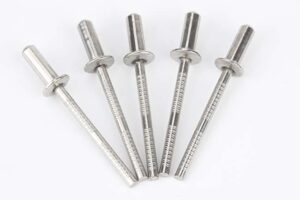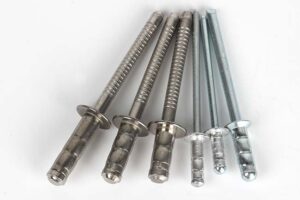
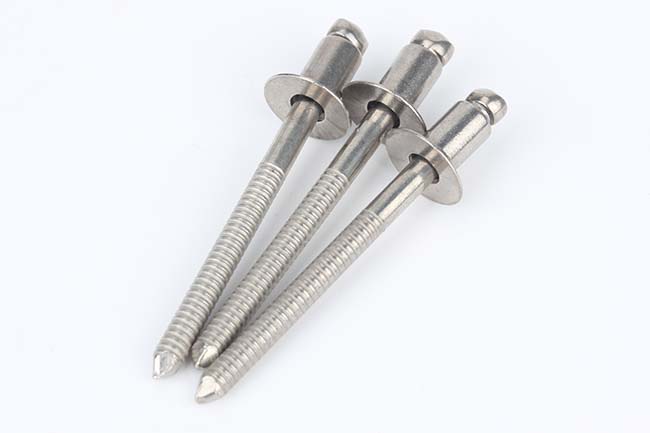
The DIN 7337 aluminum steel rivet is an open-end blind fastener for joining sheet, profiles, and enclosed sections when access is available from only one side. DIN 7337:1991-08 is withdrawn; for the aluminum-alloy body and steel break-pull mandrel with protruding or dome head covered here, the current German reference is DIN EN ISO 15977:2011-02, based on ISO 15977:2002. During setting, the tool pulls the mandrel, expands the body on the blind side, and breaks the mandrel at its designed point. Typical applications include sheet-metal fabrication, enclosures, equipment housings, and industrial assembly.
Product Overview and Key Features
This open-end blind rivet combines an aluminum-alloy tubular body with a steel mandrel and creates a permanent joint without rear-side tool access.
- One-sided installation: useful for closed sections, panels, and housings with inaccessible rear surfaces.
- Aluminum/steel construction: combines a lightweight aluminum-alloy rivet body with a steel pulling mandrel.
- Protruding head: the ISO 15977 successor form uses a conventional dome or protruding head for general-purpose bearing.
- Defined hole fit: each nominal diameter has a specified clearance-hole range to support correct setting.
- Controlled performance: ISO 15977 defines low- and high-strength classes with testing referenced to ISO 14589.
DIN 7337 Aluminum Steel Rivet Specifications
Specification Overview
| Item | Specification |
|---|---|
| Legacy trade standard | DIN 7337:1991-08, withdrawn |
| Current product reference | DIN EN ISO 15977:2011-02 / ISO 15977:2002 |
| Product form | Open-end blind rivet with break-pull mandrel and protruding head |
| Rivet body material | Aluminum alloy (AlA) |
| Mandrel material | Steel (St) |
| Nominal diameter range | 2.4 to 6.4 mm |
| Strength classes | Low (L) and High (H), as specified by ISO 15977 |
| Body finish | Natural/plain aluminum under ISO 15977 |
| Mandrel finish | Oil, phosphate and oil, or zinc coating at manufacturer discretion under the standard |
Dimensions and Common Size Details
The table uses ISO 15977 dimensional limits. d is body diameter, dk is head diameter, and k is maximum head height. Correct clearance-hole size supports proper setting. All dimensions are millimetres.
| Nominal d (mm) | Body d Min-Max (mm) | Head dk Min-Max (mm) | k Max (mm) | Clearance Hole (mm) |
|---|---|---|---|---|
| 2.4 | 2.25-2.48 | 4.2-5.0 | 1.0 | 2.5-2.6 |
| 3.0 | 2.85-3.08 | 5.4-6.3 | 1.3 | 3.1-3.2 |
| 3.2 | 3.05-3.28 | 5.8-6.7 | 1.3 | 3.3-3.4 |
| 4.0 | 3.85-4.08 | 6.9-8.4 | 1.7 | 4.1-4.2 |
| 4.8 | 4.65-4.88 | 8.3-10.1 | 2.0 | 4.9-5.0 |
| 5.0 | 4.85-5.08 | 8.7-10.5 | 2.1 | 5.1-5.2 |
| 6.0 | 5.85-6.08 | 10.8-12.6 | 2.5 | 6.1-6.2 |
| 6.4 | 6.25-6.48 | 11.6-13.4 | 2.7 | 6.5-6.6 |
Commercial dome-head catalogs include combinations such as 3.2 × 12, 4 × 10, 4.8 × 10, 5 × 12, 6 × 16, and 6.4 × 20 mm. These are market examples, not a continuous standard range. Match grip range to total joint thickness for the selected diameter and length.
Common Materials, Grades and Surface Finishes
Material and Grade Options
This product uses an aluminum-alloy body with a steel mandrel. ISO 15977 leaves detailed material selection to the manufacturer while controlling finished dimensional and mechanical requirements. Steel/steel, aluminum/aluminum, and stainless/stainless combinations are covered by separate blind-rivet standards and should not be treated as this aluminum/steel product.
Coating and Finish Options
The standardized aluminum body is natural/plain, while the steel mandrel may be oiled, phosphate-and-oiled, or zinc coated. Zinc-plated mandrels are common commercially. Painted or anodized aluminum bodies also exist but should be specified as additional market finishes rather than the standard default. Confirm finish, size, and grip combination during quotation.
Typical Applications and Selection Considerations
- Electrical cabinets, control panels, equipment housings, and appliance sheet metal.
- HVAC ducting, covers, brackets, and light fabricated assemblies.
- Automotive and transportation panels where one-sided installation is useful.
- Signs, trims, profiles, and general aluminum or sheet-steel fabrication.
Select by total grip thickness, hole diameter, joint material, head style, environment, and mechanical requirement. Dissimilar-metal contact may need corrosion review in wet environments, and open-end rivets should not be assumed watertight. Buyers can review Flybear’s industrial rivet range. For a reusable internal thread instead of a permanent rivet, compare the rivet nuts for thin sheet metal guide.
Ordering and Quality Documentation
An RFQ should state DIN 7337 or ISO 15977, diameter, length, grip range, aluminum/steel combination, head style, finish, quantity, and joint material. A countersunk aluminum/steel version should reference ISO 15978 rather than ISO 15977. Flybear’s quality control and inspection page covers dimensional, material, coating, and visual inspection support; rivet-specific tests should be confirmed per order.
Frequently Asked Questions
Is DIN 7337 still a current standard?
No. DIN 7337:1991-08 is withdrawn and was replaced by several product-specific DIN EN ISO blind-rivet standards. For an open-end rivet with an aluminum-alloy body, steel mandrel, and protruding head, DIN EN ISO 15977 is the appropriate current German reference.
What is the difference between ISO 15977 and ISO 15978?
Both cover open-end aluminum-alloy/steel blind rivets with break-pull mandrels. ISO 15977 specifies the protruding-head form, while ISO 15978 covers the countersunk-head form. Head geometry and diameter range differ, so the two standards should not be treated as dimensionally interchangeable.
How do I choose the correct rivet length?
Measure the total thickness of the components being joined and select a diameter-and-length combination whose recommended grip range contains that thickness. Rivet length should not be chosen from diameter alone because grip ranges differ among nominal lengths and sizes.
Can an aluminum/steel open-end rivet provide a sealed joint?
An ordinary open-end blind rivet should not be treated as a guaranteed liquid- or gas-tight fastener. If sealing is required, specify an appropriate closed-end or sealing rivet system and define the application test, hole condition, and sealing requirement in the RFQ.
What information should I provide for quotation?
Provide the standard, diameter, rivet length or grip range, head form, body and mandrel materials, finish, quantity, joint materials, and required documentation. A drawing is useful when head dimensions, hole size, color, coating, or performance requirements differ from the standard configuration.
Request a Quote for DIN 7337 Blind Rivets
For a DIN 7337 aluminum steel rivet quotation, send Flybear Industrial the diameter, rivet length, grip range, head style, finish, quantity, joint materials, and documentation requirements. Include the controlled drawing for legacy DIN dimensions or special finishes. Submit the details through the Flybear fastener RFQ page for review and quotation.