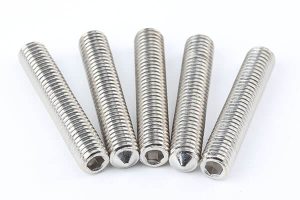
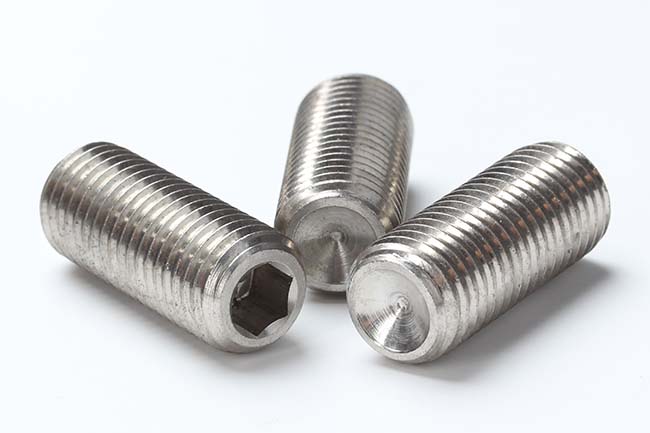
The DIN 916 stainless set screw is a headless metric fastener with an internal hex drive and cup point for locking collars, hubs, gears, pulleys, and other parts onto shafts. DIN 916:1980-12 is withdrawn; the current product reference is DIN EN ISO 4029:2026-06 / ISO 4029:2026. For stainless steel, ISO 4029 covers metric coarse threads from M1.6 to M24, product grade A. Common market materials include A2 and A4 stainless steel with mechanical properties specified to ISO 3506-3.
Product Overview and Key Features
The concave cup point forms an annular contact edge that concentrates pressure against the mating surface. It is widely used for general locking when some localized indentation is acceptable.
- Cup point locking: annular contact provides localized gripping action on shafts, hubs, and similar parts.
- Headless design: permits installation flush with or below the surrounding component surface.
- Internal hex drive: provides compact tool access without an external wrenching head.
- Stainless options: A2 and A4 are common configurations for corrosion-resistant assemblies.
DIN 916 Stainless Set Screw Specifications
Specification Overview
| Item | Specification / Common Configuration |
|---|---|
| Legacy designation | DIN 916:1980-12, withdrawn |
| Current German standard | DIN EN ISO 4029:2026-06 |
| International standard | ISO 4029:2026 |
| Product form | Hexagon socket set screw with cup point |
| Stainless thread range | M1.6 to M24, metric coarse pitch |
| Product grade | A |
| Mechanical-property reference | ISO 3506-3:2025 |
| Common stainless grades | A2 and A4 |
| Common hardness class | 21H is a common market configuration; confirm the required class |
| Surface conditions | Clean and bright or passivated |
Dimensions, Cup Point and Hex Socket Details
The table summarizes selected ISO 4029 dimensions. P is coarse pitch, dz is cup-point diameter, s is nominal hex socket size, and t is minimum socket depth. Example lengths are market combinations, not a continuous standard or Flybear stock range.
| Thread | P (mm) | Example Lengths (mm) | dz Min-Max (mm) | s Nom. (mm) | t Short-Long (mm) |
|---|---|---|---|---|---|
| M3 | 0.50 | 3, 4, 5, 6, 8, 10 | 1.15-1.40 | 1.5 | 1.2-2.0 |
| M4 | 0.70 | 4, 5, 6, 8, 10, 12 | 1.75-2.00 | 2.0 | 1.5-2.5 |
| M5 | 0.80 | 5, 6, 8, 10, 12, 16 | 2.25-2.50 | 2.5 | 2.0-3.0 |
| M6 | 1.00 | 6, 8, 10, 12, 16, 20 | 2.75-3.00 | 3.0 | 2.0-3.5 |
| M8 | 1.25 | 8, 10, 12, 16, 20, 25 | 4.70-5.00 | 4.0 | 3.0-5.0 |
| M10 | 1.50 | 10, 12, 16, 20, 25, 30 | 5.70-6.00 | 5.0 | 4.0-6.0 |
| M12 | 1.75 | 12, 16, 20, 25, 30, 40 | 7.64-8.00 | 6.0 | 4.8-8.0 |
| M16 | 2.00 | 16, 20, 25, 30, 40, 50 | 9.64-10.00 | 8.0 | 6.4-10.0 |
The stainless scope also includes M1.6, M2, M2.5, M20, and M24. New drawings should use ISO 4029:2026 or the current DIN EN ISO adoption. Retain DIN 916 when a legacy drawing specifically requires that designation.
Common Stainless Grades and Surface Finishes
A2 and A4 Stainless Steel Options
A2 is common for general machinery and mildly corrosive environments. A4 contains molybdenum and is commonly selected where improved pitting resistance in chloride-bearing environments is needed. A2 and A4 are fastener-grade designations; specify exact alloy chemistry separately when a project requires a particular stainless composition.
Surface Condition and Passivation
ISO 4029:2026 recognizes clean-and-bright and passivated stainless surface conditions. Zinc plating is not normally required for A2 or A4 stainless. Confirm stainless grade, hardness class, surface condition, thread, and length during quotation.
Typical Applications and Selection Considerations
- Shaft collars, hubs, gears, sprockets, pulleys, and adjustment knobs.
- Automation equipment, fixtures, instruments, and positioning systems.
- General locking applications where localized indentation of the mating surface is acceptable.
Flybear’s set screw point types guide compares cup, cone, dog, and flat points. Buyers can also compare the DIN 914 stainless cone point set screw when concentrated location is required. ISO 4029 set screws are intended for compressive locking service, not tensile loading.
Ordering and Quality Documentation
An RFQ should state DIN 916 for a legacy replacement or ISO 4029:2026 for a current product, plus thread size, length, A2 or A4 grade, hardness class, surface condition, quantity, mating material, and application. Buyers may request material verification, dimensional inspection, thread gauging, hardness, proof-torque, socket gauging, and passivation documentation. Flybear’s quality control and inspection page describes related support; exact acceptance requirements should be agreed for the order.
Frequently Asked Questions
Is DIN 916 still a current standard?
No. DIN 916:1980-12 is withdrawn. The current product standard is DIN EN ISO 4029:2026-06 / ISO 4029:2026. DIN 916 remains common on older drawings and purchase records, so it can be retained as a legacy designation.
What is the difference between a cup point and a flat point?
A cup point uses an annular edge that can bite into the mating surface for localized grip. A flat point spreads contact more broadly and is generally preferred when reduced surface penetration or repeated adjustment matters more.
What stainless sizes are covered by ISO 4029:2026?
The current standard covers stainless cup-point set screws from M1.6 through M24 with metric coarse pitches and product grade A. M30 was added in the 2026 edition for steel products, not stainless steel.
Should I specify A2 or A4 stainless?
A2 is common for general corrosion-resistant machinery. A4 is often selected for greater chloride exposure. The final choice should consider the actual environment, temperature, mating material, and maintenance conditions rather than grade name alone.
What information should I provide for a quotation?
Provide the standard, thread size, length, stainless grade, hardness class, surface condition, quantity, mating material, and application. Include a controlled drawing when legacy dimensions, special lengths, or point geometry differ from the standard product.
Request a Quote for DIN 916 Stainless Set Screws
Send Flybear Industrial your DIN 916 stainless set screw size, length, A2 or A4 grade, hardness class, surface condition, quantity, and application requirements. Include drawings for legacy or custom configurations. Submit the details through the Flybear fastener RFQ page for technical review and quotation.