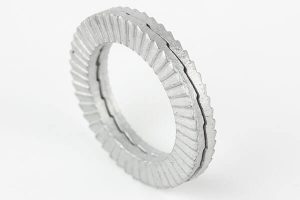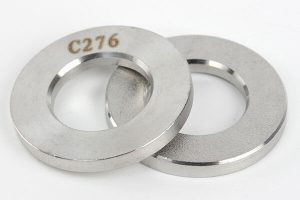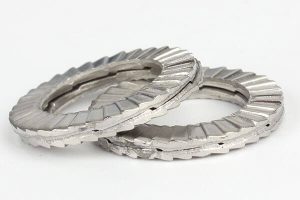
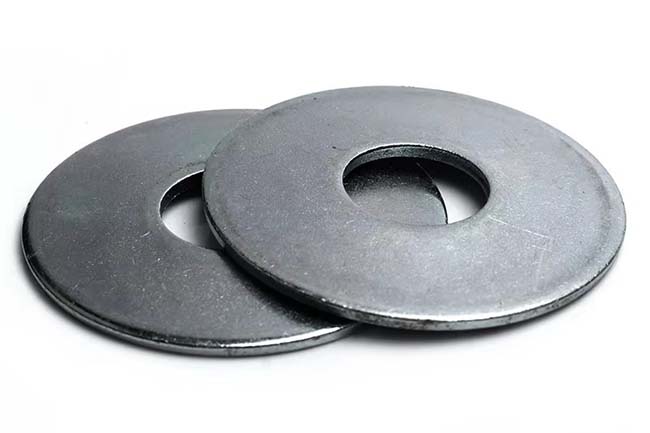
The DIN 2093 disc spring washer is a conical annular spring used to generate high axial force within a compact installation space. DIN 2093:2013-12 was withdrawn when its technical content was incorporated into DIN EN 16983:2017-09, which is now the current German standard for disc-spring quality requirements and dimensions. Calculation rules are covered by DIN EN 16984:2017-09, replacing DIN 2092. The DIN 2093 designation remains common in purchasing, while new technical documentation should reference DIN EN 16983.
Product Overview and Key Features
Disc springs, also called Belleville springs, deflect elastically under axial compression. They can be used individually or in series, parallel, or combined stacks.
- High force in limited space: conical geometry provides substantial axial spring force with short installed height.
- Configurable spring stacks: series stacking increases available deflection, while parallel stacking increases force at a given deflection.
- Defined dimensional series: Series A, B, and C use different free-cone-height-to-thickness ratios.
- Controlled manufacturing groups: production requirements vary with material thickness.
- Force and fatigue control: DIN EN 16983 specifies dimensional, force, relaxation, and fatigue-related quality requirements.
DIN 2093 Disc Spring Washer Specifications
Specification Overview
| Item | Specification |
|---|---|
| Legacy standard | DIN 2093:2013-12, withdrawn |
| Current successor | DIN EN 16983:2017-09 |
| Calculation standard | DIN EN 16984:2017-09 |
| Product form | Conical annular disc spring |
| Dimensional series | A: h0/t ≈ 0.40; B: ≈ 0.75; C: ≈ 1.30 |
| Manufacturing groups | Group 1: t < 1.25 mm; Group 2: 1.25-6 mm; Group 3: >6-14 mm |
| Size identification | Outside diameter De × inside diameter Di × thickness t |
| Common materials | C75S spring steel; 51CrV4 alloy spring steel; corrosion-resistant special materials by specification |
| Common market finish | Phosphate and oil for standard carbon/alloy spring steel |
Selected Standard Dimensions and Spring Forces
The table shows selected DIN EN 16983 standardized sizes from verified technical catalog data. De is outside diameter, Di inside diameter, t material thickness, l0 free height, and h0 free cone height. Force values are at approximately 75% of h0 deflection and are useful selection references, not universal allowable joint loads.
| Series | Approx. Bolt Size | De (mm) | Di (mm) | t (mm) | l0 (mm) | h0 (mm) | F at 0.75 h0 (N) |
|---|---|---|---|---|---|---|---|
| A | M4 | 8 | 4.2 | 0.4 | 0.60 | 0.20 | 210 |
| A | M5 | 10 | 5.2 | 0.5 | 0.75 | 0.25 | 325 |
| A | M6 | 12.5 | 6.2 | 0.7 | 1.00 | 0.30 | 660 |
| A | M8 | 16 | 8.2 | 0.9 | 1.25 | 0.35 | 1013 |
| A | M10 | 20 | 10.2 | 1.0 | 1.55 | 0.55 | 1425 |
| A | M12 | 25 | 12.2 | 1.5 | 2.05 | 0.55 | 2926 |
| B | M16 | 31.5 | 16.3 | 1.25 | 2.15 | 0.90 | 1913 |
| C | M20 | 40 | 20.4 | 1.0 | 2.30 | 1.30 | 1017 |
Group 3 springs above 6 mm thickness use contact flats and reduced effective thickness according to the current standard. Select by De, Di, thickness, force, deflection, stack arrangement, and guide clearance rather than bolt size alone.
Common Materials, Grades and Surface Finishes
Material Options
C75S is a common spring steel for thin Group 1 disc springs. 51CrV4 chromium-vanadium spring steel is commonly used for thicker and higher-load disc springs, including Group 2 and forged Group 3 configurations. Corrosion-resistant stainless and nickel-alloy materials are market options for special environments, with different spring behavior.
Coating and Finish Options
Phosphate-and-oil treatment is a common protective finish for standard carbon and alloy spring steel. Other coatings may be specified when compatible with spring performance and tolerances. Stainless or special-alloy versions are generally selected through a separate material specification. Confirm the required material, finish, size, and force characteristic during quotation.
Typical Applications and Selection Considerations
- Valves, actuators, clutches, brakes, and industrial machinery requiring compact axial spring force.
- Bearing preload, shaft assemblies, tooling, and compensation for thermal or dimensional movement.
- Energy, transportation, automation, and heavy equipment using controlled spring stacks.
- Bolted assemblies requiring a designed spring element rather than a conventional flat washer.
For bolted-joint preload washers, compare Flybear’s DIN 6796 conical spring washer. DIN 6796 is a fastening washer standard and should not be treated as interchangeable with DIN EN 16983 disc springs. Spring-stack design should also provide suitable internal or external guidance to control lateral movement.
Ordering and Quality Documentation
An RFQ should state DIN 2093 as the legacy reference and preferably DIN EN 16983 for current compliance, together with De, Di, thickness, dimensional series, material, finish, quantity, required spring force or deflection, and stack arrangement. Buyers may request dimensional reports, material verification, hardness, spring-force testing, and surface inspection. Flybear’s quality control and inspection page describes related inspection capabilities; exact tests and acceptance criteria should be agreed for the order.
Frequently Asked Questions
Is DIN 2093 still a current standard?
No. DIN 2093 was withdrawn in 2017 and its technical content was incorporated into DIN EN 16983. The DIN 2093 name remains common in catalogs, while current documentation should reference DIN EN 16983.
What are Series A, B and C?
They describe different disc-spring geometries through the approximate ratio of free cone height h0 to thickness t. Series A is about 0.40, Series B about 0.75, and Series C about 1.30, producing different deflection and force characteristics.
How do series and parallel stacks differ?
Springs stacked alternately in series increase total deflection while carrying approximately the same force as one disc. Springs nested in parallel increase total force at similar deflection. Combined arrangements can be designed for intermediate force-deflection characteristics.
Is a DIN 2093 disc spring the same as a DIN 6796 washer?
No. DIN EN 16983 disc springs are engineered spring elements with defined force-deflection characteristics. DIN 6796 covers conical spring washers for bolted connections. Their geometry, performance basis, and selection purpose are different.
What should I provide for a quotation?
Provide De, Di, thickness, Series A/B/C if applicable, material, finish, quantity, required force and deflection, operating temperature, and stack arrangement. Include the controlled drawing when special tolerances, guide clearances, contact flats, or nonstandard materials are required.
Request a Quote for DIN 2093 Disc Springs
Send Flybear Industrial your DIN 2093 disc spring washer dimensions, series, material, finish, quantity, spring-force requirement, deflection, and stacking arrangement. Include drawings for special geometries or application-controlled tolerances. Submit the details through the Flybear fastener RFQ page for technical review and quotation.