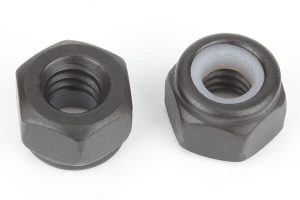
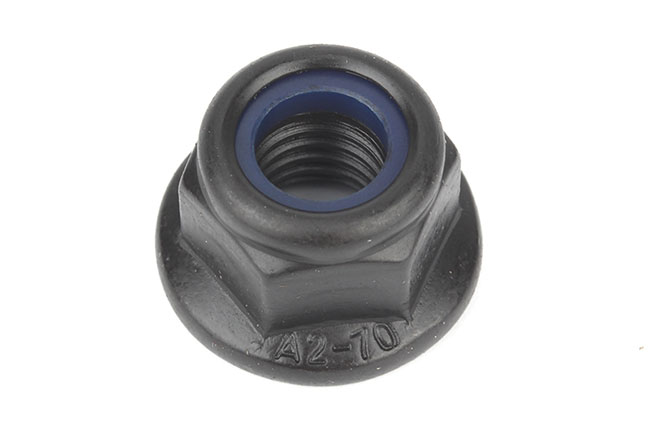
This stainless steel nylon insert flange lock nut combines a nylon locking insert, an integral flange and a black oxide finish on the metal body. Referenced to DIN 6926, it provides a practical fastening option for machinery, equipment frames, brackets and enclosures requiring rotational resistance and a wider bearing surface.
The nylon insert helps resist unintended rotation on the mating thread, while the flange spreads the bearing load over a larger area. The black finish coordinates visible hardware with dark-colored equipment and surrounding components.
Nylon Insert Flange Lock Nut: Product Specifications
| Product Type | Hexagon flange nylon insert lock nut |
|---|---|
| Body Material | Stainless steel; grade according to the confirmed specification |
| Surface Finish | Black oxide on the stainless steel body |
| Locking Element | Nylon insert |
| Standard Reference | DIN 6926, legacy designation |
| Thread Type | Metric internal thread |
| Drive Style | External hexagon |
| Bearing Feature | Integral flange |
Nylon Insert for Prevailing Torque Locking
The nylon insert is retained at the upper end of the nut. As the mating bolt passes through it, interference between the nylon and the bolt thread creates frictional resistance to rotation. This is known as prevailing torque.
This locking action is useful in equipment assemblies where additional resistance to nut rotation is required. It works alongside the clamping force established during tightening, so correct joint preload remains part of the installation requirements.
The insert material must suit the operating temperature and exposure to oils, cleaning agents or other chemicals. These conditions should be considered when selecting the nut for its intended service.
Integral Flange for a Wider Bearing Surface
The flange extends beyond the hexagonal body to provide a wider contact area against the component. This helps distribute the bearing load and reduce localized contact pressure compared with a conventional non-flanged hex nut.
Where the joint design permits, the integral flange can reduce the need for a separate flat washer, simplifying handling and assembly. Washer requirements should still be determined by the component material, hole geometry and specified joint arrangement.
The external hexagon allows installation with a matching spanner or socket. Flange diameter, nut height and tool clearance should be checked where the assembly has limited space.
Stainless Steel Body and Black Oxide Finish
Corrosion-Resistant Alloy Base
The stainless steel body provides the corrosion-resistant alloy base for the nut. It is useful for equipment assemblies where stainless steel is required together with a black appearance.
The appropriate grade depends on the service environment and mechanical requirements. Moisture, chloride exposure, cleaning chemicals and the materials of the mating components should be considered as part of fastener selection.
Black Appearance for Exposed Hardware
Black oxide creates a thin, dark conversion finish with minimal dimensional change. For visible fastening points, it helps the nut blend with painted frames, black panels and other dark hardware.
Final color, sheen and corrosion performance depend on surface preparation, the blackening process and any supplementary sealant. An approved sample can define the required appearance where color consistency matters. Any sealing, lubrication or surface cleanliness requirements should also be included in the purchase specification.
Typical Applications
- Industrial machinery: Equipment covers, brackets and accessories requiring a flange bearing surface and nylon insert locking.
- Automation equipment: Peripheral assemblies, sensor brackets and machine-mounted components.
- Material handling equipment: Conveyor accessories, mounting plates and supporting hardware.
- Electrical enclosures: Cabinet accessories and equipment mounting connections.
- Lighting and display equipment: Visible fastening points requiring a coordinated black appearance.
Selection should account for joint loading, vibration conditions, component stiffness, environmental exposure and the nylon insert’s service limits.
Thread Matching and Installation
Match the nominal thread diameter and pitch to the bolt or stud. Select a bolt length that fully engages the nylon locking element in the completed assembly.
Installation torque should account for both the prevailing resistance of the insert and the tightening requirements of the joint. The procedure should reflect the actual fastener materials, surface condition and lubrication.
For maintenance involving removal, follow the specified replacement or reuse criteria for the locking nut. Locking performance should be assessed against the applicable acceptance requirements.
DIN 6926 is a legacy reference. Confirm thread dimensions, flange diameter, nut height and width across flats against the specified standard or approved drawing.
Quality Support and Quotation
Flybear supports standard and project-specific requirements across its industrial lock nut range. Inspection requirements can include material verification, dimensional checks, thread gauging, insert condition and surface appearance evaluation.
Include any locking-performance acceptance criteria and required documentation during quotation. Learn more about our fastener quality control and inspection support.
To request a quotation, provide the thread size, pitch, stainless steel grade, mechanical requirements, quantity and applicable standard or drawing. Include the operating temperature, relevant chemical exposure and any specific finish requirements.
Send your specifications or drawing for product review and quotation.