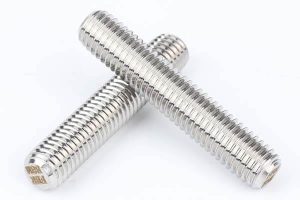
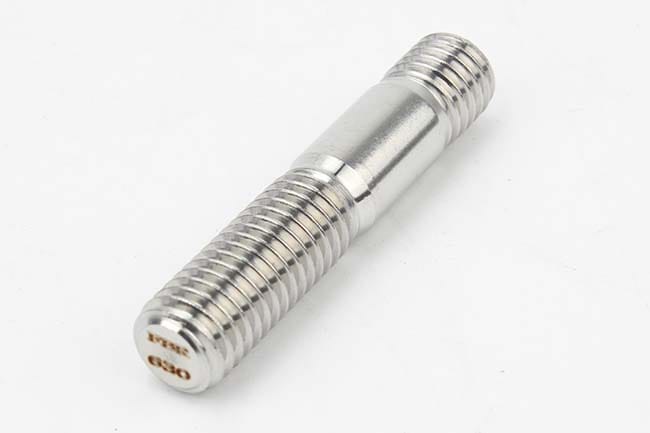
This H1150 double-end stud is made from 05Cr17Ni4Cu4Nb, the Chinese designation for 17-4PH (Type 630) precipitation-hardening stainless steel. It combines the alloy’s strength and corrosion resistance with the strength and impact toughness balance of the H1150 condition. The Type A design has metric coarse threads on both ends: one end screws into a tapped component, and the other accepts a nut to clamp the mating part.
What 17-4PH Stainless Steel Brings to the Stud
Type 630 is a stainless steel that can be strengthened by age hardening. It is a useful option for equipment connections that require both mechanical strength and corrosion resistance. For example, an external equipment mount may need to carry a specified load while being exposed to moisture during operation or maintenance.
Corrosion performance depends on the environment and the surface condition of the stud. If the joint will be exposed to chlorides or process chemicals, specify the medium and service conditions so the material can be reviewed for that application.
How H1150 Heat Treatment Changes the Material
H1150 is an aging condition for 17-4PH stainless steel. The designation refers to an aging temperature of approximately 1,150°F (621°C). Compared with the peak-aged H900 condition, H1150 generally produces lower strength and hardness, with greater ductility and impact toughness. This makes H1150 worth considering when the joint needs both strength and toughness rather than peak hardness.
For replacement parts, match the heat treatment condition on the original drawing as well as the thread dimensions. If the finished stud must meet specific tensile or hardness limits, include those limits and any required test reports in the purchase specification.
Product Specifications
| Product type | Type A double-end stud |
|---|---|
| Material | 05Cr17Ni4Cu4Nb (17-4PH / Type 630 stainless steel) |
| Heat treatment condition | H1150, age hardened |
| Dimensional reference | GB/T 898-1988, Type A |
| Thread configuration | Metric coarse threads on both ends |
| Tap-end length series | bm = 1.25d; confirm the nominal dimension for the selected size |
How the Type A Double-End Stud Is Installed
The tap end threads into the equipment body or mounting base. The exposed end passes through the mating part and is secured with a nut. Where the design allows, the nut and mating part can be removed for maintenance while the stud remains in the equipment body. This avoids repeatedly threading a headed bolt into and out of the housing.
Before ordering, check the tap-end thread length and fit, the depth of the tapped hole, and the thread length available for the nut after assembly. The bm designation identifies the tap-end length series; it does not specify the required hole depth.
Typical Equipment Applications
- Pumps and valves: External mounting adapters and actuator support brackets that attach to a tapped housing.
- Industrial machinery: Removable covers, brackets, and modules that are secured to a machine body or mounting base.
- Process equipment: Instrument supports, external guards, and other attachments that use a tapped mounting point and a nut on the exposed side.
These are examples of equipment assembly. For pressure-retaining joints, follow the bolting specification on the approved equipment drawing.
Request a Quote
Send Flybear your thread diameter, required stud length, thread lengths at both ends, and quantity. Attach a drawing if the tap end has a specific fit, and list any finish, material certificate, or finished-part inspection requirements.
Request a quote for H1150 double-end studs or browse our double-end stud range.