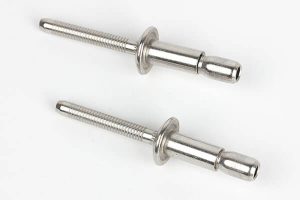
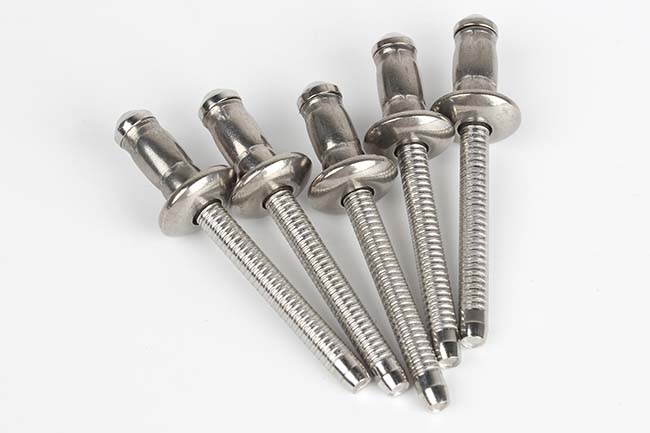
The high strength structural rivet is a blind breakstem fastener for load-transmitting joints that can be installed from one side. This page focuses on the common mechanically locked, multi-grip form, in which a retained mandrel contributes to joint strength and the expanding body helps fill the prepared hole. No single DIN or ISO dimensional standard covers every commercial structural blind rivet. IFI standards define several structural self-plugging forms, while many industrial products use manufacturer- or drawing-controlled geometry. Typical buyers include commercial-vehicle, rail, equipment, enclosure, and fabricated-metal manufacturers.
Product Overview and Key Features
Structural blind rivets differ from general-purpose break-mandrel rivets through designs intended for higher shear and tensile performance, controlled stem retention, and demanding assembly conditions. Actual performance depends on the product family, material, diameter, grip, hole, and parent materials.
- Mechanically retained stem: common structural designs lock the mandrel in the rivet body so it remains part of the installed fastener.
- Multi-grip capability: selected designs cover a wider material-thickness range than conventional single-grip rivets.
- Hole filling: radial body expansion can improve contact in the prepared hole and reduce joint movement.
- One-sided installation: useful for closed profiles, panels, and assemblies without rear access.
High Strength Structural Rivet Specifications
Specification Overview
| Item | Typical Product-Family Requirement |
|---|---|
| Product form | Mechanically locked or positively retained breakstem structural blind rivet |
| Installation access | One side of the joint |
| Common nominal diameters | 4.8, 6.4, and 10.0 mm; other structural families cover additional sizes |
| Common head styles | Protruding / dome and countersunk |
| Common materials | Steel, aluminum alloy, A2 / 304-type stainless, and A4 / 316 stainless depending on product family |
| Common steel finish | Zinc-plated or another qualified corrosion-protective finish |
| Relevant standards | IFI-119 / IFI-551 for specific structural self-plugging forms; customer or manufacturer specifications are common for proprietary structural systems |
Dimensions, Grip Range and Performance Reference
The following table is a verified market reference for a steel/steel protruding-head, mechanically locked multi-grip structural breakstem family. It is not a universal standard or Flybear inventory statement. Strength values are typical catalog rivet-failure values; project design values must come from the approved fastener specification and joint validation.
| Nominal d (mm) | Grip Range (mm) | Hole Size (mm) | Head Dia. Max (mm) | Typical Shear (N) | Typical Tensile (N) |
|---|---|---|---|---|---|
| 4.8 | 1.63-6.86 | 4.9-5.1 | 10.1 | 6,400 | 5,100 |
| 4.8 | 1.63-11.10 | 4.9-5.1 | 10.1 | 6,400 | 5,100 |
| 6.4 | 2.03-9.53 | 6.6-7.0 | 13.4 | 11,700 | 10,400 |
| 6.4 | 2.03-15.87 | 6.6-7.0 | 13.4 | 11,700 | 10,400 |
| 10.0 | 3.04-15.88 | 9.95-10.40 | 20.3 | 26,300 | 17,500 |
Grip range is the total thickness clamped by the rivet. Hole diameter is equally important: undersized or oversized holes can affect insertion, expansion, hole fill, and joint performance. Do not interpolate unlisted grip or load values between catalog sizes.
Common Materials, Grades and Surface Finishes
Material and Grade Options
Steel/steel structural rivets are common where strength and cost efficiency are priorities. Aluminum-alloy versions reduce weight. Stainless structural rivets are available in A2 / 304-type and A4 / 316 configurations in established market families, with A4 / 316 used where greater resistance to pitting and crevice corrosion is needed. Material combinations are product-specific.
Coating and Finish Options
Carbon-steel bodies and stems commonly use zinc-based finishes; some heavy-duty designs use zinc-plated sleeves with black-oxide alloy-steel stems. Stainless products are commonly supplied in their natural condition. Coating must remain compatible with tooling, hole fit, parent materials, and the corrosion environment. Confirm material, finish, size, and grip during quotation.
Typical Applications and Selection Considerations
- Commercial vehicle bodies, trailers, containers, and transportation equipment.
- Rail equipment, machinery guards, platforms, cabinets, and fabricated enclosures.
- Renewable-energy equipment and heavy industrial sheet or profile assemblies.
Review Flybear’s rivet range and industry fastening solutions for related sourcing context. “Structural” in this product family means the rivet is designed for load-transmitting, higher-performance joints; it does not automatically make the rivet approved for building-code structural steelwork. Qualification must follow the actual project specification.
Ordering and Quality Documentation
An RFQ should state rivet family or drawing, diameter, grip range, head style, body and mandrel materials, finish, quantity, hole size, parent materials, and required performance. If IFI-119, IFI-551, or another specification is mandatory, identify it explicitly. Flybear’s quality control and inspection page describes available inspection support; rivet-specific tests should be agreed for the order.
Frequently Asked Questions
What makes a blind rivet “structural”?
A structural blind rivet is intended to transmit higher joint loads than an ordinary general-purpose blind rivet. Common designs use positive or mechanical stem retention, improved hole fill, and controlled blind-side formation. The term alone does not define one strength value, so performance must be tied to a specific product specification.
Is there one ISO standard for all structural blind rivets?
No. Structural blind rivets include several geometries and proprietary systems. IFI-119 and metric IFI-551 cover particular structural flush break-pull self-plugging rivets, while other structural products use different standards or manufacturer specifications. ISO 13469 addresses testing procedures for certain form-fit blind-rivet joints, not a universal structural-rivet dimension series.
How do I choose the correct grip range?
Measure the total thickness of all components being clamped and select a listed rivet whose grip range contains that thickness. Also verify hole diameter, blind-side clearance, head seating, and parent-material strength. A larger nominal diameter does not automatically mean every grip length is available.
Are steel and stainless structural rivets interchangeable?
No. Material changes affect strength, corrosion behavior, setting force, galvanic compatibility, and sometimes geometry or available grip ranges. Stainless may be preferable for corrosive environments, while steel can provide an efficient high-strength option. Use performance data for the exact material combination being purchased.
What should be included in a structural rivet RFQ?
Provide diameter, grip range, head style, body and mandrel materials, finish, quantity, hole size, parent materials, required shear or tensile performance, and any governing drawing or standard. For safety-critical joints, also identify validation, traceability, inspection, and installation-tool requirements.
Request a Quote for High Strength Structural Rivets
For a high strength structural rivet quotation, send Flybear Industrial the required diameter, grip range, head style, body and mandrel materials, finish, quantity, hole size, joint materials, and performance requirements. Include a drawing or approved reference specification for controlled structural applications. Submit the project through the Flybear fastener RFQ page for technical review and quotation.