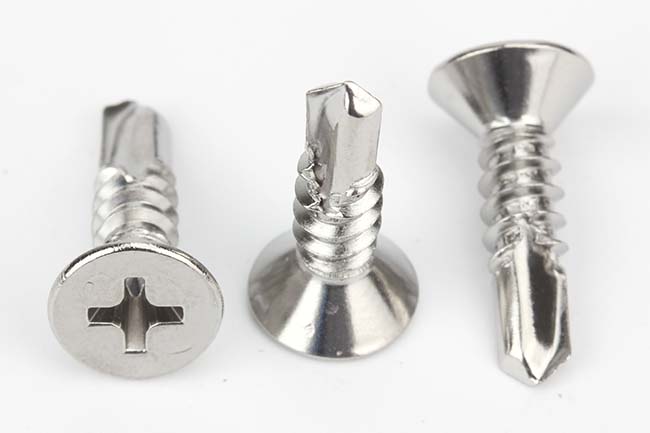
The DIN 7504-P self-drilling screw is a Phillips countersunk fastener for drilling, tapping, and fastening suitable sheet metal in one installation sequence. DIN 7504-P remains widely used as a trade designation, although the former DIN 7504 standard was withdrawn and the cross-recessed countersunk drilling-screw product family is now covered by DIN EN ISO 15482 / ISO 15482. Because legacy DIN 7504-P and later ISO dimensional tables should not be assumed identical in every detail, buyers working from an older drawing should retain the specified DIN designation and dimensions. Typical applications include enclosures, panels, HVAC equipment, brackets, and fabricated sheet-metal assemblies requiring a flush or nearly flush head.
Product Overview and Key Features
The P form combines a drill point, tapping screw thread, 80-degree countersunk head, and Phillips Type H recess. The drill point forms the core hole before the thread engages and the head seats into a prepared countersink.
- One-step drilling and fastening: removes a separate pilot-drilling operation within the verified drilling range.
- Flush head profile: seats flush or nearly flush when the mating countersink is correctly formed.
- Phillips drive: Type H cross recess suits common manual or production tooling.
- ST tapping thread: the product uses coarse tapping-screw geometry rather than a metric machine-screw thread.
- Size-specific drilling capacity: allowable sheet thickness increases with screw size and drill-point geometry.
DIN 7504-P Self-Drilling Screw Specifications
Specification Overview
| Item | Specification |
|---|---|
| Legacy designation | DIN 7504-P, cross-recessed countersunk drilling screw |
| Current related standard | DIN EN ISO 15482:2000-02 / ISO 15482:1999 |
| Head form | 80-degree countersunk head |
| Drive covered here | Phillips Type H cross recess |
| Legacy size range | ST2.9, ST3.5, ST3.9, ST4.2, ST4.8, ST5.5, ST6.3 |
| Thread reference | ISO 1478 tapping screw thread |
| Mechanical reference | ISO 10666 for heat-treated steel drilling screws |
| Common market material | Case-hardened carbon steel; stainless versions require separate performance confirmation |
| Common finish options | Zinc plating, black zinc, zinc-flake, or other specified coating systems |
Dimensions and Thread Details
The table below uses legacy DIN 7504-P geometry commonly cited for this trade form. P is thread pitch, dk is maximum head diameter, k is approximate head height, and dp is maximum drill-point diameter. ST3.9 is a non-preferred size in later reference tables. Dimensions are millimetres.
| Thread | P (mm) | dk Max (mm) | k Approx. (mm) | Phillips | dp Max (mm) | Drilling Range (mm) |
|---|---|---|---|---|---|---|
| ST2.9 | 1.1 | 5.5 | 1.7 | PH1 | 2.3 | 0.70-1.90 |
| ST3.5 | 1.3 | 6.8 | 2.1 | PH2 | 2.8 | 0.70-2.25 |
| ST3.9 | 1.3 | 7.5 | 2.3 | PH2 | 3.1 | 0.70-2.40 |
| ST4.2 | 1.4 | 8.1 | 2.5 | PH2 | 3.6 | 1.75-3.00 |
| ST4.8 | 1.6 | 9.5 | 3.0 | PH2 | 4.1 | 1.75-4.40 |
| ST5.5 | 1.8 | 10.8 | 3.4 | PH3 | 4.8 | 1.75-5.25 |
| ST6.3 | 1.8 | 12.4 | 3.8 | PH3 | 5.8 | 2.00-6.00 |
Commercial catalogs commonly show lengths from about 9.5 to 50 mm, but availability depends on diameter and manufacturer. These values are not a universal standard range. Length must allow the drill point to pass through the drilling thickness before full thread engagement and head seating.
Common Materials, Grades and Surface Finishes
Material and Grade Options
For heat-treated steel drilling screws, ISO 10666 specifies case-hardening steel or heat-treatable steel and controls drilling, thread forming, hardness, and torsional strength. C1022 is a common commercial carbon-steel choice, not a mandatory DIN material designation. Stainless A2 and bi-metal versions also exist, but drilling capability must be confirmed against the substrate.
Coating and Finish Options
Electroplated zinc is a common finish for case-hardened steel versions; black zinc and specified zinc-flake systems are also used. Select the coating for corrosion exposure, appearance, friction, and project requirements. Electroplating hardened drilling screws requires hydrogen-embrittlement control. Confirm the material, finish, size, and drilling-capacity combination during quotation.
Typical Applications and Selection Considerations
- Electrical cabinets, control panels, covers, and equipment enclosures.
- HVAC ductwork, brackets, rails, and light fabricated frames.
- Sheet-metal panels and trim where a projecting screw head would interfere with adjacent components.
- Metal-to-metal assembly within the verified drilling range of the selected screw.
Flybear’s electrical enclosure screw guide covers countersunk heads for limited-clearance assemblies. The Phillips, Pozidriv and Torx drive guide helps with tooling selection. The mating part needs a suitable countersink; excessive countersinking can weaken or distort thin sheet.
Ordering and Quality Documentation
An RFQ should state DIN 7504-P, screw size, nominal length, Phillips drive, material, finish, quantity, substrate material, combined drilling thickness, and countersink condition. If the drawing instead calls for ISO 15482, state that standard directly rather than assuming dimensional interchangeability. Flybear’s quality control and inspection page covers dimensional, thread, hardness, torque, coating, and visual inspection support; exact test documents should be agreed for the order.
Frequently Asked Questions
Is DIN 7504-P still a current DIN standard?
No. DIN 7504 was withdrawn, while DIN EN ISO 15482 is the current German standard for cross-recessed countersunk head drilling screws with tapping screw threads. DIN 7504-P remains common in purchasing language, especially on legacy drawings and supplier catalogs.
Is DIN 7504-P exactly equivalent to ISO 15482?
They describe the same general product family, but buyers should not assume complete dimensional equivalence without checking the specified edition or drawing. Legacy DIN 7504-P tables and later ISO-based commercial tables can show dimensional differences, particularly in head geometry.
Does a DIN 7504-P screw require a pilot hole?
Within its verified drilling range and suitable material conditions, the drill point creates the required core hole during installation. A separate countersink is still needed when the head must seat flush. Material hardness, total thickness, installation speed, and tool alignment affect drilling performance.
Why choose a countersunk self-drilling screw?
The main advantage is a low-profile finished surface combined with drilling and tapping capability. It is useful for panels, covers, and assemblies where a projecting head would cause interference. The countersink must support the head correctly and should not excessively weaken thin sheet.
What information should be included in an RFQ?
Provide the DIN or ISO designation, ST size, length, Phillips recess, material, coating, quantity, substrate, total drilling thickness, and countersink details. Include a drawing when legacy dimensions, special drill points, stainless construction, or application-specific inspection requirements are important.
Request a Quote for DIN 7504-P Self-Drilling Screws
For a DIN 7504-P self-drilling screw quotation, send Flybear Industrial the ST size, length, material, coating, quantity, substrate, drilling thickness, and countersink requirements. Include the controlled drawing when legacy DIN dimensions must be retained. Submit the project through the Flybear fastener RFQ page for review and quotation.